 Movie
Movie Controller

[English] 日本語
 Yorodumi
- PDB-9mi3: Cryo-EM structure of SARS-CoV-2 spike protein in complex with neu... -
+ Open data

- Basic information
| Entry | Database: PDB / ID: 9mi3 | ||||||||||||||||||||||||
|---|---|---|---|---|---|---|---|---|---|---|---|---|---|---|---|---|---|---|---|---|---|---|---|---|---|
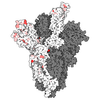
| Title | Cryo-EM structure of SARS-CoV-2 spike protein in complex with neutralizing human antibody WRAIR-2008 | ||||||||||||||||||||||||
 Components Components |
| ||||||||||||||||||||||||
 Keywords Keywords | VIRAL PROTEIN / immune system / severe acute respiratory syndrome coronavirus 2 / HexaPro / neutralizing antibody / human antibody | ||||||||||||||||||||||||
| Function / homology |  Function and homology information Function and homology informationsymbiont-mediated disruption of host tissue / Maturation of spike protein / host cell surface / Translation of Structural Proteins / Virion Assembly and Release / Lectin pathway of complement activation / host extracellular region / symbiont-mediated-mediated suppression of host tetherin activity / structural constituent of virion / Induction of Cell-Cell Fusion ...symbiont-mediated disruption of host tissue / Maturation of spike protein / host cell surface / Translation of Structural Proteins / Virion Assembly and Release / Lectin pathway of complement activation / host extracellular region / symbiont-mediated-mediated suppression of host tetherin activity / structural constituent of virion / Induction of Cell-Cell Fusion / positive regulation of viral entry into host cell / Initial triggering of complement / membrane fusion / host cell endoplasmic reticulum-Golgi intermediate compartment membrane / Attachment and Entry / entry receptor-mediated virion attachment to host cell / receptor-mediated virion attachment to host cell / host cell surface receptor binding / symbiont-mediated suppression of host innate immune response / endocytosis involved in viral entry into host cell / receptor ligand activity / fusion of virus membrane with host plasma membrane / fusion of virus membrane with host endosome membrane / viral envelope / symbiont entry into host cell / virion attachment to host cell / host cell plasma membrane / SARS-CoV-2 activates/modulates innate and adaptive immune responses / virion membrane / membrane / identical protein binding / plasma membrane Similarity search - Function | ||||||||||||||||||||||||
| Biological species |  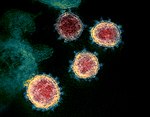 Severe acute respiratory syndrome coronavirus 2 Severe acute respiratory syndrome coronavirus 2 Homo sapiens (human) Homo sapiens (human) | ||||||||||||||||||||||||
| Method | ELECTRON MICROSCOPY / single particle reconstruction / cryo EM / Resolution: 3.23 Å | ||||||||||||||||||||||||
 Authors Authors | Jensen, J.L. / Thomas, P.V. / Joyce, M.G. | ||||||||||||||||||||||||
| Funding support |  United States, 1items United States, 1items
| ||||||||||||||||||||||||
 Citation Citation | Journal: mBio / Year: 2025 Title: First-generation N-terminal domain supersite public antibodies retain activity against Omicron-derived lineages and protect mice against Omicron BA.5 challenge. Authors: Vincent Dussupt / Jaime L Jensen / Paul V Thomas / Letzibeth Mendez-Rivera / Kerri G Lal / Michelle Zemil McCrea / Isabella Swafford / Joana Hernandez / Rajeshwer S Sankhala / Mekhala Rao / ...Authors: Vincent Dussupt / Jaime L Jensen / Paul V Thomas / Letzibeth Mendez-Rivera / Kerri G Lal / Michelle Zemil McCrea / Isabella Swafford / Joana Hernandez / Rajeshwer S Sankhala / Mekhala Rao / Juhi Arora / Agnes Hajduczki / Ningbo Jian / Phyllis A Rees / Indica Showell-De Leon / Gabriel Smith / Lauren Smith / Diana Wasson / Annika Schmid / I-Ting Teng / Tongqing Zhou / Peter D Kwong / Jeffrey R Currier / William W Reiley / Dominic Paquin-Proulx / Victoria R Polonis / Natalie D Collins / Nelson L Michael / M Gordon Joyce / Shelly J Krebs / Abstract: Monoclonal antibodies to SARS-CoV-2 can offer prophylactic and therapeutic protection against severe disease, with particular utility for immunosuppressed and vulnerable populations. With the ...Monoclonal antibodies to SARS-CoV-2 can offer prophylactic and therapeutic protection against severe disease, with particular utility for immunosuppressed and vulnerable populations. With the constant emergence of new variants, understanding the neutralizing potency of monoclonal antibodies to dynamic spike protein epitopes is crucial. We show that a set of VH1-24-derived N-terminal domain (NTD)-directed antibodies, isolated from a convalescent donor early in the pandemic, displayed remarkable neutralization resilience against many Omicron SARS-CoV-2 variants, including BA.2, BA.5, and BQ.1.1. Neutralization potency to these Omicron variants is associated with slower off-rates to the spike protein. Structural characterization of the most potent NTD antibody, WRAIR-2008, revealed a conserved mode of interaction shared with other antibodies of the same multi-donor class. WRAIR-2008 protected mice from weight loss following BA.5 challenge and reduced infectious viral titers in the lungs. Our study highlights the retention of neutralization activity and protection of first-generation VH1-24-derived NTD-directed antibodies to specific Omicron variants and provides valuable insights into the shifting landscape of SARS-CoV-2 variants that are vulnerable to select monoclonal antibodies. IMPORTANCE: As SARS-CoV-2 circulating variants evolve, it is important to understand the vulnerabilities of these viruses to neutralizing antibodies. Within this manuscript, we describe first- ...IMPORTANCE: As SARS-CoV-2 circulating variants evolve, it is important to understand the vulnerabilities of these viruses to neutralizing antibodies. Within this manuscript, we describe first-generation antibodies isolated following infection with WA-1 that retain viral neutralization to subsequent Omicron variants by targeting a site of viral vulnerability called the NTD. This work highlights the shifting landscape of SARS-CoV-2 variants and provides mechanistic insights into how antibodies from prior infections may play a role in preventing subsequent SARS-CoV-2 variant infections. | ||||||||||||||||||||||||
| History |
|
- Structure visualization
| Structure viewer | Molecule: MolmilJmol/JSmol |
|---|
- Downloads & links
-Download
| PDBx/mmCIF format | 9mi3.cif.gz | 1.2 MB | Display | PDBx/mmCIF format |
|---|---|---|---|---|
| PDB format | pdb9mi3.ent.gz | 1 MB | Display | PDB format |
| PDBx/mmJSON format | 9mi3.json.gz | Tree view | PDBx/mmJSON format | |
| Others |  Other downloads Other downloads |
-Validation report
| Arichive directory | https://data.pdbj.org/pub/pdb/validation_reports/mi/9mi3ftp://data.pdbj.org/pub/pdb/validation_reports/mi/9mi3 | HTTPS FTP |
|---|
-Related structure data
| Related structure data |  48284MC  9ecxC  9ecyC  9eczC M: map data used to model this data C: citing same article ( |
|---|---|
| Similar structure data |

-Links
 PDBj
PDBj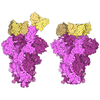
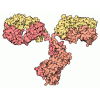
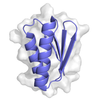
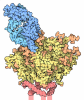
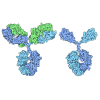
- Assembly
| Deposited unit | 
|
|---|---|
| 1 |
|
-Components
| #1: Protein | Mass: 140766.359 Da / Num. of mol.: 3 Source method: isolated from a genetically manipulated source Source: (gene. exp.) Severe acute respiratory syndrome coronavirus 2Gene: S, 2 / Production host: Homo sapiens (human) / References: UniProt: P0DTC2#2: Antibody | Mass: 24786.604 Da / Num. of mol.: 3 Source method: isolated from a genetically manipulated source Source: (gene. exp.) Homo sapiens (human) / Production host: Homo sapiens (human)#3: Antibody | Mass: 24106.947 Da / Num. of mol.: 3 Source method: isolated from a genetically manipulated source Source: (gene. exp.) Homo sapiens (human) / Production host: Homo sapiens (human)#4: Sugar | ChemComp-NAG /  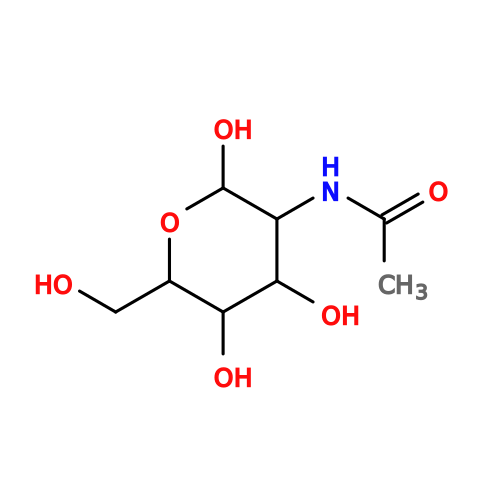 Type: D-saccharide, beta linking / Mass: 221.208 Da / Num. of mol.: 32 / Source method: obtained synthetically / Formula: C8H15NO6 Type: D-saccharide, beta linking / Mass: 221.208 Da / Num. of mol.: 32 / Source method: obtained synthetically / Formula: C8H15NO6Has ligand of interest | N | Has protein modification | Y | |
|---|
-Experimental details
-Experiment
| Experiment | Method: ELECTRON MICROSCOPY |
|---|---|
| EM experiment | Aggregation state: PARTICLE / 3D reconstruction method: single particle reconstruction |
- Sample preparation
| Component | Name: SARS-CoV-2 spike protein with WRAIR-2008 Fab / Type: COMPLEX / Entity ID: #1-#3 / Source: RECOMBINANT |
|---|---|
| Molecular weight | Value: 0.573 MDa / Experimental value: YES |
| Source (natural) | Organism: Severe acute respiratory syndrome coronavirus 2 |
| Source (recombinant) | Organism: Homo sapiens (human) |
| Buffer solution | pH: 7.4 / Details: PBS + 2% v/v glycerol |
| Specimen | Conc.: 0.6 mg/ml / Embedding applied: NO / Shadowing applied: NO / Staining applied: NO / Vitrification applied: YES |
| Specimen support | Grid material: COPPER / Grid mesh size: 400 divisions/in. / Grid type: Quantifoil R0.6/1 |
| Vitrification | Instrument: LEICA EM GP / Cryogen name: ETHANE |
- Electron microscopy imaging
| Microscopy | Model: JEOL CRYO ARM 200 |
|---|---|
| Electron gun | Electron source:  FIELD EMISSION GUN / Accelerating voltage: 200 kV / Illumination mode: OTHER FIELD EMISSION GUN / Accelerating voltage: 200 kV / Illumination mode: OTHER |
| Electron lens | Mode: BRIGHT FIELD / Nominal defocus max: 3200 nm / Nominal defocus min: 100 nm |
| Image recording | Electron dose: 50 e/Å2 / Film or detector model: GATAN K3 (6k x 4k) |
- Processing
| EM software |
| ||||||||||||||||||||||||||||
|---|---|---|---|---|---|---|---|---|---|---|---|---|---|---|---|---|---|---|---|---|---|---|---|---|---|---|---|---|---|
| CTF correction | Type: PHASE FLIPPING AND AMPLITUDE CORRECTION | ||||||||||||||||||||||||||||
| Symmetry | Point symmetry: C3 (3 fold cyclic) | ||||||||||||||||||||||||||||
| 3D reconstruction | Resolution: 3.23 Å / Resolution method: FSC 0.143 CUT-OFF / Num. of particles: 296457 / Symmetry type: POINT | ||||||||||||||||||||||||||||
| Atomic model building | PDB-ID: 6gze Accession code: 6gze / Source name: PDB / Type: experimental model | ||||||||||||||||||||||||||||
| Refine LS restraints |
|

