Journal: mBio / Year: 2025 Title: First-generation N-terminal domain supersite public antibodies retain activity against Omicron-derived lineages and protect mice against Omicron BA.5 challenge. Authors: Vincent Dussupt / Jaime L Jensen / Paul V Thomas / Letzibeth Mendez-Rivera / Kerri G Lal / Michelle Zemil McCrea / Isabella Swafford / Joana Hernandez / Rajeshwer S Sankhala / Mekhala Rao / ...Authors: Vincent Dussupt / Jaime L Jensen / Paul V Thomas / Letzibeth Mendez-Rivera / Kerri G Lal / Michelle Zemil McCrea / Isabella Swafford / Joana Hernandez / Rajeshwer S Sankhala / Mekhala Rao / Juhi Arora / Agnes Hajduczki / Ningbo Jian / Phyllis A Rees / Indica Showell-De Leon / Gabriel Smith / Lauren Smith / Diana Wasson / Annika Schmid / I-Ting Teng / Tongqing Zhou / Peter D Kwong / Jeffrey R Currier / William W Reiley / Dominic Paquin-Proulx / Victoria R Polonis / Natalie D Collins / Nelson L Michael / M Gordon Joyce / Shelly J Krebs / Abstract: Monoclonal antibodies to SARS-CoV-2 can offer prophylactic and therapeutic protection against severe disease, with particular utility for immunosuppressed and vulnerable populations. With the ...Monoclonal antibodies to SARS-CoV-2 can offer prophylactic and therapeutic protection against severe disease, with particular utility for immunosuppressed and vulnerable populations. With the constant emergence of new variants, understanding the neutralizing potency of monoclonal antibodies to dynamic spike protein epitopes is crucial. We show that a set of VH1-24-derived N-terminal domain (NTD)-directed antibodies, isolated from a convalescent donor early in the pandemic, displayed remarkable neutralization resilience against many Omicron SARS-CoV-2 variants, including BA.2, BA.5, and BQ.1.1. Neutralization potency to these Omicron variants is associated with slower off-rates to the spike protein. Structural characterization of the most potent NTD antibody, WRAIR-2008, revealed a conserved mode of interaction shared with other antibodies of the same multi-donor class. WRAIR-2008 protected mice from weight loss following BA.5 challenge and reduced infectious viral titers in the lungs. Our study highlights the retention of neutralization activity and protection of first-generation VH1-24-derived NTD-directed antibodies to specific Omicron variants and provides valuable insights into the shifting landscape of SARS-CoV-2 variants that are vulnerable to select monoclonal antibodies. IMPORTANCE: As SARS-CoV-2 circulating variants evolve, it is important to understand the vulnerabilities of these viruses to neutralizing antibodies. Within this manuscript, we describe first- ...IMPORTANCE: As SARS-CoV-2 circulating variants evolve, it is important to understand the vulnerabilities of these viruses to neutralizing antibodies. Within this manuscript, we describe first-generation antibodies isolated following infection with WA-1 that retain viral neutralization to subsequent Omicron variants by targeting a site of viral vulnerability called the NTD. This work highlights the shifting landscape of SARS-CoV-2 variants and provides mechanistic insights into how antibodies from prior infections may play a role in preventing subsequent SARS-CoV-2 variant infections.
Mass: 23582.410 Da / Num. of mol.: 1 Source method: isolated from a genetically manipulated source Source: (gene. exp.) Homo sapiens (human) / Production host: Homo sapiens (human)
#2: Antibody
WRAIR-2039Fablightchain
Mass: 22951.285 Da / Num. of mol.: 1 Source method: isolated from a genetically manipulated source Source: (gene. exp.) Homo sapiens (human) / Production host: Homo sapiens (human)
In the structure databanks used in Yorodumi, some data are registered as the other names, "COVID-19 virus" and "2019-nCoV". Here are the details of the virus and the list of structure data.
Jan 31, 2019. EMDB accession codes are about to change! (news from PDBe EMDB page)
EMDB accession codes are about to change! (news from PDBe EMDB page)
The allocation of 4 digits for EMDB accession codes will soon come to an end. Whilst these codes will remain in use, new EMDB accession codes will include an additional digit and will expand incrementally as the available range of codes is exhausted. The current 4-digit format prefixed with “EMD-” (i.e. EMD-XXXX) will advance to a 5-digit format (i.e. EMD-XXXXX), and so on. It is currently estimated that the 4-digit codes will be depleted around Spring 2019, at which point the 5-digit format will come into force.
The EM Navigator/Yorodumi systems omit the EMD- prefix.
Related info.:Q: What is EMD? / ID/Accession-code notation in Yorodumi/EM Navigator
Yorodumi is a browser for structure data from EMDB, PDB, SASBDB, etc.
This page is also the successor to EM Navigator detail page, and also detail information page/front-end page for Omokage search.
The word "yorodu" (or yorozu) is an old Japanese word meaning "ten thousand". "mi" (miru) is to see.
Related info.:EMDB / PDB / SASBDB / Comparison of 3 databanks / Yorodumi Search / Aug 31, 2016. New EM Navigator & Yorodumi / Yorodumi Papers / Jmol/JSmol / Function and homology information / Changes in new EM Navigator and Yorodumi
 Movie
Movie Controller

 Yorodumi
 Open data
 Basic information
 Components
 Keywords
 Homo sapiens (human)
 X-RAY DIFFRACTION /
  Authors
 United States, 1items
  Citation
 Structure visualization
 Molmil
 Downloads & links
 Other downloads


 PDBj
PDBj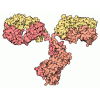
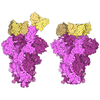
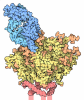
 Assembly
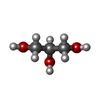
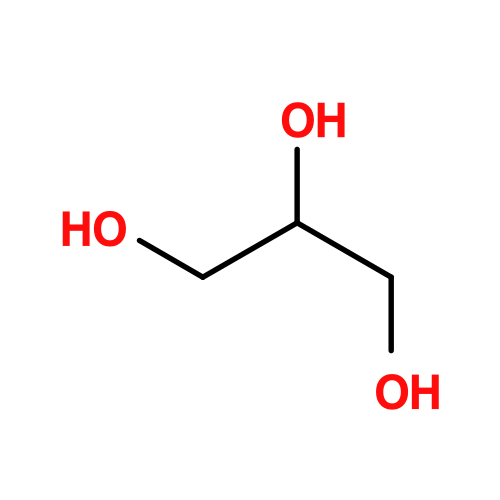 Mass: 92.094 Da / Num. of mol.: 4 / Source method: obtained synthetically / Formula: C3H8O3
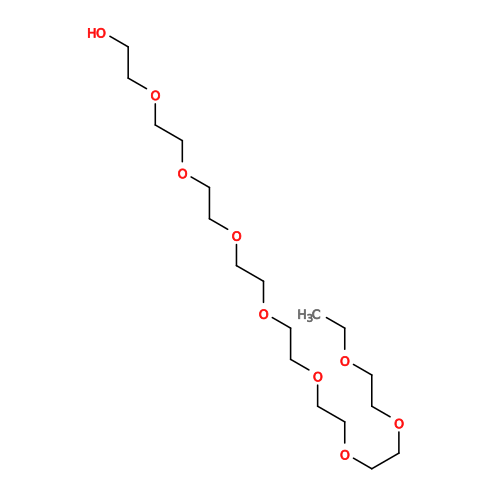 Mass: 398.489 Da / Num. of mol.: 1 / Source method: obtained synthetically / Formula: C18H38O9 / Comment: precipitant*YM
 Mass: 18.015 Da / Num. of mol.: 378 / Source method: isolated from a natural source / Formula: H2O
 Sample preparation
 Processing