Movie
Movie Controller

[English] 日本語
 Yorodumi
- PDB-9mh9: CryoEM structure of G protein-gated inwardly rectifying potassium... -
+ Open data

- Basic information
| Entry | Database: PDB / ID: 9mh9 | ||||||||||||||||||||||||
|---|---|---|---|---|---|---|---|---|---|---|---|---|---|---|---|---|---|---|---|---|---|---|---|---|---|
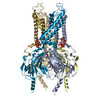
| Title | CryoEM structure of G protein-gated inwardly rectifying potassium channel 2 R92F (State 1) | ||||||||||||||||||||||||
 Components Components | G protein-activated inward rectifier potassium channel 2 | ||||||||||||||||||||||||
 Keywords Keywords | MEMBRANE PROTEIN / G protein gated-inwardly rectifying potassium channels | ||||||||||||||||||||||||
| Function / homology |  Function and homology information Function and homology informationG-protein activated inward rectifier potassium channel activity / inward rectifier potassium channel complex Similarity search - Function | ||||||||||||||||||||||||
| Biological species |   Mus musculus (house mouse) Mus musculus (house mouse) | ||||||||||||||||||||||||
| Method | ELECTRON MICROSCOPY / single particle reconstruction / cryo EM / Resolution: 3.68 Å | ||||||||||||||||||||||||
 Authors Authors | Nguyen, H. / Mount, J. / Yuan, P. / Slesinger, P. | ||||||||||||||||||||||||
| Funding support |  United States, 1items United States, 1items
| ||||||||||||||||||||||||
 Citation Citation | Journal: To Be Published Title: Key residue Unlocks Dual PIP2-Dependent and Independent Gating in G Protein-Gated Inwardly Rectifying Potassium Channels Authors: Nguyen, H. / Mount, J. / Hutchinson, K. / Zhao, Y. / Zhao, Y. / Glaaser, I. / Yuan, P. / Schlessinger, A. / Slesinger, P. | ||||||||||||||||||||||||
| History |
|
- Structure visualization
| Structure viewer | Molecule: MolmilJmol/JSmol |
|---|
- Downloads & links
-Download
| PDBx/mmCIF format | 9mh9.cif.gz | 227.7 KB | Display | PDBx/mmCIF format |
|---|---|---|---|---|
| PDB format | pdb9mh9.ent.gz | 180.7 KB | Display | PDB format |
| PDBx/mmJSON format | 9mh9.json.gz | Tree view | PDBx/mmJSON format | |
| Others |  Other downloads Other downloads |
-Validation report
| Arichive directory | https://data.pdbj.org/pub/pdb/validation_reports/mh/9mh9ftp://data.pdbj.org/pub/pdb/validation_reports/mh/9mh9 | HTTPS FTP |
|---|
-Related structure data
| Related structure data |  48268MC  9mh8C M: map data used to model this data C: citing same article ( |
|---|---|
| Similar structure data |


-Links
 PDBj
PDBj- Assembly
| Deposited unit | 
|
|---|---|
| 1 |
|
-Components
| #1: Protein | Mass: 48685.371 Da / Num. of mol.: 4 Source method: isolated from a genetically manipulated source Source: (gene. exp.) Mus musculus (house mouse) / Gene: Kcnj6 / Production host:  Komagataella pastoris (fungus) / References: UniProt: Q3UTV4 Komagataella pastoris (fungus) / References: UniProt: Q3UTV4Has protein modification | N | |
|---|
-Experimental details
-Experiment
| Experiment | Method: ELECTRON MICROSCOPY |
|---|---|
| EM experiment | Aggregation state: PARTICLE / 3D reconstruction method: single particle reconstruction |
- Sample preparation
| Component | Name: G protein-gated inwardly rectifying potassium channel 2 R92F (State 1) Type: COMPLEX / Entity ID: all / Source: RECOMBINANT |
|---|---|
| Molecular weight | Experimental value: NO |
| Source (natural) | Organism: Mus musculus (house mouse) |
| Source (recombinant) | Organism: Komagataella pastoris (fungus) |
| Buffer solution | pH: 7.5 |
| Specimen | Conc.: 8 mg/ml / Embedding applied: NO / Shadowing applied: NO / Staining applied: NO / Vitrification applied: YES |
| Specimen support | Grid material: COPPER / Grid mesh size: 200 divisions/in. / Grid type: Quantifoil R1.2/1.3 |
| Vitrification | Instrument: FEI VITROBOT MARK IV / Cryogen name: ETHANE / Humidity: 80 % / Chamber temperature: 277.15 K |
- Electron microscopy imaging
| Experimental equipment |  Model: Titan Krios / Image courtesy: FEI Company |
|---|---|
| Microscopy | Model: TFS KRIOS |
| Electron gun | Electron source:  FIELD EMISSION GUN / Accelerating voltage: 300 kV / Illumination mode: FLOOD BEAM FIELD EMISSION GUN / Accelerating voltage: 300 kV / Illumination mode: FLOOD BEAM |
| Electron lens | Mode: BRIGHT FIELD / Nominal defocus max: 2300 nm / Nominal defocus min: 800 nm |
| Image recording | Electron dose: 53.92 e/Å2 / Film or detector model: GATAN K3 (6k x 4k) / Num. of grids imaged: 2 / Num. of real images: 20083 |
- Processing
| EM software |
| ||||||||||||
|---|---|---|---|---|---|---|---|---|---|---|---|---|---|
| CTF correction | Type: PHASE FLIPPING AND AMPLITUDE CORRECTION | ||||||||||||
| 3D reconstruction | Resolution: 3.68 Å / Resolution method: FSC 0.143 CUT-OFF / Num. of particles: 782546 / Symmetry type: POINT | ||||||||||||
| Atomic model building | Protocol: FLEXIBLE FIT / Space: REAL | ||||||||||||
| Atomic model building | PDB-ID: 6XEU Pdb chain-ID: A / Accession code: 6XEU / Source name: PDB / Type: experimental model |