[English] 日本語
Yorodumi
- PDB-9lgs: R-degron fused ZZ-domain of the Arabidopsis thaliana E3 ubiquitin... -

+
Open data


ID or keywords:

Loading...

-
Basic information

Entry
Database: PDB / ID: 9lgs
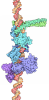
TitleR-degron fused ZZ-domain of the Arabidopsis thaliana E3 ubiquitin-protein ligase BIG
ComponentsAuxin transport protein BIG
KeywordsLIGASE / complex / ZZ-domain / Arabidopsis thaliana / BIG / E3-ubiquitin ligase
Function / homology
Function and homology information


inflorescence morphogenesis / unidimensional cell growth / lateral root formation / auxin polar transport / root development / photomorphogenesis / response to fungus / response to auxin / auxin-activated signaling pathway / plasmodesma ...inflorescence morphogenesis / unidimensional cell growth / lateral root formation / auxin polar transport / root development / photomorphogenesis / response to fungus / response to auxin / auxin-activated signaling pathway / plasmodesma / zinc ion binding / membrane / cytosol
Similarity search - Function
: / E3 ubiquitin-protein ligase UBR4-like domain / E3 ubiquitin ligase UBR4, C-terminal / E3 ubiquitin ligase UBR4-like / E3 ubiquitin-protein ligase UBR4 / UBR4 E3 catalytic module profile. / Zinc finger, UBR-type / Zinc finger UBR-type profile. / Putative zinc finger in N-recognin, a recognition component of the N-end rule pathway / Zinc finger ZZ-type signature. ...: / E3 ubiquitin-protein ligase UBR4-like domain / E3 ubiquitin ligase UBR4, C-terminal / E3 ubiquitin ligase UBR4-like / E3 ubiquitin-protein ligase UBR4 / UBR4 E3 catalytic module profile. / Zinc finger, UBR-type / Zinc finger UBR-type profile. / Putative zinc finger in N-recognin, a recognition component of the N-end rule pathway / Zinc finger ZZ-type signature. / Zinc finger, ZZ type / Zinc-binding domain, present in Dystrophin, CREB-binding protein. / Zinc finger, ZZ-type / Zinc finger, ZZ-type superfamily / Zinc finger ZZ-type profile. / Armadillo-like helical / Armadillo-type fold / WD40-repeat-containing domain superfamily
Similarity search - Domain/homology
NICKEL (II) ION / Auxin transport protein BIG
Similarity search - Component
Biological speciesArabidopsis thaliana (thale cress)
MethodX-RAY DIFFRACTION / SYNCHROTRON / MOLECULAR REPLACEMENT / Resolution: 1.5 Å
AuthorsYang, W.S. / Lee, J. / Song, H.K.
Funding support Korea, Republic Of, 3items
OrganizationGrant numberCountry
National Research Foundation (NRF, Korea)2020R1A2C3008285 Korea, Republic Of
National Research Foundation (NRF, Korea)2021M3A9I4030068 Korea, Republic Of
National Research Foundation (NRF, Korea)2022M3A9G8082638 Korea, Republic Of
CitationJournal: Science / Year: 2025
Title: Architecture of the UBR4 complex, a giant E4 ligase central to eukaryotic protein quality control.
Authors: Daniel B Grabarczyk / Julian F Ehrmann / Paul Murphy / Woo Seok Yang / Robert Kurzbauer / Lillie E Bell / Luiza Deszcz / Jana Neuhold / Alexander Schleiffer / Alexandra Shulkina / Juyeon Lee ...Authors: Daniel B Grabarczyk / Julian F Ehrmann / Paul Murphy / Woo Seok Yang / Robert Kurzbauer / Lillie E Bell / Luiza Deszcz / Jana Neuhold / Alexander Schleiffer / Alexandra Shulkina / Juyeon Lee / Jin Seok Shin / Anton Meinhart / Gijs A Versteeg / Eszter Zavodszky / Hyun Kyu Song / Ramanujan S Hegde / Tim Clausen /
Abstract: Eukaryotic cells have evolved sophisticated quality control mechanisms to eliminate aggregation-prone proteins that compromise cellular health. Central to this defense is the ubiquitin-proteasome ...Eukaryotic cells have evolved sophisticated quality control mechanisms to eliminate aggregation-prone proteins that compromise cellular health. Central to this defense is the ubiquitin-proteasome system, where UBR4 acts as an essential E4 ubiquitin ligase, amplifying degradation marks on defective proteins. Cryo-electron microscopy analysis of UBR4 in complex with its cofactors KCMF1 and CALM1 reveals a massive 1.3-megadalton ring structure, featuring a central substrate-binding arena and flexibly attached catalytic units. Our structure shows how UBR4 binds substrate and extends lysine-48-specific ubiquitin chains. Efficient substrate targeting depends on both preubiquitination and specific N-degrons, with KCMF1 acting as a key substrate filter. The architecture of the E4 megacomplex is conserved across eukaryotes, but species-specific adaptations allow UBR4 to perform its precisely tuned quality control function in diverse cellular environments.
History
DepositionJan 10, 2025Deposition site: PDBJ / Processing site: PDBJ
Revision 1.0Sep 17, 2025Provider: repository / Type: Initial release

-
Structure visualization

Structure viewerMolecule:
MolmilJmol/JSmol

Downloads & links

-
Assembly

Deposited unit
A: Auxin transport protein BIG
B: Auxin transport protein BIG
C: Auxin transport protein BIG
hetero molecules


Theoretical massNumber of molelcules
Total (without water)20,87812
Polymers20,3093
Non-polymers5699
Water2,720151
1
A: Auxin transport protein BIG
B: Auxin transport protein BIG
hetero molecules


Theoretical massNumber of molelcules
Total (without water)13,9198
Polymers13,5402
Non-polymers3796
Water362
TypeNameSymmetry operationNumber
identity operation1_555x,y,z1
2
C: Auxin transport protein BIG
hetero molecules

C: Auxin transport protein BIG
hetero molecules


Theoretical massNumber of molelcules
Total (without water)13,9198
Polymers13,5402
Non-polymers3796
Water362
TypeNameSymmetry operationNumber
identity operation1_555x,y,z1
crystal symmetry operation3_655-x+1,y,-z1
Unit cell
Length a, b, c (Å)79.747, 146.855, 48.734
Angle α, β, γ (deg.)90.000, 90.000, 90.000
Int Tables number21
Space group name H-MC222
Space group name HallC22
Symmetry operation#1: x,y,z
#2: x,-y,-z
#3: -x,y,-z
#4: -x,-y,z
#5: x+1/2,y+1/2,z
#6: x+1/2,-y+1/2,-z
#7: -x+1/2,y+1/2,-z
#8: -x+1/2,-y+1/2,z
Components on special symmetry positions
IDModelComponents
11A-2703-

NI

21B-2703-

NI

31C-2703-

NI

41C-2816-

HOH

51C-2820-

HOH

Noncrystallographic symmetry (NCS)NCS domain:
IDEns-IDDetails
d_1ens_1(chain "A" and (resid 2611 through 2627 or resid 2629...
d_2ens_1(chain "B" and (resid 2611 through 2627 or resid 2629...
d_3ens_1(chain "C" and (resid 2611 through 2627 or resid 2629...

NCS domain segments:

Ens-ID: ens_1

Dom-IDComponent-IDBeg auth comp-IDBeg label comp-IDEnd auth comp-IDEnd label comp-IDAuth asym-IDLabel asym-IDAuth seq-IDLabel seq-ID
d_11ARGARGLEULEUAA2611 - 26271 - 17
d_12ARGARGCYSCYSAA2629 - 264219 - 32
d_13ALAALAASPASPAA2644 - 265234 - 42
d_14PROPROILEILEAA2655 - 266945 - 59
d_15ZNZNZNZNAD2701
d_16ZNZNZNZNAE2702
d_21ARGARGLEULEUBB2611 - 26271 - 17
d_22ARGARGCYSCYSBB2629 - 264219 - 32
d_23ALAALAASPASPBB2644 - 265234 - 42
d_24PROPROILEILEBB2655 - 266945 - 59
d_25ZNZNZNZNBG2701
d_26ZNZNZNZNBH2702
d_31ARGARGLEULEUCC2611 - 26271 - 17
d_32ARGARGCYSCYSCC2629 - 264219 - 32
d_33ALAALAASPASPCC2644 - 265234 - 42
d_34PROPROILEILECC2655 - 266945 - 59
d_35ZNZNZNZNCJ2701
d_36ZNZNZNZNCK2702

NCS oper:
IDCodeMatrixVector
1given(0.378529673803, -0.925589066291, -0.000407936435162), (-0.925566108253, -0.378517101103, -0.00722380974366), (0.00653186839883, 0.00311199848459, -0.999973824738)46.402977714, 69.0929307364, -2.57142439631
2given(0.576471623067, 0.817112570851, 0.00274123241659), (0.817067739026, -0.576470406483, 0.00906533457555), (0.00898763820612, -0.00298613556364, -0.999955151671)-1.66366591087, 4.8623549043, -1.30497560994

-
Components

#1: Protein Auxin transport protein BIG / Protein ATTENUATED SHADE AVOIDANCE 1 / Protein CORYMBOSA1 / Protein DARK OVER-EXPRESSION OF CAB 1 / ...Protein ATTENUATED SHADE AVOIDANCE 1 / Protein CORYMBOSA1 / Protein DARK OVER-EXPRESSION OF CAB 1 / Protein LOW PHOSPHATE-RESISTANT ROOT 1 / Protein TRANSPORT INHIBITOR RESPONSE 3 / Protein UMBRELLA 1


Mass: 6769.792 Da / Num. of mol.: 3
Source method: isolated from a genetically manipulated source
Source: (gene. exp.) Arabidopsis thaliana (thale cress)
Gene: BIG, ASA1, CRM1, DOC1, GA6, LPR1, TIR3, UMB1, At3g02260, F14P3.9
Production host: Escherichia coli (E. coli) / References: UniProt: Q9SRU2
#2: Chemical
ChemComp-ZN / ZINC ION


Mass: 65.409 Da / Num. of mol.: 6 / Source method: obtained synthetically / Formula: Zn / Feature type: SUBJECT OF INVESTIGATION
#3: Chemical ChemComp-NI / NICKEL (II) ION


Mass: 58.693 Da / Num. of mol.: 3 / Source method: obtained synthetically / Formula: Ni / Feature type: SUBJECT OF INVESTIGATION
#4: Water ChemComp-HOH / water


Mass: 18.015 Da / Num. of mol.: 151 / Source method: isolated from a natural source / Formula: H2O
Has ligand of interestY
Has protein modificationN

-
Experimental details

-
Experiment

ExperimentMethod: X-RAY DIFFRACTION / Number of used crystals: 1

-
Sample preparation

CrystalDensity Matthews: 3.51 Å3/Da / Density % sol: 64.98 %
Crystal growTemperature: 293 K / Method: vapor diffusion, sitting drop
Details: 15% w/v Polyethylene glycol 3,350 0.1 M HEPES sodium pH 7.0 0.01 M Magnesium chloride hexahydrate 0.005 M Nickel(II) chloride hexahydrate

-
Data collection

DiffractionMean temperature: 100 K / Serial crystal experiment: N
Diffraction sourceSource: SYNCHROTRON / Site: PAL/PLS / Beamline: 5C (4A) / Wavelength: 1 Å
DetectorType: DECTRIS EIGER X 9M / Detector: PIXEL / Date: Nov 19, 2022
RadiationProtocol: SINGLE WAVELENGTH / Monochromatic (M) / Laue (L): M / Scattering type: x-ray
Radiation wavelengthWavelength: 1 Å / Relative weight: 1
ReflectionResolution: 1.5→50 Å / Num. obs: 46158 / % possible obs: 99.23 % / Redundancy: 12.7 % / Biso Wilson estimate: 12.83 Å2 / Rmerge(I) obs: 0.099 / Net I/σ(I): 25.6
Reflection shellResolution: 1.5→1.53 Å / Rmerge(I) obs: 0.728 / Mean I/σ(I) obs: 2 / Num. unique obs: 46148

-
Processing

Software
NameVersionClassification
PHENIX1.18rc7_3834refinement
HKL-2000data scaling
PHENIXphasing
HKL-2000data reduction
RefinementMethod to determine structure: MOLECULAR REPLACEMENT / Resolution: 1.5→36.71 Å / SU ML: 0.1493 / Cross valid method: FREE R-VALUE / σ(F): 1.35 / Phase error: 17.2884
Stereochemistry target values: GeoStd + Monomer Library + CDL v1.2
RfactorNum. reflection% reflection
Rfree0.1846 2003 4.34 %
Rwork0.1753 44145 -
obs0.1757 46148 98.88 %
Solvent computationShrinkage radii: 0.9 Å / VDW probe radii: 1.11 Å / Solvent model: FLAT BULK SOLVENT MODEL
Displacement parametersBiso mean: 19.19 Å2
Refinement stepCycle: LAST / Resolution: 1.5→36.71 Å
ProteinNucleic acidLigandSolventTotal
Num. atoms1404 0 9 151 1564
Refine LS restraints
Refine-IDTypeDev idealNumber
X-RAY DIFFRACTIONf_bond_d0.00931446
X-RAY DIFFRACTIONf_angle_d1.2091980
X-RAY DIFFRACTIONf_chiral_restr0.0857219
X-RAY DIFFRACTIONf_plane_restr0.0097261
X-RAY DIFFRACTIONf_dihedral_angle_d25.3686543
Refine LS restraints NCS
Ens-IDDom-IDAsym-IDAuth asym-IDRefine-IDTypeRms dev position (Å)
ens_1d_2AAX-RAY DIFFRACTIONTorsion NCS0.662684675846
ens_1d_3AAX-RAY DIFFRACTIONTorsion NCS0.615432718344
LS refinement shell
Resolution (Å)Rfactor RfreeNum. reflection RfreeRfactor RworkNum. reflection RworkRefine-ID% reflection obs (%)
1.5-1.530.29911340.29772916X-RAY DIFFRACTION91.65
1.53-1.570.25921430.23373073X-RAY DIFFRACTION98.11
1.57-1.620.22811290.19913108X-RAY DIFFRACTION98.96
1.62-1.670.18821500.1743139X-RAY DIFFRACTION99.19
1.67-1.730.16541430.16813124X-RAY DIFFRACTION99.15
1.73-1.80.18741360.16613130X-RAY DIFFRACTION99
1.8-1.880.20031420.173124X-RAY DIFFRACTION99.36
1.88-1.980.18811470.17633170X-RAY DIFFRACTION99.52
1.98-2.110.1741430.17383158X-RAY DIFFRACTION99.76
2.11-2.270.16651460.17033159X-RAY DIFFRACTION99.79
2.27-2.50.17821450.16573194X-RAY DIFFRACTION99.97
2.5-2.860.1941450.16453241X-RAY DIFFRACTION100
2.86-3.60.17021500.16663227X-RAY DIFFRACTION99.97
3.61-36.710.17541500.17543382X-RAY DIFFRACTION99.8

+
About Yorodumi

-
News

-
Feb 9, 2022. New format data for meta-information of EMDB entries

New format data for meta-information of EMDB entries

  • Version 3 of the EMDB header file is now the official format.
  • The previous official version 1.9 will be removed from the archive.

Related info.:EMDB header

External links:wwPDB to switch to version 3 of the EMDB data model

-
Aug 12, 2020. Covid-19 info

Covid-19 info

URL: https://pdbj.org/emnavi/covid19.php

New page: Covid-19 featured information page in EM Navigator.

Related info.:Covid-19 info / Mar 5, 2020. Novel coronavirus structure data

+
Mar 5, 2020. Novel coronavirus structure data

Novel coronavirus structure data

Related info.:Yorodumi Speices / Aug 12, 2020. Covid-19 info

External links:COVID-19 featured content - PDBj / Molecule of the Month (242):Coronavirus Proteases

+
Jan 31, 2019. EMDB accession codes are about to change! (news from PDBe EMDB page)

EMDB accession codes are about to change! (news from PDBe EMDB page)

  • The allocation of 4 digits for EMDB accession codes will soon come to an end. Whilst these codes will remain in use, new EMDB accession codes will include an additional digit and will expand incrementally as the available range of codes is exhausted. The current 4-digit format prefixed with “EMD-” (i.e. EMD-XXXX) will advance to a 5-digit format (i.e. EMD-XXXXX), and so on. It is currently estimated that the 4-digit codes will be depleted around Spring 2019, at which point the 5-digit format will come into force.
  • The EM Navigator/Yorodumi systems omit the EMD- prefix.

Related info.:Q: What is EMD? / ID/Accession-code notation in Yorodumi/EM Navigator

External links:EMDB Accession Codes are Changing Soon! / Contact to PDBj

+
Jul 12, 2017. Major update of PDB

Major update of PDB

  • wwPDB released updated PDB data conforming to the new PDBx/mmCIF dictionary.
  • This is a major update changing the version number from 4 to 5, and with Remediation, in which all the entries are updated.
  • In this update, many items about electron microscopy experimental information are reorganized (e.g. em_software).
  • Now, EM Navigator and Yorodumi are based on the updated data.

External links:wwPDB Remediation / Enriched Model Files Conforming to OneDep Data Standards Now Available in the PDB FTP Archive

-
Yorodumi

Thousand views of thousand structures

  • Yorodumi is a browser for structure data from EMDB, PDB, SASBDB, etc.
  • This page is also the successor to EM Navigator detail page, and also detail information page/front-end page for Omokage search.
  • The word "yorodu" (or yorozu) is an old Japanese word meaning "ten thousand". "mi" (miru) is to see.

Related info.:EMDB / PDB / SASBDB / Comparison of 3 databanks / Yorodumi Search / Aug 31, 2016. New EM Navigator & Yorodumi / Yorodumi Papers / Jmol/JSmol / Function and homology information / Changes in new EM Navigator and Yorodumi

Read more