 Movie
Movie Controller

[English] 日本語
 Yorodumi
- PDB-9l2o: Cryo-EM structure and rational engineering of a novel efficient o... -
+ Open data

- Basic information
| Entry | Database: PDB / ID: 9l2o | |||||||||||||||||||||
|---|---|---|---|---|---|---|---|---|---|---|---|---|---|---|---|---|---|---|---|---|---|---|
| Title | Cryo-EM structure and rational engineering of a novel efficient ochratoxin A-detoxifying amidohydrolase | |||||||||||||||||||||
 Components Components | Imidazolonepropionase | |||||||||||||||||||||
 Keywords Keywords | HYDROLASE / amide hydrolase / Iron-binding / Ochratoxin A / ZN | |||||||||||||||||||||
| Function / homology |  Function and homology information Function and homology informationhydrolase activity, acting on carbon-nitrogen (but not peptide) bonds / metal ion binding Similarity search - Function | |||||||||||||||||||||
| Biological species |  Pseudoxanthomonas wuyuanensis (bacteria) Pseudoxanthomonas wuyuanensis (bacteria) | |||||||||||||||||||||
| Method | ELECTRON MICROSCOPY / single particle reconstruction / cryo EM / Resolution: 2.86 Å | |||||||||||||||||||||
 Authors Authors | Dai, L.H. / Xu, Y.H. / Hu, Y.M. / He, B.Y. / Huang, J.P. / Xie, Z.Z. / Li, H. / Niu, D. / Guo, R.-T. / Chen, C.-C. | |||||||||||||||||||||
| Funding support | 1items
| |||||||||||||||||||||
 Citation Citation | Journal: Int J Biol Macromol / Year: 2026 Title: Structure-guided protein engineering and immobilization of an amidohydrolase for efficient ochratoxin A detoxification. Authors: Yumei Hu / Yuhang Xu / Biyu He / Du Niu / Xuechun Yang / Jiaping Huang / Zhenzhen Xie / Panpan Shen / Xian Li / Maosen Bai / Ziwei Liu / Hao Li / Yunyun Yang / Jian-Wen Huang / Chun-Chi Chen ...Authors: Yumei Hu / Yuhang Xu / Biyu He / Du Niu / Xuechun Yang / Jiaping Huang / Zhenzhen Xie / Panpan Shen / Xian Li / Maosen Bai / Ziwei Liu / Hao Li / Yunyun Yang / Jian-Wen Huang / Chun-Chi Chen / Rey-Ting Guo / Longhai Dai /  Abstract: Ochratoxin A (OTA) is a pervasive and significant mycotoxin that poses serious health risks to humans and animals. The development of efficient biocatalysts for the enzymatic detoxification of OTA is ...Ochratoxin A (OTA) is a pervasive and significant mycotoxin that poses serious health risks to humans and animals. The development of efficient biocatalysts for the enzymatic detoxification of OTA is of great importance. In this study, we enhanced the OTA-degrading activity of three amidohydrolases (ADHs) by up to ninefold. This improvement was achieved by reducing steric hindrance in the binding pocket and fine-tuning the hydrophilic interactions between the enzyme and substrate. The most efficient variant, PwADH/DM, was immobilized onto magnetic FeO nanoparticles functionalized by the co-deposition of dopamine and polyethyleneimine. Under optimal conditions, this immobilization process achieved a high immobilization efficiency (85.4%) and activity recovery (76.9%). The immobilized enzyme exhibited enhanced pH stability and thermostability, along with good storage stability, reusability, and recyclability. More importantly, the immobilized enzyme completely degraded 100 ng/mL OTA in contaminated milk without affecting the milk's properties. These findings expand our understanding of the molecular mechanisms governing substrate binding and catalysis in OTA-degrading ADHs. Furthermore, they provide a blueprint for enzyme-based OTA decontamination during food processing. #1: Journal: Int J Biol Macromol / Year: 2024Title: Functional characterization and structural basis of an efficient ochratoxin A-degrading amidohydrolase. Authors: Yumei Hu / Longhai Dai / Yuhang Xu / Du Niu / Xuechun Yang / Zhenzhen Xie / Panpan Shen / Xian Li / Hao Li / Lilan Zhang / Jian Min / Rey-Ting Guo / Chun-Chi Chen / Abstract: Ochratoxin A (OTA) contamination in various agro-products poses a serious threat to the global food safety and human health, leading to enormous economic losses. Enzyme-mediated OTA degradation is an ...Ochratoxin A (OTA) contamination in various agro-products poses a serious threat to the global food safety and human health, leading to enormous economic losses. Enzyme-mediated OTA degradation is an appealing strategy, and the search for more efficient enzymes is a prerequisite for achieving this goal. Here, a novel amidohydrolase, termed PwADH, was demonstrated to exhibit 7.3-fold higher activity than that of the most efficient OTA-degrading ADH3 previously reported. Cryo-electron microscopy structure analysis indicated that additional hydrogen-bond interactions among OTA and the adjacent residue H163, the more compact substrate-binding pocket, and the wider entry to the substrate-access cavity might account for the more efficient OTA-degrading activity of PwADH compared with that of ADH3. We conducted a structure-guided rational design of PwADH and obtained an upgraded variant, G88D, whose OTA-degrading activity was elevated by 1.2-fold. In addition, PwADH and the upgraded G88D were successfully expressed in the industrial yeast Pichia pastoris, and their catalytic activities were compared to those of their counterparts produced in E. coli, revealing the feasibility of producing PwADH and its variants in industrial yeast strains. These results illustrate the structural basis of a novel, efficient OTA-degrading amidohydrolase and will be beneficial for the development of high-efficiency OTA-degrading approaches. | |||||||||||||||||||||
| History |
|
- Structure visualization
| Structure viewer | Molecule: MolmilJmol/JSmol |
|---|
- Downloads & links
-Download
| PDBx/mmCIF format | 9l2o.cif.gz | 585 KB | Display | PDBx/mmCIF format |
|---|---|---|---|---|
| PDB format | pdb9l2o.ent.gz | 483.2 KB | Display | PDB format |
| PDBx/mmJSON format | 9l2o.json.gz | Tree view | PDBx/mmJSON format | |
| Others |  Other downloads Other downloads |
-Validation report
| Arichive directory | https://data.pdbj.org/pub/pdb/validation_reports/l2/9l2oftp://data.pdbj.org/pub/pdb/validation_reports/l2/9l2o | HTTPS FTP |
|---|
-Related structure data
| Related structure data |  62778MC  9l2tC  9l36C  9l6pC M: map data used to model this data C: citing same article ( |
|---|---|
| Similar structure data |


-Links
 PDBj
PDBj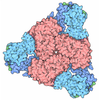
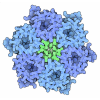
- Assembly
| Deposited unit | 
|
|---|---|
| 1 |
|
-Components
| #1: Protein | Mass: 43481.820 Da / Num. of mol.: 8 / Mutation: G88Y/I325A Source method: isolated from a genetically manipulated source Source: (gene. exp.) Pseudoxanthomonas wuyuanensis (bacteria)Gene: SAMN06296416_10433 / Production host:  Escherichia coli BL21(DE3) (bacteria) / References: UniProt: A0A286D6Z1 Escherichia coli BL21(DE3) (bacteria) / References: UniProt: A0A286D6Z1#2: Chemical | ChemComp-ZN /   Mass: 65.409 Da / Num. of mol.: 16 / Source method: obtained synthetically / Formula: Zn Mass: 65.409 Da / Num. of mol.: 16 / Source method: obtained synthetically / Formula: Zn#3: Chemical | ChemComp-97U / (   Mass: 403.813 Da / Num. of mol.: 8 / Source method: obtained synthetically / Formula: C20H18ClNO6 / Comment: toxin*YM Mass: 403.813 Da / Num. of mol.: 8 / Source method: obtained synthetically / Formula: C20H18ClNO6 / Comment: toxin*YMHas ligand of interest | Y | Has protein modification | Y | |
|---|
-Experimental details
-Experiment
| Experiment | Method: ELECTRON MICROSCOPY |
|---|---|
| EM experiment | Aggregation state: PARTICLE / 3D reconstruction method: single particle reconstruction |
- Sample preparation
| Component | Name: PwADH-G88D-D344N / Type: COMPLEX Details: amidohydrolase family protein [Pseudoxanthomonas wuyuanensis] Entity ID: #1 / Source: RECOMBINANT |
|---|---|
| Source (natural) | Organism: Pseudoxanthomonas wuyuanensis (bacteria) |
| Source (recombinant) | Organism: Escherichia coli BL21(DE3) (bacteria) |
| Buffer solution | pH: 8 / Details: 20 mM Tris-HCL,pH 8.0 |
| Specimen | Conc.: 1.5 mg/ml / Embedding applied: NO / Shadowing applied: NO / Staining applied: NO / Vitrification applied: YES |
| Vitrification | Cryogen name: ETHANE |
- Electron microscopy imaging
| Microscopy | Model: FEI MORGAGNI |
|---|---|
| Electron gun | Electron source:  FIELD EMISSION GUN / Accelerating voltage: 300 kV / Illumination mode: FLOOD BEAM FIELD EMISSION GUN / Accelerating voltage: 300 kV / Illumination mode: FLOOD BEAM |
| Electron lens | Mode: BRIGHT FIELD / Nominal defocus max: 2400 nm / Nominal defocus min: 1000 nm |
| Image recording | Electron dose: 52 e/Å2 / Film or detector model: GATAN K3 (6k x 4k) |
- Processing
| CTF correction | Type: PHASE FLIPPING AND AMPLITUDE CORRECTION |
|---|---|
| 3D reconstruction | Resolution: 2.86 Å / Resolution method: FSC 0.143 CUT-OFF / Num. of particles: 94365 / Num. of class averages: 20 / Symmetry type: POINT |
| Atomic model building | Protocol: RIGID BODY FIT / Space: REAL |
