 Movie
Movie Controller

[English] 日本語
 Yorodumi
- PDB-9l0k: Cryo-EM structure of PSI-11ACPIs from Rhodomonas sp. NIES-2332 at... -
+ Open data

- Basic information
| Entry | Database: PDB / ID: 9l0k | |||||||||||||||||||||||||||
|---|---|---|---|---|---|---|---|---|---|---|---|---|---|---|---|---|---|---|---|---|---|---|---|---|---|---|---|---|
| Title | Cryo-EM structure of PSI-11ACPIs from Rhodomonas sp. NIES-2332 at 2.14 angstrom resolution | |||||||||||||||||||||||||||
 Components Components |
| |||||||||||||||||||||||||||
 Keywords Keywords | PHOTOSYNTHESIS / photosynthesis complex | |||||||||||||||||||||||||||
| Function / homology |  Function and homology information Function and homology informationCHLOROPHYLL A ISOMER / CHLOROPHYLL A / DIGALACTOSYL DIACYL GLYCEROL (DGDG) / Chem-IHT / Chem-II0 / Chlorophyll c2 / 1,2-DIPALMITOYL-PHOSPHATIDYL-GLYCEROLE / 1,2-DISTEAROYL-MONOGALACTOSYL-DIGLYCERIDE / PHYLLOQUINONE / IRON/SULFUR CLUSTER ...CHLOROPHYLL A ISOMER / CHLOROPHYLL A / DIGALACTOSYL DIACYL GLYCEROL (DGDG) / Chem-IHT / Chem-II0 / Chlorophyll c2 / 1,2-DIPALMITOYL-PHOSPHATIDYL-GLYCEROLE / 1,2-DISTEAROYL-MONOGALACTOSYL-DIGLYCERIDE / PHYLLOQUINONE / IRON/SULFUR CLUSTER / Chem-SQD / : Similarity search - Component | |||||||||||||||||||||||||||
| Biological species |  Rhodomonas sp. NIES-2332 (eukaryote) Rhodomonas sp. NIES-2332 (eukaryote) | |||||||||||||||||||||||||||
| Method | ELECTRON MICROSCOPY / single particle reconstruction / cryo EM / Resolution: 2.14 Å | |||||||||||||||||||||||||||
 Authors Authors | Zhang, W.Y. / Akita, F. / Shen, J.R. | |||||||||||||||||||||||||||
| Funding support |  Japan, 1items Japan, 1items
| |||||||||||||||||||||||||||
 Citation Citation | Journal: Front Plant Sci / Year: 2025 Title: Structural analysis of PSI-ACPI and PSII-ACPII supercomplexes from a cryptophyte alga sp. NIES-2332. Authors: Wenyue Zhang / Nozomi Yonehara / Mizuki Ishii / Haowei Jiang / Romain La Rocca / Pi-Cheng Tsai / Hongjie Li / Koji Kato / Fusamichi Akita / Jian-Ren Shen Abstract: Light energy is converted to chemical energy by two photosystems (PSI and PSII) in complex with their light-harvesting complex proteins (LHCI and LHCII) in photosynthesis. is a member of cryptophyte ...Light energy is converted to chemical energy by two photosystems (PSI and PSII) in complex with their light-harvesting complex proteins (LHCI and LHCII) in photosynthesis. is a member of cryptophyte alga whose LHCs contain unique chlorophyll proteins (ACPs) and phycobiliproteins. We purified PSI-ACPI and PSII-ACPII supercomplexes from a cryptophyte sp. NIES-2332 and analyzed their structures at high resolutions of 2.08 Å and 2.17 Å, respectively, using cryo-electron microscopy. These structures are largely similar to those reported previously from two other species of cryptophytes, but exhibited some differences in both the pigment locations and subunit structures. A part of the antenna subunits of both photosystems is shifted compared with the previously reported structures from other species of cryptophytes, suggesting some differences in the energy transfer rates from the antenna to the PSI and PSII cores. Newly identified lipids are found to occupy the interfaces between the antennae and cores, which may be important for assembly and stabilization of the supercomplexes. Water molecules surrounding three iron-sulfur clusters of the PSI core are found in our high-resolution structure, some of which are conserved from cyanobacteria to higher plants but some are different. In addition, our structure of PSII-ACPII lacks the subunits of oxygen-evolving complex as well as the MnCaO cluster, suggesting that the cells are in the S-growth phase, yet the PSI-ACPI structure showed the binding of PsaQ, suggesting that it is in an L-phase. These results suggest that the S-phase and L-phase can co-exist in the cryptophytic cells. The high-resolution structures of both PSI-ACPIs and PSII-ACPIIs solved in this study provide a more solid structural basis for elucidating the energy transfer and quenching mechanisms in this group of the organisms. | |||||||||||||||||||||||||||
| History |
|
- Structure visualization
| Structure viewer | Molecule: MolmilJmol/JSmol |
|---|
- Downloads & links
-Download
| PDBx/mmCIF format | 9l0k.cif.gz | 1.2 MB | Display | PDBx/mmCIF format |
|---|---|---|---|---|
| PDB format | pdb9l0k.ent.gz | 1.1 MB | Display | PDB format |
| PDBx/mmJSON format | 9l0k.json.gz | Tree view | PDBx/mmJSON format | |
| Others |  Other downloads Other downloads |
-Validation report
| Arichive directory | https://data.pdbj.org/pub/pdb/validation_reports/l0/9l0kftp://data.pdbj.org/pub/pdb/validation_reports/l0/9l0k | HTTPS FTP |
|---|
-Related structure data
| Related structure data |  62717MC  9kz9C  9l5vC M: map data used to model this data C: citing same article ( |
|---|---|
| Similar structure data |


-Links
 PDBj
PDBj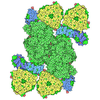
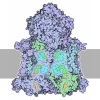
- Assembly
| Deposited unit | 
|
|---|---|
| 1 |
|
-Components
-Photosystem I P700 chlorophyll a apoprotein ... , 2 types, 2 molecules AB
| #1: Protein | Mass: 83441.609 Da / Num. of mol.: 1 / Source method: isolated from a natural source / Source: (natural) Rhodomonas sp. NIES-2332 (eukaryote) |
|---|---|
| #2: Protein | Mass: 82087.664 Da / Num. of mol.: 1 / Source method: isolated from a natural source / Source: (natural) Rhodomonas sp. NIES-2332 (eukaryote) |
-Protein , 14 types, 15 molecules CscabhmjlkidRnQ
| #3: Protein | Mass: 8759.131 Da / Num. of mol.: 1 / Source method: isolated from a natural source / Source: (natural) Rhodomonas sp. NIES-2332 (eukaryote) | ||||||||||||||
|---|---|---|---|---|---|---|---|---|---|---|---|---|---|---|---|
| #12: Protein | Mass: 31529.000 Da / Num. of mol.: 1 / Source method: isolated from a natural source / Source: (natural) Rhodomonas sp. NIES-2332 (eukaryote) | ||||||||||||||
| #13: Protein | Mass: 23785.516 Da / Num. of mol.: 1 / Source method: isolated from a natural source / Source: (natural) Rhodomonas sp. NIES-2332 (eukaryote) | ||||||||||||||
| #14: Protein | Mass: 23380.867 Da / Num. of mol.: 1 / Source method: isolated from a natural source / Source: (natural) Rhodomonas sp. NIES-2332 (eukaryote) | ||||||||||||||
| #15: Protein | Mass: 24814.875 Da / Num. of mol.: 1 / Source method: isolated from a natural source / Source: (natural) Rhodomonas sp. NIES-2332 (eukaryote) | ||||||||||||||
| #16: Protein | Mass: 23646.422 Da / Num. of mol.: 1 / Source method: isolated from a natural source / Source: (natural) Rhodomonas sp. NIES-2332 (eukaryote) | ||||||||||||||
| #17: Protein | Mass: 22379.064 Da / Num. of mol.: 2 / Source method: isolated from a natural source / Source: (natural) Rhodomonas sp. NIES-2332 (eukaryote)#18: Protein | | Mass: 18985.742 Da / Num. of mol.: 1 / Source method: isolated from a natural source / Source: (natural) Rhodomonas sp. NIES-2332 (eukaryote)#19: Protein | | Mass: 24658.832 Da / Num. of mol.: 1 / Source method: isolated from a natural source / Source: (natural) Rhodomonas sp. NIES-2332 (eukaryote)#20: Protein | | Mass: 21402.549 Da / Num. of mol.: 1 / Source method: isolated from a natural source / Source: (natural) Rhodomonas sp. NIES-2332 (eukaryote)#21: Protein | | Mass: 23069.039 Da / Num. of mol.: 1 / Source method: isolated from a natural source / Source: (natural) Rhodomonas sp. NIES-2332 (eukaryote)#22: Protein | | Mass: 13949.042 Da / Num. of mol.: 1 / Source method: isolated from a natural source / Source: (natural) Rhodomonas sp. NIES-2332 (eukaryote)#23: Protein | | Mass: 23069.830 Da / Num. of mol.: 1 / Source method: isolated from a natural source / Source: (natural) Rhodomonas sp. NIES-2332 (eukaryote)#24: Protein | | Mass: 23676.062 Da / Num. of mol.: 1 / Source method: isolated from a natural source / Source: (natural) Rhodomonas sp. NIES-2332 (eukaryote) |
-Photosystem I reaction center subunit ... , 8 types, 8 molecules DEFIJLMK
| #4: Protein | Mass: 15585.724 Da / Num. of mol.: 1 / Source method: isolated from a natural source / Source: (natural) Rhodomonas sp. NIES-2332 (eukaryote) |
|---|---|
| #5: Protein | Mass: 7309.363 Da / Num. of mol.: 1 / Source method: isolated from a natural source / Source: (natural) Rhodomonas sp. NIES-2332 (eukaryote) |
| #6: Protein | Mass: 20849.227 Da / Num. of mol.: 1 / Source method: isolated from a natural source / Source: (natural) Rhodomonas sp. NIES-2332 (eukaryote) |
| #7: Protein/peptide | Mass: 3927.708 Da / Num. of mol.: 1 / Source method: isolated from a natural source / Source: (natural) Rhodomonas sp. NIES-2332 (eukaryote) |
| #8: Protein/peptide | Mass: 4974.812 Da / Num. of mol.: 1 / Source method: isolated from a natural source / Source: (natural) Rhodomonas sp. NIES-2332 (eukaryote) |
| #9: Protein | Mass: 16489.076 Da / Num. of mol.: 1 / Source method: isolated from a natural source / Source: (natural) Rhodomonas sp. NIES-2332 (eukaryote) |
| #10: Protein/peptide | Mass: 3318.070 Da / Num. of mol.: 1 / Source method: isolated from a natural source / Source: (natural) Rhodomonas sp. NIES-2332 (eukaryote) |
| #11: Protein | Mass: 8715.256 Da / Num. of mol.: 1 / Source method: isolated from a natural source / Source: (natural) Rhodomonas sp. NIES-2332 (eukaryote) |
-Sugars , 2 types, 7 molecules 
| #30: Sugar | ChemComp-LMU / 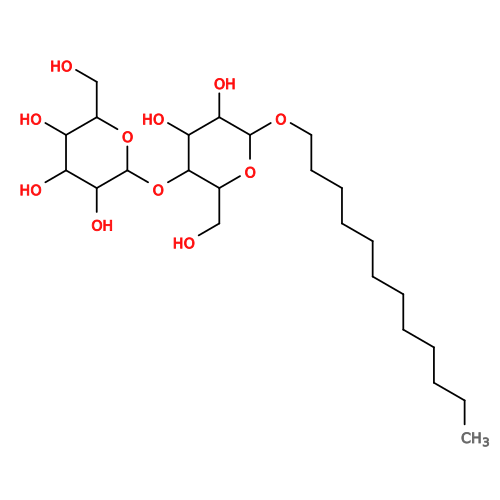 Type: D-saccharide / Mass: 510.615 Da / Num. of mol.: 5 / Source method: obtained synthetically / Formula: C24H46O11 / Feature type: SUBJECT OF INVESTIGATION / Comment: detergent*YM Type: D-saccharide / Mass: 510.615 Da / Num. of mol.: 5 / Source method: obtained synthetically / Formula: C24H46O11 / Feature type: SUBJECT OF INVESTIGATION / Comment: detergent*YM#33: Sugar |  Type: saccharide / Mass: 949.299 Da / Num. of mol.: 2 / Source method: obtained synthetically / Formula: C51H96O15 / Feature type: SUBJECT OF INVESTIGATION Type: saccharide / Mass: 949.299 Da / Num. of mol.: 2 / Source method: obtained synthetically / Formula: C51H96O15 / Feature type: SUBJECT OF INVESTIGATION |
|---|
-Non-polymers , 12 types, 758 molecules 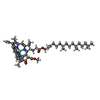
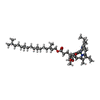
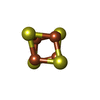
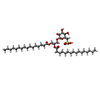
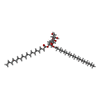


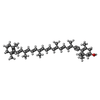

| #25: Chemical | ChemComp-CL0 / 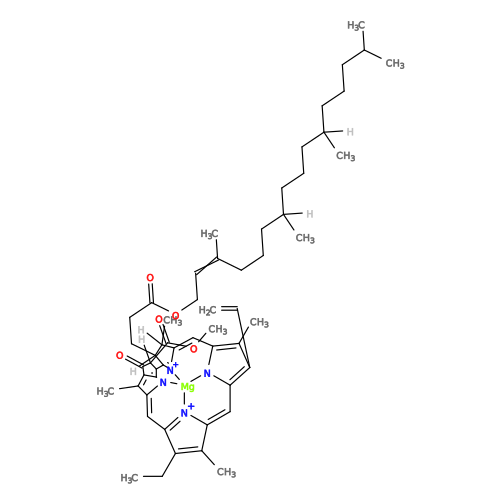 Mass: 893.489 Da / Num. of mol.: 1 / Source method: obtained synthetically / Formula: C55H72MgN4O5 / Feature type: SUBJECT OF INVESTIGATION Mass: 893.489 Da / Num. of mol.: 1 / Source method: obtained synthetically / Formula: C55H72MgN4O5 / Feature type: SUBJECT OF INVESTIGATION | ||||||||||||||||||||
|---|---|---|---|---|---|---|---|---|---|---|---|---|---|---|---|---|---|---|---|---|---|
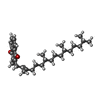
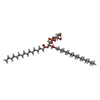
| #26: Chemical | ChemComp-CLA / 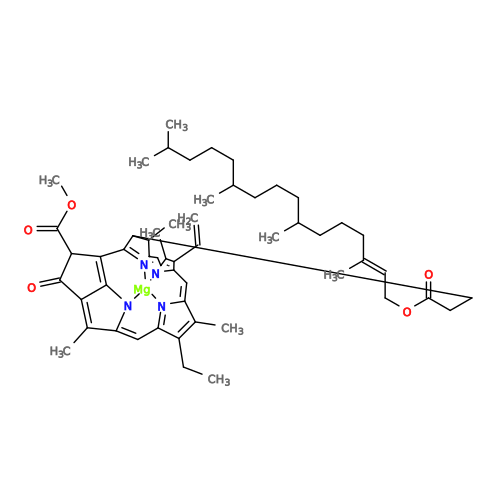 Mass: 893.489 Da / Num. of mol.: 218 / Source method: obtained synthetically / Formula: C55H72MgN4O5 / Feature type: SUBJECT OF INVESTIGATION Mass: 893.489 Da / Num. of mol.: 218 / Source method: obtained synthetically / Formula: C55H72MgN4O5 / Feature type: SUBJECT OF INVESTIGATION#27: Chemical | 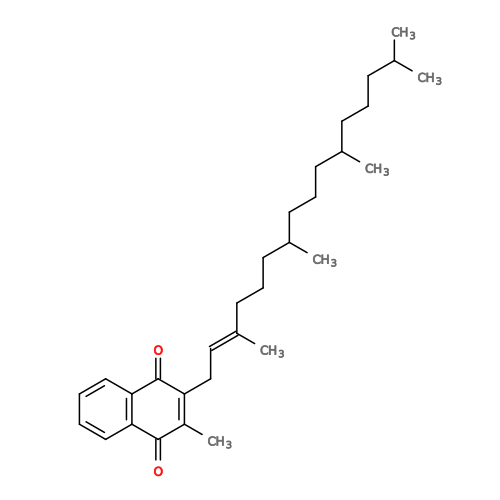 Mass: 450.696 Da / Num. of mol.: 2 / Source method: obtained synthetically / Formula: C31H46O2 / Feature type: SUBJECT OF INVESTIGATION Mass: 450.696 Da / Num. of mol.: 2 / Source method: obtained synthetically / Formula: C31H46O2 / Feature type: SUBJECT OF INVESTIGATION#28: Chemical | ChemComp-LHG / 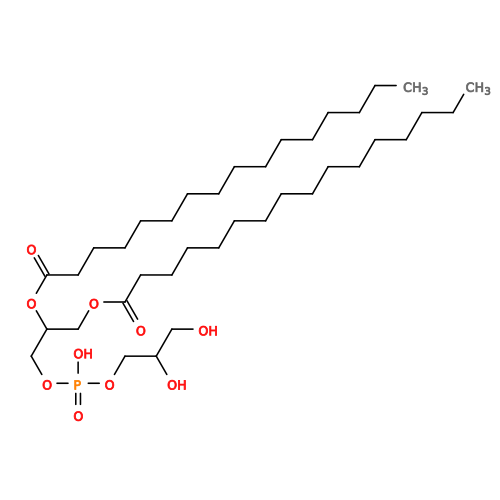 Mass: 722.970 Da / Num. of mol.: 18 / Source method: obtained synthetically / Formula: C38H75O10P / Feature type: SUBJECT OF INVESTIGATION / Comment: phospholipid*YM Mass: 722.970 Da / Num. of mol.: 18 / Source method: obtained synthetically / Formula: C38H75O10P / Feature type: SUBJECT OF INVESTIGATION / Comment: phospholipid*YM#29: Chemical | ChemComp-WVN / Mass: 536.873 Da / Num. of mol.: 28 / Source method: obtained synthetically / Formula: C40H56 / Feature type: SUBJECT OF INVESTIGATION #31: Chemical | 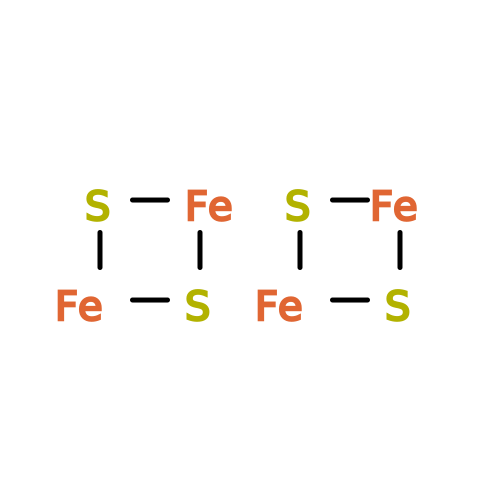 Mass: 351.640 Da / Num. of mol.: 3 / Source method: obtained synthetically / Formula: Fe4S4 / Feature type: SUBJECT OF INVESTIGATION Mass: 351.640 Da / Num. of mol.: 3 / Source method: obtained synthetically / Formula: Fe4S4 / Feature type: SUBJECT OF INVESTIGATION#32: Chemical | ChemComp-SQD / | 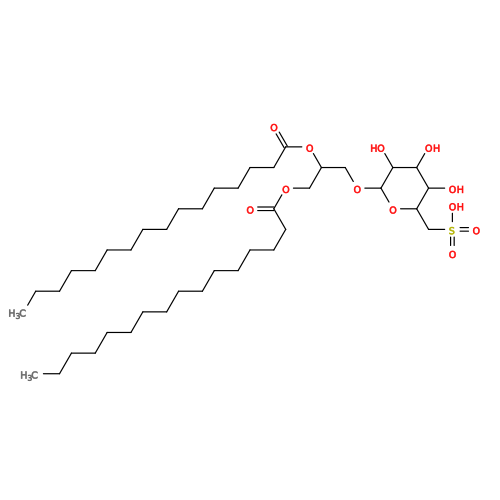 Mass: 795.116 Da / Num. of mol.: 1 / Source method: obtained synthetically / Formula: C41H78O12S / Feature type: SUBJECT OF INVESTIGATION Mass: 795.116 Da / Num. of mol.: 1 / Source method: obtained synthetically / Formula: C41H78O12S / Feature type: SUBJECT OF INVESTIGATION#34: Chemical | ChemComp-LMG / 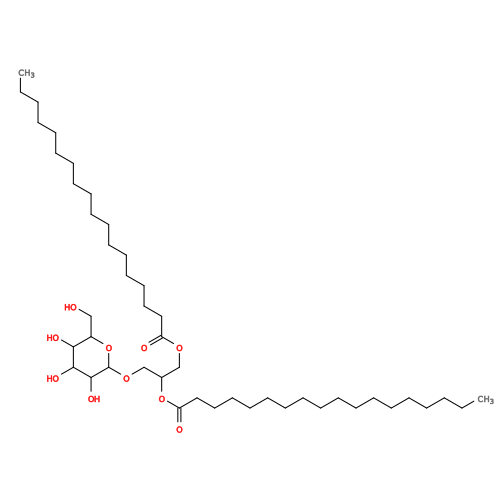 Mass: 787.158 Da / Num. of mol.: 8 / Source method: obtained synthetically / Formula: C45H86O10 / Feature type: SUBJECT OF INVESTIGATION Mass: 787.158 Da / Num. of mol.: 8 / Source method: obtained synthetically / Formula: C45H86O10 / Feature type: SUBJECT OF INVESTIGATION#35: Chemical | ChemComp-II0 / ( 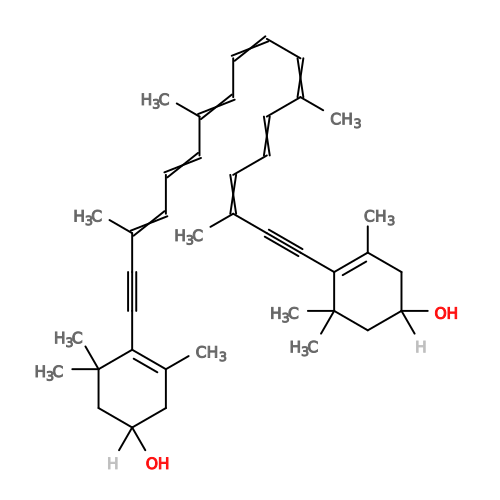 Mass: 564.840 Da / Num. of mol.: 45 / Source method: obtained synthetically / Formula: C40H52O2 / Feature type: SUBJECT OF INVESTIGATION Mass: 564.840 Da / Num. of mol.: 45 / Source method: obtained synthetically / Formula: C40H52O2 / Feature type: SUBJECT OF INVESTIGATION#36: Chemical | ChemComp-KC2 / 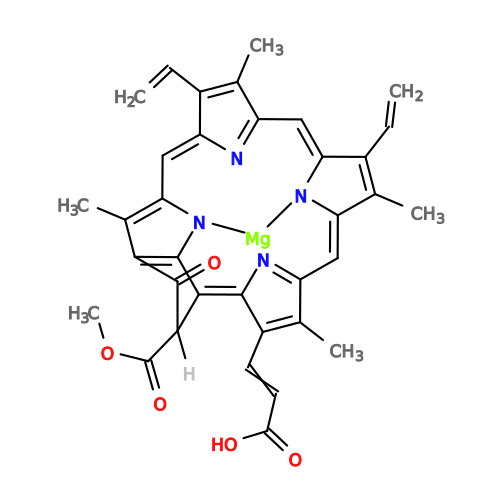 Mass: 608.926 Da / Num. of mol.: 15 / Source method: obtained synthetically / Formula: C35H28MgN4O5 / Feature type: SUBJECT OF INVESTIGATION Mass: 608.926 Da / Num. of mol.: 15 / Source method: obtained synthetically / Formula: C35H28MgN4O5 / Feature type: SUBJECT OF INVESTIGATION#37: Chemical | ChemComp-IHT / ( 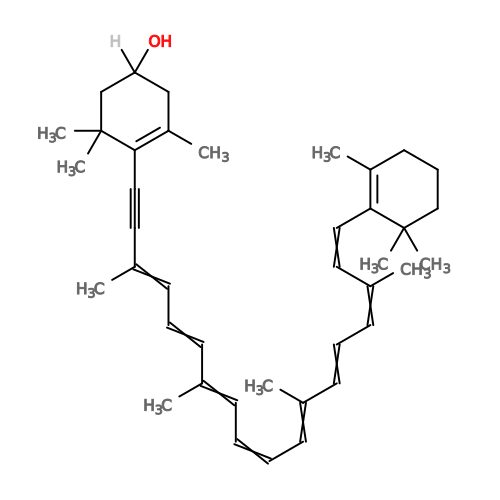 Mass: 550.856 Da / Num. of mol.: 8 / Source method: obtained synthetically / Formula: C40H54O / Feature type: SUBJECT OF INVESTIGATION Mass: 550.856 Da / Num. of mol.: 8 / Source method: obtained synthetically / Formula: C40H54O / Feature type: SUBJECT OF INVESTIGATION#38: Water | ChemComp-HOH / | Mass: 18.015 Da / Num. of mol.: 411 / Source method: isolated from a natural source / Formula: H2O |
-Details
| Has ligand of interest | Y |
|---|---|
| Has protein modification | Y |
-Experimental details
-Experiment
| Experiment | Method: ELECTRON MICROSCOPY |
|---|---|
| EM experiment | Aggregation state: PARTICLE / 3D reconstruction method: single particle reconstruction |
- Sample preparation
| Component | Name: Photosystem I complex binding with 11 ACPIs / Type: COMPLEX / Entity ID: #1-#24 / Source: NATURAL |
|---|---|
| Molecular weight | Value: 0.726968 MDa / Experimental value: NO |
| Source (natural) | Organism: Rhodomonas sp. NIES-2332 (eukaryote) |
| Buffer solution | pH: 6.5 |
| Specimen | Embedding applied: NO / Shadowing applied: NO / Staining applied: NO / Vitrification applied: YES |
| Vitrification | Cryogen name: ETHANE |
- Electron microscopy imaging
| Experimental equipment |  Model: Titan Krios / Image courtesy: FEI Company |
|---|---|
| Microscopy | Model: TFS KRIOS |
| Electron gun | Electron source:  FIELD EMISSION GUN / Accelerating voltage: 300 kV / Illumination mode: FLOOD BEAM FIELD EMISSION GUN / Accelerating voltage: 300 kV / Illumination mode: FLOOD BEAM |
| Electron lens | Mode: BRIGHT FIELD / Nominal defocus max: 1000 nm / Nominal defocus min: 200 nm |
| Image recording | Electron dose: 50 e/Å2 / Film or detector model: FEI FALCON IV (4k x 4k) |
- Processing
| EM software | Name: PHENIX |
|---|---|
| CTF correction | Type: PHASE FLIPPING AND AMPLITUDE CORRECTION |
| 3D reconstruction | Resolution: 2.14 Å / Resolution method: FSC 0.143 CUT-OFF / Num. of particles: 33179 / Symmetry type: POINT |
| Refinement | Highest resolution: 2.14 Å |
