 Movie
Movie Controller

[English] 日本語
 Yorodumi
- PDB-9i2h: A 3.3 angstrom cryo-EM structure of an engineered high-affinity h... -
+ Open data

- Basic information
| Entry | Database: PDB / ID: 9i2h | |||||||||||||||||||||||||||
|---|---|---|---|---|---|---|---|---|---|---|---|---|---|---|---|---|---|---|---|---|---|---|---|---|---|---|---|---|
| Title | A 3.3 angstrom cryo-EM structure of an engineered high-affinity human prothrombinase complex | |||||||||||||||||||||||||||
 Components Components |
| |||||||||||||||||||||||||||
 Keywords Keywords | BLOOD CLOTTING / enzyme / complex / prothrombinase | |||||||||||||||||||||||||||
| Function / homology |  Function and homology information Function and homology informationDefective cleavage of FV variant at a.a.534 / Defective cleavage of FV variant at R334 / response to vitamin K / coagulation factor Xa / platelet alpha granule / Amplification and propagation of coagulation cascade / Cargo concentration in the ER / Initiation of coagulation cascade / : / COPII-coated ER to Golgi transport vesicle ...Defective cleavage of FV variant at a.a.534 / Defective cleavage of FV variant at R334 / response to vitamin K / coagulation factor Xa / platelet alpha granule / Amplification and propagation of coagulation cascade / Cargo concentration in the ER / Initiation of coagulation cascade / : / COPII-coated ER to Golgi transport vesicle / Defective factor IX causes thrombophilia / Defective cofactor function of FVIIIa variant / Defective F9 variant does not activate FX / COPII-mediated vesicle transport / Regulation of clotting cascade / blood circulation / : / : / positive regulation of TOR signaling / Transport of gamma-carboxylated protein precursors from the endoplasmic reticulum to the Golgi apparatus / Gamma-carboxylation of protein precursors / Removal of aminoterminal propeptides from gamma-carboxylated proteins / endoplasmic reticulum-Golgi intermediate compartment membrane / platelet alpha granule lumen / Post-translational protein phosphorylation / phospholipid binding / Golgi lumen / blood coagulation / Regulation of Insulin-like Growth Factor (IGF) transport and uptake by Insulin-like Growth Factor Binding Proteins (IGFBPs) / Platelet degranulation / extracellular vesicle / positive regulation of cell migration / endoplasmic reticulum lumen / copper ion binding / serine-type endopeptidase activity / external side of plasma membrane / calcium ion binding / : / proteolysis / extracellular region / membrane / plasma membrane Similarity search - Function | |||||||||||||||||||||||||||
| Biological species |  Homo sapiens (human) Homo sapiens (human) | |||||||||||||||||||||||||||
| Method | ELECTRON MICROSCOPY / single particle reconstruction / cryo EM / Resolution: 3.28 Å | |||||||||||||||||||||||||||
 Authors Authors | Huntington, J.A. / Faille, A. / Ustok, F.I. | |||||||||||||||||||||||||||
| Funding support |  United Kingdom, 2items United Kingdom, 2items
| |||||||||||||||||||||||||||
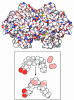
 Citation Citation | Journal: Blood / Year: 2026 Title: A 3.3-Å cryo-EM structure of an engineered high-affinity human prothrombinase complex. Authors: Fatma Işık Üstok / Alexandre Faille / James A Huntington / Abstract: Thrombin is generated from prothrombin through cleavage at 2 sites by the enzyme prothrombinase, composed of factor Xa (fXa) and fVa. The affinity of fXa for fVa is low, with assembly and function ...Thrombin is generated from prothrombin through cleavage at 2 sites by the enzyme prothrombinase, composed of factor Xa (fXa) and fVa. The affinity of fXa for fVa is low, with assembly and function dependent on phospholipid (PL) membranes. Some snakes have evolved venom versions of fXa that bind to fVa with high affinity and efficiently activate prothrombin in the absence of PL. We created a similar high-affinity, PL-independent human prothrombinase with 17 mutations to human fXa (M17). The increase in affinity enabled cryogenic electron microscopy (cryo-EM) structure determination of M17-prothrombinase to a resolution of 3.3 Å. All protein domains were well resolved in the map, except for the γ-carboxyglutamic acid domain of fXa. The main contacts involve the serine protease and epidermal growth factor-like domain 2 (EGF2) domains of fXa and the A2 and A3 domains of fVa, resulting in the burying of a total surface area of 4900 Å2. The map is of sufficient quality to resolve side-chain interactions, including several key M17 mutations. To aid in the placement of the loop C-terminal to the A2 domain (a2-loop), we solved a high-resolution crystal structure of fXa in complex with a synthetic a2 peptide. The acidic a2-loop interacts with the basic heparin-binding site of fXa, involving a conserved antiparallel β-strand interaction. The M17-prothrombinase structure is compatible with data from biochemical and mutagenesis research and provides important new insights into the assembly and function of the prothrombinase complex. | |||||||||||||||||||||||||||
| History |
|
- Structure visualization
| Structure viewer | Molecule: MolmilJmol/JSmol |
|---|
- Downloads & links
-Download
| PDBx/mmCIF format | 9i2h.cif.gz | 448.4 KB | Display | PDBx/mmCIF format |
|---|---|---|---|---|
| PDB format | pdb9i2h.ent.gz | Display | PDB format | |
| PDBx/mmJSON format | 9i2h.json.gz | Tree view | PDBx/mmJSON format | |
| Others |  Other downloads Other downloads |
-Validation report
| Arichive directory | https://data.pdbj.org/pub/pdb/validation_reports/i2/9i2hftp://data.pdbj.org/pub/pdb/validation_reports/i2/9i2h | HTTPS FTP |
|---|
-Related structure data
| Related structure data |  52585MC  9i24C M: map data used to model this data C: citing same article ( |
|---|---|
| Similar structure data |


-Links
 PDBj
PDBj
- Assembly
| Deposited unit | 
|
|---|---|
| 1 |
|
-Components
-Protein , 2 types, 2 molecules HL
| #1: Protein | Mass: 28789.916 Da / Num. of mol.: 1 Mutation: E129N, S130E, T132K, K134D, N166H, K169M, S173D, I175R, A233R, D239K Source method: isolated from a genetically manipulated source Details: Mutations given using chymotrypsin template numbering as in the coordinates. Source: (gene. exp.) Homo sapiens (human) / Gene: F10 / Plasmid: pCEP4 / Cell line (production host): HEK/EBNA / Production host:  Cytomegalovirus / References: UniProt: P00742 Cytomegalovirus / References: UniProt: P00742 |
|---|---|
| #2: Protein | Mass: 15765.613 Da / Num. of mol.: 1 / Mutation: S90R, L91A, D92F, H101K, E102R, E103V, N105S Source method: isolated from a genetically manipulated source Source: (gene. exp.) Homo sapiens (human) / Gene: F10 / Plasmid: pCEP4 / Cell line (production host): HEK/EBNA / Production host: Cytomegalovirus / References: UniProt: P00742 |
-Coagulation factor V ... , 2 types, 2 molecules AB
| #3: Protein | Mass: 81354.453 Da / Num. of mol.: 1 Source method: isolated from a genetically manipulated source Details: TYS is a sulphated Tyrosine. / Source: (gene. exp.) Homo sapiens (human) / Gene: F5 / Cell (production host): BHK-M / Production host: unidentified plasmid (others) / References: UniProt: P12259 |
|---|---|
| #4: Protein | Mass: 75283.008 Da / Num. of mol.: 1 Source method: isolated from a genetically manipulated source Source: (gene. exp.) Homo sapiens (human) / Gene: F5 / Cell (production host): BHK-M / Production host: unidentified plasmid (others) / References: UniProt: P12259 |
-Sugars , 4 types, 4 molecules
| #5: Polysaccharide | alpha-D-mannopyranose-(1-3)-[alpha-D-mannopyranose-(1-6)]beta-D-mannopyranose-(1-4)-2-acetamido-2- ...alpha-D-mannopyranose-(1-3)-[alpha-D-mannopyranose-(1-6)]beta-D-mannopyranose-(1-4)-2-acetamido-2-deoxy-beta-D-glucopyranose-(1-4)-[alpha-L-fucopyranose-(1-6)]2-acetamido-2-deoxy-beta-D-glucopyranose Source method: isolated from a genetically manipulated source |
|---|---|
| #6: Polysaccharide | alpha-D-mannopyranose-(1-3)-[alpha-D-mannopyranose-(1-6)]beta-D-mannopyranose-(1-4)-2-acetamido-2- ...alpha-D-mannopyranose-(1-3)-[alpha-D-mannopyranose-(1-6)]beta-D-mannopyranose-(1-4)-2-acetamido-2-deoxy-beta-D-glucopyranose-(1-4)-2-acetamido-2-deoxy-beta-D-glucopyranose Source method: isolated from a genetically manipulated source |
| #7: Polysaccharide | alpha-D-mannopyranose-(1-6)-alpha-D-mannopyranose-(1-3)-[alpha-D-mannopyranose-(1-6)-alpha-D- ...alpha-D-mannopyranose-(1-6)-alpha-D-mannopyranose-(1-3)-[alpha-D-mannopyranose-(1-6)-alpha-D-mannopyranose-(1-6)]beta-D-mannopyranose-(1-4)-2-acetamido-2-deoxy-beta-D-glucopyranose-(1-4)-2-acetamido-2-deoxy-beta-D-glucopyranose Source method: isolated from a genetically manipulated source |
| #8: Polysaccharide | alpha-L-fucopyranose-(1-6)-2-acetamido-2-deoxy-beta-D-glucopyranose Source method: isolated from a genetically manipulated source |
-Non-polymers , 4 types, 5 molecules 


| #9: Chemical |  Mass: 40.078 Da / Num. of mol.: 2 / Source method: obtained synthetically / Formula: Ca Mass: 40.078 Da / Num. of mol.: 2 / Source method: obtained synthetically / Formula: Ca#10: Chemical | ChemComp-NA / |  Mass: 22.990 Da / Num. of mol.: 1 / Source method: obtained synthetically / Formula: Na Mass: 22.990 Da / Num. of mol.: 1 / Source method: obtained synthetically / Formula: Na#11: Chemical | ChemComp-0GJ / | 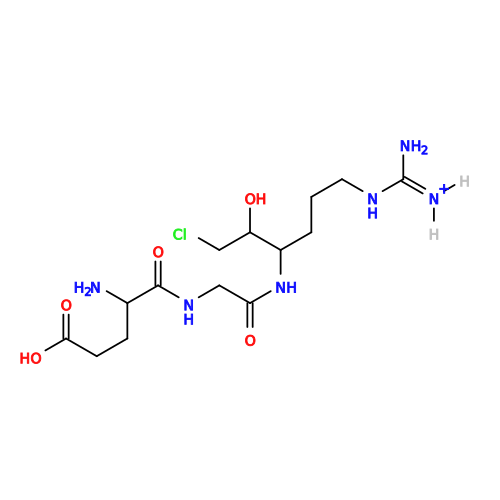 Type: peptide-like, Peptide-like / Class: Inhibitor / Mass: 395.862 Da / Num. of mol.: 1 Type: peptide-like, Peptide-like / Class: Inhibitor / Mass: 395.862 Da / Num. of mol.: 1Source method: isolated from a genetically manipulated source Formula: C14H28ClN6O5 / References: GLU-GLY-ARG-CHLOROMETHYL KETONE #12: Chemical | ChemComp-CU / |  Mass: 63.546 Da / Num. of mol.: 1 / Source method: obtained synthetically / Formula: Cu Mass: 63.546 Da / Num. of mol.: 1 / Source method: obtained synthetically / Formula: Cu |
|---|
-Details
| Has ligand of interest | Y |
|---|---|
| Has protein modification | Y |
-Experimental details
-Experiment
| Experiment | Method: ELECTRON MICROSCOPY |
|---|---|
| EM experiment | Aggregation state: PARTICLE / 3D reconstruction method: single particle reconstruction |
- Sample preparation
| Component | Name: prothrombinase, a complex of fVa and fXa / Type: COMPLEX Details: M17-prothrombinase was formed by mixing fVa with EGRCK-inhibited M17-fXa at a 1:6 molar ratio with a final concentration of 1.68uM in 20mM HEPES pH 7.5, 150mM NaCl and 5mM CaCl2 Entity ID: #1-#4 / Source: RECOMBINANT |
|---|---|
| Molecular weight | Experimental value: NO |
| Source (natural) | Organism: Homo sapiens (human) |
| Source (recombinant) | Organism: unidentified (others) |
| Buffer solution | pH: 7.5 / Details: 20mM HEPES, 150mM NaCl and 5mM CaCl2 |
| Specimen | Embedding applied: NO / Shadowing applied: NO / Staining applied: NO / Vitrification applied: YES Details: M17-prothrombinase was formed by mixing fVa with EGRCK-inhibited M17-fXa at a 1:6 molar ratio with a final concentration of 1.68uM |
| Specimen support | Details: using a Pelco EasiGlow / Grid material: GOLD / Grid mesh size: 300 divisions/in. / Grid type: Quantifoil R0.6/1 |
| Vitrification | Instrument: FEI VITROBOT MARK IV / Cryogen name: ETHANE |
- Electron microscopy imaging
| Experimental equipment |  Model: Titan Krios / Image courtesy: FEI Company |
|---|---|
| Microscopy | Model: TFS KRIOS |
| Electron gun | Electron source:  FIELD EMISSION GUN / Accelerating voltage: 300 kV / Illumination mode: FLOOD BEAM FIELD EMISSION GUN / Accelerating voltage: 300 kV / Illumination mode: FLOOD BEAM |
| Electron lens | Mode: BRIGHT FIELD / Nominal defocus max: 2000 nm / Nominal defocus min: 1000 nm |
| Image recording | Electron dose: 45.74 e/Å2 / Film or detector model: GATAN K3 (6k x 4k) |
- Processing
| EM software | Name: PHENIX / Version: 1.21.1_5286 / Category: model refinement | ||||||||||||||||||||||||
|---|---|---|---|---|---|---|---|---|---|---|---|---|---|---|---|---|---|---|---|---|---|---|---|---|---|
| CTF correction | Type: PHASE FLIPPING AND AMPLITUDE CORRECTION | ||||||||||||||||||||||||
| 3D reconstruction | Resolution: 3.28 Å / Resolution method: FSC 0.143 CUT-OFF / Num. of particles: 70154 / Symmetry type: POINT | ||||||||||||||||||||||||
| Refinement | Cross valid method: NONE Stereochemistry target values: GeoStd + Monomer Library + CDL v1.2 | ||||||||||||||||||||||||
| Displacement parameters | Biso mean: 110.91 Å2 | ||||||||||||||||||||||||
| Refine LS restraints |
|
