 Movie
Movie Controller


+ Open data

- Basic information
| Entry | Database: PDB / ID: 9hgs | ||||||||||||||||||||||||
|---|---|---|---|---|---|---|---|---|---|---|---|---|---|---|---|---|---|---|---|---|---|---|---|---|---|
| Title | In vitro grown G14R Alpha-Synuclein Fibrils | ||||||||||||||||||||||||
 Components Components | Alpha-synuclein | ||||||||||||||||||||||||
 Keywords Keywords | PROTEIN FIBRIL / Alpha-Synuclein / G14R Mutation / Fibrils / Cryo-EM / Protein Aggregation / Amyloid Structure | ||||||||||||||||||||||||
| Function / homology |  Function and homology information Function and homology informationnegative regulation of mitochondrial electron transport, NADH to ubiquinone / negative regulation of dopamine uptake involved in synaptic transmission / negative regulation of norepinephrine uptake / response to desipramine / positive regulation of SNARE complex assembly / positive regulation of hydrogen peroxide catabolic process / supramolecular fiber / negative regulation of chaperone-mediated autophagy / regulation of synaptic vesicle recycling / regulation of reactive oxygen species biosynthetic process ...negative regulation of mitochondrial electron transport, NADH to ubiquinone / negative regulation of dopamine uptake involved in synaptic transmission / negative regulation of norepinephrine uptake / response to desipramine / positive regulation of SNARE complex assembly / positive regulation of hydrogen peroxide catabolic process / supramolecular fiber / negative regulation of chaperone-mediated autophagy / regulation of synaptic vesicle recycling / regulation of reactive oxygen species biosynthetic process / positive regulation of protein localization to cell periphery / negative regulation of exocytosis / dopamine biosynthetic process / dopamine uptake involved in synaptic transmission / negative regulation of dopamine metabolic process / response to iron(II) ion / negative regulation of platelet-derived growth factor receptor signaling pathway / SNARE complex assembly / negative regulation of thrombin-activated receptor signaling pathway / negative regulation of microtubule polymerization / synaptic vesicle priming / synaptic vesicle transport / Lewy body / synaptic vesicle exocytosis / regulation of norepinephrine uptake / transporter regulator activity / protein kinase inhibitor activity / positive regulation of inositol phosphate biosynthetic process / positive regulation of receptor recycling / regulation of dopamine secretion / cuprous ion binding / positive regulation of exocytosis / nuclear outer membrane / dynein complex binding / synaptic transmission, dopaminergic / response to magnesium ion / positive regulation of endocytosis / negative regulation of serotonin uptake / cysteine-type endopeptidase inhibitor activity / kinesin binding / regulation of presynapse assembly / alpha-tubulin binding / synaptic vesicle endocytosis / beta-tubulin binding / phospholipase binding / behavioral response to cocaine / cellular response to fibroblast growth factor stimulus / supramolecular fiber organization / response to type II interferon / cellular response to epinephrine stimulus / inclusion body / response to interleukin-1 / Hsp70 protein binding / positive regulation of release of sequestered calcium ion into cytosol / cellular response to copper ion / axon terminus / enzyme inhibitor activity / glutathione metabolic process / SNARE binding / protein tetramerization / regulation of microtubule cytoskeleton organization / receptor internalization / phosphoprotein binding / microglial cell activation / protein destabilization / protein sequestering activity / tubulin binding / ferrous iron binding / phospholipid binding / synapse organization / PKR-mediated signaling / tau protein binding / enzyme activator activity / positive regulation of inflammatory response / terminal bouton / actin cytoskeleton / synaptic vesicle membrane / negative regulation of neuron apoptotic process / response to lipopolysaccharide / growth cone / actin binding / cellular response to oxidative stress / histone binding / cell cortex / microtubule binding / amyloid fibril formation / mitochondrial outer membrane / lysosome / oxidoreductase activity / transcription cis-regulatory region binding / mitochondrial inner membrane / positive regulation of apoptotic process / ribosome / mitochondrial matrix / Amyloid fiber formation / copper ion binding / protein domain specific binding / axon / neuronal cell body / calcium ion binding Similarity search - Function | ||||||||||||||||||||||||
| Biological species |  Homo sapiens (human) Homo sapiens (human) | ||||||||||||||||||||||||
| Method | ELECTRON MICROSCOPY / single particle reconstruction / cryo EM / Resolution: 3 Å | ||||||||||||||||||||||||
 Authors Authors | Sicking, K. / Fernandez-Busnadiego, R. | ||||||||||||||||||||||||
| Funding support |  Germany, Germany,  United States, 5items United States, 5items
| ||||||||||||||||||||||||
 Citation Citation | Journal: Mov Disord / Year: 2025 Title: A Novel α-Synuclein K58N Missense Variant in a Patient with Parkinson's Disease. Authors: Mohammed Al-Azzani / Sandrina Weber / Nagendran Ramalingam / Maria Ramón / Liana Shvachiy / Gonçalo Mestre / Michael Zech / Kevin Sicking / Alain Ibáñez de Opakua / Vidyashree Jayanthi / ...Authors: Mohammed Al-Azzani / Sandrina Weber / Nagendran Ramalingam / Maria Ramón / Liana Shvachiy / Gonçalo Mestre / Michael Zech / Kevin Sicking / Alain Ibáñez de Opakua / Vidyashree Jayanthi / Leslie Amaral / Aishwarya Agarwal / Aswathy Chandran / Susana R Chaves / Juliane Winkelmann / Claudia Trenkwalder / Maike Schwager / Silke Pauli / Ulf Dettmer / Claudio O Fernández / Janin Lautenschläger / Markus Zweckstetter / Ruben Fernandez-Busnadiego / Brit Mollenhauer / Tiago Fleming Outeiro /    Abstract: BACKGROUND: Parkinson's disease (PD) is a complex multifactorial disorder with a genetic component in about 15% of cases. Multiplications and point mutations in SNCA gene, encoding α-synuclein (aSyn) ...BACKGROUND: Parkinson's disease (PD) is a complex multifactorial disorder with a genetic component in about 15% of cases. Multiplications and point mutations in SNCA gene, encoding α-synuclein (aSyn), are linked to rare familial forms of PD. OBJECTIVE: Our goal was to assess the clinical presentation and the biological effects of a novel K58N aSyn mutation identified in a patient with PD. METHODS: We describe the clinical presentation associated with the novel mutation, together with genetic testing through whole exome sequencing (WES). Furthermore, we conducted extensive biophysical ...METHODS: We describe the clinical presentation associated with the novel mutation, together with genetic testing through whole exome sequencing (WES). Furthermore, we conducted extensive biophysical and cellular assays to assess the functional consequences of this novel variant. RESULTS: The patient exhibited typical features of sporadic PD with early onset and a benign disease course. WES showed a novel heterozygous missense variant in SNCA (NM_000345.4, c.174G>C; p.K58N). ...RESULTS: The patient exhibited typical features of sporadic PD with early onset and a benign disease course. WES showed a novel heterozygous missense variant in SNCA (NM_000345.4, c.174G>C; p.K58N). A positive family history of PD was evident, because both a parent and a grandparent had been diagnosed with PD but were deceased. The patient underwent deep brain stimulation surgery 13 years postdiagnosis, showing stable, long-term improvements in motor symptoms. Biophysical studies demonstrated K58N substitution causes local structural effects, disrupts membrane binding, and enhances aSyn in vitro aggregation. In cellular systems, K58N aSyn produces fewer inclusions per cell and does not form condensates. The variant increases aSyn cytoplasmic distribution and displays aberrant activity-dependent dynamic serine-129 phosphorylation. CONCLUSIONS: The clinical presentation associated with the novel K58N aSyn mutation suggests a relatively benign PD course consistent with the phenotypic spectrum of idiopathic PD. Overall, our ...CONCLUSIONS: The clinical presentation associated with the novel K58N aSyn mutation suggests a relatively benign PD course consistent with the phenotypic spectrum of idiopathic PD. Overall, our molecular studies provide novel insight into the biology and pathobiology of aSyn. © 2025 The Author(s). Movement Disorders published by Wiley Periodicals LLC on behalf of International Parkinson and Movement Disorder Society. #1: Journal: medRxiv / Year: 2025 Title: A novel alpha-synuclein K58N missense variant in a patient with Parkinson's disease. Authors: Mohammed Al-Azzani / Sandrina Weber / Nagendran Ramalingam / Maria Ramón / Liana Shvachiy / Gonçalo Mestre / Michael Zech / Kevin Sicking / Alain Ibáñez de Opakua / Vidyashree Jayanthi / ...Authors: Mohammed Al-Azzani / Sandrina Weber / Nagendran Ramalingam / Maria Ramón / Liana Shvachiy / Gonçalo Mestre / Michael Zech / Kevin Sicking / Alain Ibáñez de Opakua / Vidyashree Jayanthi / Leslie Amaral / Aishwarya Agarwal / Aswathy Chandran / Susana R Chaves / Juliane Winkelmann / Claudia Trenkwalder / Maike Schwager / Silke Pauli / Ulf Dettmer / Claudio O Fernández / Janin Lautenschläger / Markus Zweckstetter / Ruben Fernandez Busnadiego / Brit Mollenhauer / Tiago Fleming Outeiro / Abstract: Mutations and multiplications in the SNCA , encoding alpha-synuclein (aSyn), are associated with familial forms of Parkinson's disease (PD). We report the identification of a novel missense mutation ...Mutations and multiplications in the SNCA , encoding alpha-synuclein (aSyn), are associated with familial forms of Parkinson's disease (PD). We report the identification of a novel missense mutation (NM_000345.4, cDNA 174G>C; protein K58N) in a PD patient using whole exome sequencing, and describe comprehensive molecular and cellular analysss of the effects of this novel mutation. The patient exhibited typical sporadic PD with early onset and a benign disease course. Biophysical studies revealed that the K58N substitution causes local structural effects, disrupts binding to membranes, and enhances aSyn in vitro aggregation. K58N aSyn produces fewer inclusions per cell, and fails to undergo condensate formation. The mutation increases the cytoplasmic distribution of the protein, and has minimal effect on the dynamic reversibility of serine-129 phosphorylation. In total, the identification of this novel mutation advances our understanding of aSyn biology and pathobiology. #2: Journal: medRxiv / Year: 2025 Title: A novel alpha-synuclein G14R missense variant is associated with atypical neuropathological features. Authors: Christof Brücke / Mohammed Al-Azzani / Nagendran Ramalingam / Maria Ramón / Rita L Sousa / Fiamma Buratti / Michael Zech / Kevin Sicking / Leslie Amaral / Ellen Gelpi / Aswathy Chandran / ...Authors: Christof Brücke / Mohammed Al-Azzani / Nagendran Ramalingam / Maria Ramón / Rita L Sousa / Fiamma Buratti / Michael Zech / Kevin Sicking / Leslie Amaral / Ellen Gelpi / Aswathy Chandran / Aishwarya Agarwal / Susana R Chaves / Claudio O Fernández / Ulf Dettmer / Janin Lautenschläger / Markus Zweckstetter / Ruben Fernandez Busnadiego / Alexander Zimprich / Tiago Fleming Outeiro /  Abstract: BACKGROUND: Parkinson's disease (PD) affects millions of people worldwide, but only 5-10% of patients suffer from a monogenic form of the disease with Mendelian inheritance. , the gene encoding for ...BACKGROUND: Parkinson's disease (PD) affects millions of people worldwide, but only 5-10% of patients suffer from a monogenic form of the disease with Mendelian inheritance. , the gene encoding for the protein alpha-synuclein (aSyn), was the first to be associated with familial forms of PD and, since then, several missense variants and multiplications of the gene have been established as rare causes of autosomal dominant forms of PD. AIM AND METHODS: A patient carrying aSyn missense mutation and his family members were studied. We present the clinical features, genetic testing - whole exome sequencing (WES), and neuropathological ...AIM AND METHODS: A patient carrying aSyn missense mutation and his family members were studied. We present the clinical features, genetic testing - whole exome sequencing (WES), and neuropathological findings. The functional consequences of this aSyn variant were extensively investigated using biochemical, biophysical, and cellular assays. RESULTS: The patient exhibited a complex neurodegenerative disease that included generalized myocloni, bradykinesia, dystonia of the left arm and apraxia. WES identified a novel heterozygous variant ...RESULTS: The patient exhibited a complex neurodegenerative disease that included generalized myocloni, bradykinesia, dystonia of the left arm and apraxia. WES identified a novel heterozygous variant (cDNA 40G>A; protein G14R). Neuropathological examination showed extensive atypical aSyn pathology with frontotemporal lobar degeneration (FTLD) and nigral degeneration pattern with abundant ring-like neuronal inclusions, and few oligodendroglial inclusions. Sanger sequencing confirmed the variant in the healthy, elderly parent of the patient patient suggesting incomplete penetrance. NMR studies suggest that the G14R mutation induces a local structural alteration in aSyn, and lower thioflavin T binding in in vitro fibrillization assays. Interestingly, the G14R aSyn fibers display different fibrillar morphologies as revealed by cryo-electron microscopy. Cellular studies of the G14R variant revealed increased inclusion formation, enhanced membrane association, and impaired dynamic reversibility of serine-129 phosphorylation. SUMMARY: The atypical neuropathological features observed, which are reminiscent of those observed for the G51D aSyn variant, suggest a causal role of the variant with a distinct clinical and ...SUMMARY: The atypical neuropathological features observed, which are reminiscent of those observed for the G51D aSyn variant, suggest a causal role of the variant with a distinct clinical and pathological phenotype, which is further supported by the properties of the mutant aSyn, compatible with the strain hypothesis of proteinopathies. | ||||||||||||||||||||||||
| History |
|
- Structure visualization
| Structure viewer | Molecule: MolmilJmol/JSmol |
|---|
- Downloads & links
-Download
| PDBx/mmCIF format | 9hgs.cif.gz | 26.6 KB | Display | PDBx/mmCIF format |
|---|---|---|---|---|
| PDB format | pdb9hgs.ent.gz | 14.4 KB | Display | PDB format |
| PDBx/mmJSON format | 9hgs.json.gz | Tree view | PDBx/mmJSON format | |
| Others |  Other downloads Other downloads |
-Validation report
| Arichive directory | https://data.pdbj.org/pub/pdb/validation_reports/hg/9hgsftp://data.pdbj.org/pub/pdb/validation_reports/hg/9hgs | HTTPS FTP |
|---|
-Related structure data
| Related structure data |  52166MC 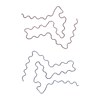 9hxaC M: map data used to model this data C: citing same article ( |
|---|---|
| Similar structure data |

-Links
 PDBj
PDBj- Assembly
| Deposited unit | 
|
|---|---|
| 1 |
|
-Components
| #1: Protein | Mass: 14576.251 Da / Num. of mol.: 1 Source method: isolated from a genetically manipulated source Source: (gene. exp.) Homo sapiens (human) / Gene: SNCA, NACP, PARK1 / Production host:   Escherichia coli (E. coli) / References: UniProt: P37840 Escherichia coli (E. coli) / References: UniProt: P37840 |
|---|---|
| Has protein modification | N |
-Experimental details
-Experiment
| Experiment | Method: ELECTRON MICROSCOPY |
|---|---|
| EM experiment | Aggregation state: FILAMENT / 3D reconstruction method: single particle reconstruction |
- Sample preparation
| Component | Name: Alpha-Synuclein G14R / Type: ORGANELLE OR CELLULAR COMPONENT / Entity ID: all / Source: RECOMBINANT |
|---|---|
| Molecular weight | Value: 14.46 kDa/nm / Experimental value: NO |
| Source (natural) | Organism: Homo sapiens (human) |
| Source (recombinant) | Organism: Escherichia coli (E. coli) |
| Buffer solution | pH: 7 |
| Specimen | Embedding applied: NO / Shadowing applied: NO / Staining applied: NO / Vitrification applied: YES |
| Vitrification | Cryogen name: ETHANE-PROPANE |
- Electron microscopy imaging
| Experimental equipment |  Model: Titan Krios / Image courtesy: FEI Company |
|---|---|
| Microscopy | Model: TFS KRIOS |
| Electron gun | Electron source:  FIELD EMISSION GUN / Accelerating voltage: 300 kV / Illumination mode: FLOOD BEAM FIELD EMISSION GUN / Accelerating voltage: 300 kV / Illumination mode: FLOOD BEAM |
| Electron lens | Mode: OTHER / Nominal defocus max: 2400 nm / Nominal defocus min: 1200 nm |
| Image recording | Electron dose: 40 e/Å2 / Film or detector model: FEI FALCON IV (4k x 4k) |
- Processing
| EM software | Name: PHENIX / Category: model refinement | ||||||||||||||||||||||||
|---|---|---|---|---|---|---|---|---|---|---|---|---|---|---|---|---|---|---|---|---|---|---|---|---|---|
| CTF correction | Type: PHASE FLIPPING AND AMPLITUDE CORRECTION | ||||||||||||||||||||||||
| 3D reconstruction | Resolution: 3 Å / Resolution method: FSC 0.143 CUT-OFF / Num. of particles: 128762 / Symmetry type: POINT | ||||||||||||||||||||||||
| Refine LS restraints |
|
