ジャーナル: Proc Natl Acad Sci U S A / 年: 2025 タイトル: The mechanism of pathogenic α-antitrypsin aggregation in the human liver. 著者: Ibrahim Aldobiyan / Emma L K Elliston / Narinder Heyer-Chauhan / Stefan T Arold / Lingyun Zhao / Brandon Huntington / Sarah M Lowen / Elena V Orlova / James A Irving / David A Lomas / 要旨: Originating 2 to 3 millennia ago in a Scandinavian population, the SERPINA1 Z allele (Glu342Lys) is present in up to 2.5% of populations of Northern European descent and accounts for 95% of severe α- ...Originating 2 to 3 millennia ago in a Scandinavian population, the SERPINA1 Z allele (Glu342Lys) is present in up to 2.5% of populations of Northern European descent and accounts for 95% of severe α-antitrypsin deficiency. The α-antitrypsin Z variant self-assembles into polymer chains that deposit within hepatocytes, predisposing to liver disease. Here, the 4.0Å subunit structure of polymers isolated directly from human liver tissue has been determined using cryoelectron microscopy. Challenges of flexibility, small subunit size, heterogeneous length, and preferred orientations were mitigated using antibody Fab domains and sample preparation strategies. This structure demonstrates that the formation of polymers in vivo involves self-incorporation of an exposed structural element (the reactive center loop) as an additional β-strand into the central β-sheet of α-antitrypsin and displacement of a C-terminal region from one subunit with incorporation into the next. Unlike amyloid aggregation, this well-folded structure partially recapitulates a conformation adopted during normal function of the protein. These perturbations to the constituent α-antitrypsin subunits of human tissue-derived polymers are consistent with a pronounced stability, their tendency toward long-chain forms, the ability of a subset to undergo canonical secretion, and the action of a class of small molecules that block polymerization in vivo.
 ムービー
ムービー コントローラー


 データを開く
 基本情報
基本情報 要素
要素 キーワード
キーワード
 Mus musculus (ハツカネズミ)
 X線回折 /
  データ登録者
 英国,
英国,  米国, 3件
  引用
引用
 構造の表示
構造の表示 Molmil
 ダウンロードとリンク
 その他のダウンロード

 PDBj
PDBj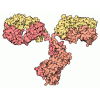
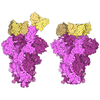
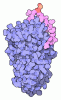
 集合体
集合体
 分子量: 18.015 Da / 分子数: 68 / 由来タイプ: 天然 / 式: H2O
 試料調製
試料調製 / ビームライン: ID23-1 / 波長: 0.8856 Å
 解析
解析