 Movie
Movie Controller

[English] 日本語
 Yorodumi
- EMDB-52659: A subunit of alpha-1 antitrypsin polymers isolated from ZZ explan... -
+ Open data

- Basic information
| Entry |  | ||||||||||||
|---|---|---|---|---|---|---|---|---|---|---|---|---|---|
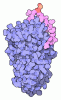
| Title | A subunit of alpha-1 antitrypsin polymers isolated from ZZ explant liver tissue and decorated with conformationally nonselective Fab 9C5 | ||||||||||||
 Map data Map data | The EM map of the monomer of ex vivo ZZ alpha-1 antitrypsin polymers in complex with a conformationally unselective Fab fragment. | ||||||||||||
 Sample Sample |
| ||||||||||||
 Keywords Keywords | Alpha-1 antitrypsin / Alpha-1 antitrypsin polymer / Antitrypsin / AAT / Serpin / Serine protease inhibitor / Misfolding / Protein misfolding / Protein oligomer / Oligomerisation / Cirrhosis / Liver tissue / Ex-vivo polymer / Antibody / Antibody-antigen complex / Complex / Fragment antigen-binding region / Fab / PROTEIN BINDING | ||||||||||||
| Function / homology |  Function and homology information Function and homology informationCargo concentration in the ER / COPII-coated ER to Golgi transport vesicle / COPII-mediated vesicle transport / endoplasmic reticulum-Golgi intermediate compartment membrane / platelet alpha granule lumen / serine-type endopeptidase inhibitor activity / Post-translational protein phosphorylation / Regulation of Insulin-like Growth Factor (IGF) transport and uptake by Insulin-like Growth Factor Binding Proteins (IGFBPs) / Platelet degranulation / protease binding ...Cargo concentration in the ER / COPII-coated ER to Golgi transport vesicle / COPII-mediated vesicle transport / endoplasmic reticulum-Golgi intermediate compartment membrane / platelet alpha granule lumen / serine-type endopeptidase inhibitor activity / Post-translational protein phosphorylation / Regulation of Insulin-like Growth Factor (IGF) transport and uptake by Insulin-like Growth Factor Binding Proteins (IGFBPs) / Platelet degranulation / protease binding / extracellular matrix / ficolin-1-rich granule lumen / endoplasmic reticulum lumen / Neutrophil degranulation / Golgi apparatus / endoplasmic reticulum / extracellular exosome / extracellular region / identical protein binding Similarity search - Function | ||||||||||||
| Biological species |  Homo sapiens (human) / Homo sapiens (human) /   Mus musculus (house mouse) Mus musculus (house mouse) | ||||||||||||
| Method | single particle reconstruction / cryo EM / Resolution: 3.98 Å | ||||||||||||
 Authors Authors | Aldobiyan IF / Irving JA / Orlova EV / Lomas DA | ||||||||||||
| Funding support |  United Kingdom, 3 items United Kingdom, 3 items
| ||||||||||||
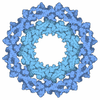
 Citation Citation | Journal: Proc Natl Acad Sci U S A / Year: 2025 Title: The mechanism of pathogenic α-antitrypsin aggregation in the human liver. Authors: Ibrahim Aldobiyan / Emma L K Elliston / Narinder Heyer-Chauhan / Stefan T Arold / Lingyun Zhao / Brandon Huntington / Sarah M Lowen / Elena V Orlova / James A Irving / David A Lomas /  Abstract: Originating 2 to 3 millennia ago in a Scandinavian population, the SERPINA1 Z allele (Glu342Lys) is present in up to 2.5% of populations of Northern European descent and accounts for 95% of severe α- ...Originating 2 to 3 millennia ago in a Scandinavian population, the SERPINA1 Z allele (Glu342Lys) is present in up to 2.5% of populations of Northern European descent and accounts for 95% of severe α-antitrypsin deficiency. The α-antitrypsin Z variant self-assembles into polymer chains that deposit within hepatocytes, predisposing to liver disease. Here, the 4.0Å subunit structure of polymers isolated directly from human liver tissue has been determined using cryoelectron microscopy. Challenges of flexibility, small subunit size, heterogeneous length, and preferred orientations were mitigated using antibody Fab domains and sample preparation strategies. This structure demonstrates that the formation of polymers in vivo involves self-incorporation of an exposed structural element (the reactive center loop) as an additional β-strand into the central β-sheet of α-antitrypsin and displacement of a C-terminal region from one subunit with incorporation into the next. Unlike amyloid aggregation, this well-folded structure partially recapitulates a conformation adopted during normal function of the protein. These perturbations to the constituent α-antitrypsin subunits of human tissue-derived polymers are consistent with a pronounced stability, their tendency toward long-chain forms, the ability of a subset to undergo canonical secretion, and the action of a class of small molecules that block polymerization in vivo. | ||||||||||||
| History |
|
- Structure visualization
| Supplemental images |
|---|

- Downloads & links
-EMDB archive
| Map data | emd_52659.map.gz | 20.6 MB | EMDB map data format | |
|---|---|---|---|---|
| Header (meta data) | emd-52659-v30.xmlemd-52659.xml | 43.4 KB 43.4 KB | Display Display | EMDB header |
| FSC (resolution estimation) | emd_52659_fsc.xml | 6.5 KB | Display | FSC data file |
| Images |  emd_52659.png emd_52659.png | 58 KB | ||
| Masks | emd_52659_msk_1.map | 22.2 MB | Mask map | |
| Filedesc metadata | emd-52659.cif.gz | 8.3 KB | ||
| Others | emd_52659_additional_1.map.gzemd_52659_additional_2.map.gzemd_52659_half_map_1.map.gzemd_52659_half_map_2.map.gz | 2.6 MB 20.8 MB 17.1 MB 17.1 MB | ||
| Archive directory |  https://data.pdbj.org/pub/emdb/structures/EMD-52659ftp://data.pdbj.org/pub/emdb/structures/EMD-52659 https://data.pdbj.org/pub/emdb/structures/EMD-52659ftp://data.pdbj.org/pub/emdb/structures/EMD-52659 | HTTPS FTP |
-Related structure data


-Links
| EMDB pages | EMDB (EBI/PDBe) / EMDataResource |
|---|---|
| Related items in Molecule of the Month |
-Map
| File | Download / File: emd_52659.map.gz / Format: CCP4 / Size: 22.2 MB / Type: IMAGE STORED AS FLOATING POINT NUMBER (4 BYTES) | ||||||||||||||||||||||||||||||||||||
|---|---|---|---|---|---|---|---|---|---|---|---|---|---|---|---|---|---|---|---|---|---|---|---|---|---|---|---|---|---|---|---|---|---|---|---|---|---|
| Annotation | The EM map of the monomer of ex vivo ZZ alpha-1 antitrypsin polymers in complex with a conformationally unselective Fab fragment. | ||||||||||||||||||||||||||||||||||||
| Projections & slices | Image control
Images are generated by Spider. | ||||||||||||||||||||||||||||||||||||
| Voxel size | X=Y=Z: 0.93 Å | ||||||||||||||||||||||||||||||||||||
| Density |
| ||||||||||||||||||||||||||||||||||||
| Symmetry | Space group: 1 | ||||||||||||||||||||||||||||||||||||
| Details | EMDB XML:
|
 Z (Sec.)
 Y (Row.)
 X (Col.)


-Supplemental data
-Mask #1
| File | emd_52659_msk_1.map | ||||||||||||
|---|---|---|---|---|---|---|---|---|---|---|---|---|---|
| Projections & Slices |
| ||||||||||||
| Density Histograms |


-Additional map: The post-processed EM map (masked). B-factor 150.
| File | emd_52659_additional_1.map | ||||||||||||
|---|---|---|---|---|---|---|---|---|---|---|---|---|---|
| Annotation | The post-processed EM map (masked). B-factor 150. | ||||||||||||
| Projections & Slices |
| ||||||||||||
| Density Histograms |


-Additional map: The post-processed EM map. B-factor 150.
| File | emd_52659_additional_2.map | ||||||||||||
|---|---|---|---|---|---|---|---|---|---|---|---|---|---|
| Annotation | The post-processed EM map. B-factor 150. | ||||||||||||
| Projections & Slices |
| ||||||||||||
| Density Histograms |


-Half map: Half-map 1 of: The EM map of the...
| File | emd_52659_half_map_1.map | ||||||||||||
|---|---|---|---|---|---|---|---|---|---|---|---|---|---|
| Annotation | Half-map 1 of: The EM map of the monomer of ex vivo ZZ alpha-1 antitrypsin polymers in complex with a conformationally unselective Fab fragment. | ||||||||||||
| Projections & Slices |
| ||||||||||||
| Density Histograms |


-Half map: Half-map 2 of: The EM map of the...
| File | emd_52659_half_map_2.map | ||||||||||||
|---|---|---|---|---|---|---|---|---|---|---|---|---|---|
| Annotation | Half-map 2 of: The EM map of the monomer of ex vivo ZZ alpha-1 antitrypsin polymers in complex with a conformationally unselective Fab fragment. | ||||||||||||
| Projections & Slices |
| ||||||||||||
| Density Histograms |


- Sample components
-Entire : Complex of the 9C5 Fab fragment and a subunit of polymers of the ...
| Entire | Name: Complex of the 9C5 Fab fragment and a subunit of polymers of the severe deficiency Z alpha-1 antitrypsin variant |
|---|---|
| Components |
|
-Supramolecule #1: Complex of the 9C5 Fab fragment and a subunit of polymers of the ...
| Supramolecule | Name: Complex of the 9C5 Fab fragment and a subunit of polymers of the severe deficiency Z alpha-1 antitrypsin variant type: complex / ID: 1 / Parent: 0 / Macromolecule list: all |
|---|---|
| Source (natural) | Organism: Homo sapiens (human) |
| Molecular weight | Theoretical: 50 KDa |
-Supramolecule #2: Alpha-1 antitrypsin Z variant
| Supramolecule | Name: Alpha-1 antitrypsin Z variant / type: complex / ID: 2 / Parent: 1 / Macromolecule list: #1 Details: The Z severe deficiency variant of alpha-1 antitrypsin. |
|---|---|
| Source (natural) | Organism: Homo sapiens (human) / Organ: Liver / Tissue: Explant liver tissue / Organelle: ER-derived / Location in cell: Inclusion bodies |
-Supramolecule #3: 9C5 Fab
| Supramolecule | Name: 9C5 Fab / type: complex / ID: 3 / Parent: 1 / Macromolecule list: #2-#3 |
|---|---|
| Source (natural) | Organism: Mus musculus (house mouse) / Strain: BALB/c / Organ: Spleen / Location in cell: Secreted |
-Macromolecule #1: Alpha-1 antitrypsin Z variant
| Macromolecule | Name: Alpha-1 antitrypsin Z variant / type: protein_or_peptide / ID: 1 Details: The Z severe deficiency variant of alpha-1 antitrypsin E342K variant Enantiomer: LEVO |
|---|---|
| Source (natural) | Organism: Homo sapiens (human) / Organ: Liver / Tissue: Explant tissue |
| Sequence | String: MPSSVSWGIL LLAGLCCLVP VSLAEDPQGD AAQKTDTSHH DQDHPTFNKI TPNLAEFAFS LYRQLAHQSN STNIFFSPVS IATAFAMLSL GTKADTHDEI LEGLNFNLTE IPEAQIHEGF QELLRTLNQP DSQLQLTTGN GLFLSEGLKL VDKFLEDVKK LYHSEAFTVN ...String: MPSSVSWGIL LLAGLCCLVP VSLAEDPQGD AAQKTDTSHH DQDHPTFNKI TPNLAEFAFS LYRQLAHQSN STNIFFSPVS IATAFAMLSL GTKADTHDEI LEGLNFNLTE IPEAQIHEGF QELLRTLNQP DSQLQLTTGN GLFLSEGLKL VDKFLEDVKK LYHSEAFTVN FGDTEEAKKQ INDYVEKGTQ GKIVDLVKEL DRDTVFALVN YIFFKGKWER PFEVKDTEEE DFHVDQVTTV KVPMMKRLGM FNIQHCKKLS SWVLLMKYLG NATAIFFLPD EGKLQHLENE LTHDIITKFL ENEDRRSASL HLPKLSITGT YDLKSVLGQL GITKVFSNGA DLSGVTEEAP LKLSKAVHKA VLTIDKKGTE AAGAMFLEAI PMSIPPEVKF NKPFVFLMIE QNTKSPLFMG KVVNPTQK UniProtKB: Alpha-1-antitrypsin |
-Macromolecule #2: 9C5 Fab heavy chain
| Macromolecule | Name: 9C5 Fab heavy chain / type: protein_or_peptide / ID: 2 Details: Heavy chain of the Fab fragment of a conformationally nonselective antibody (9C5) that binds to alpha-1-antitrypsin Enantiomer: LEVO |
|---|---|
| Source (natural) | Organism: Mus musculus (house mouse) / Strain: BALB/c / Organ: Spleen |
| Sequence | String: QVQLQQSGAE LVKPGASVKL SCTATGFNIK DTYMHWVKQR PEQGLEWIGR IDPANGNTKY DPKFQGKATL TADTSSNTAY LQLSSLTSED TAVYYCARKR YSMDYWGQGT SVTVSSAKTT PPSVYPLAPG SGAQTNSMVT LGCLVKGYFP EPVTVTWNSG SLSSGVHTFP ...String: QVQLQQSGAE LVKPGASVKL SCTATGFNIK DTYMHWVKQR PEQGLEWIGR IDPANGNTKY DPKFQGKATL TADTSSNTAY LQLSSLTSED TAVYYCARKR YSMDYWGQGT SVTVSSAKTT PPSVYPLAPG SGAQTNSMVT LGCLVKGYFP EPVTVTWNSG SLSSGVHTFP AVLQSDLYTL SSSVTVPSST WPSETVTCNV AHPASSTKVD KKIVPRD |
-Macromolecule #3: 9C5 Fab light chain
| Macromolecule | Name: 9C5 Fab light chain / type: protein_or_peptide / ID: 3 Details: Light chain of the Fab fragment of a conformationally nonselective antibody (9C5) that binds to alpha-1-antitrypsin Enantiomer: LEVO |
|---|---|
| Source (natural) | Organism: Mus musculus (house mouse) / Strain: BALB/c / Organ: Spleen |
| Sequence | String: SIVMTQTPKF LLVSAGERVT ITCKASQSVS NDVGWYQQKP GQPPKLLIYN ASNRKNGVPD RFTGSGYGTD FTFTISTVQA EDLAVYFCQQ DHSFPLKFGA GTKLELKRAD AAPTVSIFPP SSEQLTSGGA SVVCFLNNFY PKDINVKWKI DGSERQNGVL NSWTDQDSKD ...String: SIVMTQTPKF LLVSAGERVT ITCKASQSVS NDVGWYQQKP GQPPKLLIYN ASNRKNGVPD RFTGSGYGTD FTFTISTVQA EDLAVYFCQQ DHSFPLKFGA GTKLELKRAD AAPTVSIFPP SSEQLTSGGA SVVCFLNNFY PKDINVKWKI DGSERQNGVL NSWTDQDSKD STYSMSSTLT LTKDEYERHN SYTCEATHKT STSPIVKSFN RNE |
-Experimental details
-Structure determination
| Method | cryo EM |
|---|---|
 Processing Processing | single particle reconstruction |
| Aggregation state | particle |
-Sample preparation #1
| Preparation ID | 1 | ||||||||||||
|---|---|---|---|---|---|---|---|---|---|---|---|---|---|
| Concentration | 0.5 mg/mL | ||||||||||||
| Buffer | pH: 7.4 Component:
Details: 50mM Tris pH 7.4, 50mM NaCl, 5mM EDTA, 0.02 % (w/v) NaN3 | ||||||||||||
| Grid | Model: C-flat-1.2/1.3 / Material: GOLD / Mesh: 400 / Support film - Film type ID: 1 / Support film - Material: CARBON / Support film - topology: HOLEY / Support film - Film thickness: 20 / Pretreatment - Type: GLOW DISCHARGE / Pretreatment - Time: 30 sec. / Pretreatment - Atmosphere: AIR | ||||||||||||
| Vitrification | Cryogen name: ETHANE / Chamber humidity: 94 % / Chamber temperature: 277 K / Instrument: FEI VITROBOT MARK IV Details: Incubation time: 0s Blot time: 3.5s Blot force: 0s. | ||||||||||||
| Details | The sample comprised a mixed population of unbranched Z alpha-1 antirypsin polymers of varying length (primarily between 4-6 subunits), labelled with the Fab fragment of the 9C5 antibody |
-Sample preparation #2
| Preparation ID | 2 | ||||||||||||
|---|---|---|---|---|---|---|---|---|---|---|---|---|---|
| Concentration | 0.05 mg/mL | ||||||||||||
| Buffer | pH: 7.4 Component:
Details: 50mM Tris pH 7.4, 50mM NaCl, 5mM EDTA, 0.02 % (w/v) NaN3 | ||||||||||||
| Grid | Model: C-flat-1.2/1.3 / Material: GOLD / Mesh: 400 / Support film - Film type ID: 1 / Support film - Material: CARBON / Support film - topology: HOLEY / Support film - Film thickness: 20 / Pretreatment - Type: GLOW DISCHARGE / Pretreatment - Time: 30 sec. / Pretreatment - Atmosphere: AIR | ||||||||||||
| Vitrification | Cryogen name: ETHANE / Chamber humidity: 94 % / Chamber temperature: 277 K / Instrument: FEI VITROBOT MARK IV Details: Incubation time: 0s Blot time: 3.5s Blot force: 0s. | ||||||||||||
| Details | The sample comprised a mixed population of unbranched Z alpha-1 antirypsin polymers of varying length (primarily between 4-6 subunits), labelled with the Fab fragment of the 9C5 antibody |
-Sample preparation #3
| Preparation ID | 3 | ||||||||||||
|---|---|---|---|---|---|---|---|---|---|---|---|---|---|
| Concentration | 0.05 mg/mL | ||||||||||||
| Buffer | pH: 7.4 Component:
Details: 50mM Tris pH 7.4, 50mM NaCl, 5mM EDTA, 0.02 % (w/v) NaN3 | ||||||||||||
| Grid | Model: C-flat-1.2/1.3 / Material: GOLD / Mesh: 400 / Support film - Film type ID: 1 / Support film - Material: CARBON / Support film - topology: HOLEY / Support film - Film thickness: 20 / Pretreatment - Type: GLOW DISCHARGE / Pretreatment - Time: 30 sec. / Pretreatment - Atmosphere: AIR | ||||||||||||
| Vitrification | Cryogen name: ETHANE / Chamber humidity: 94 % / Chamber temperature: 277 K / Instrument: FEI VITROBOT MARK IV Details: Incubation time: 0s Blot time: 3.5s Blot force: 0s. | ||||||||||||
| Details | The sample comprised a mixed population of unbranched Z alpha-1 antirypsin polymers of varying length (primarily between 4-6 subunits), labelled with the Fab fragment of the 9C5 antibody |
- Electron microscopy #1
| Microscopy ID | 1 |
|---|---|
| Microscope | TFS KRIOS |
| Temperature | Min: 88.0 K / Max: 89.0 K |
| Specialist optics | Energy filter - Name: GIF Bioquantum / Energy filter - Slit width: 20 eV |
| Image recording | Image recording ID: 1 / Film or detector model: FEI FALCON IV (4k x 4k) / Number grids imaged: 2 / Number real images: 11968 / Average exposure time: 4.0 sec. / Average electron dose: 49.81 e/Å2 Details: Each movie had 1323 raw frames 2 shots per hole Data was collected on a TFS Krios G4 fitted with a (Selectrix X energy filter using a slit width of 20 eV) |
| Electron beam | Acceleration voltage: 300 kV / Electron source:  FIELD EMISSION GUN FIELD EMISSION GUN |
| Electron optics | C2 aperture diameter: 50.0 µm / Illumination mode: FLOOD BEAM / Imaging mode: BRIGHT FIELD / Cs: 2.7 mm / Nominal defocus max: 2.7 µm / Nominal defocus min: 1.5 µm / Nominal magnification: 130000 |
| Sample stage | Specimen holder model: FEI TITAN KRIOS AUTOGRID HOLDER / Cooling holder cryogen: NITROGEN |
| Experimental equipment |  Model: Titan Krios / Image courtesy: FEI Company |
-Electron microscopy #1~
| Microscopy ID | 1 |
|---|---|
| Microscope | TFS KRIOS |
| Temperature | Min: 88.0 K / Max: 89.0 K |
| Image recording | Image recording ID: 2 / Film or detector model: GATAN K3 BIOQUANTUM (6k x 4k) / Number grids imaged: 2 / Number real images: 15366 / Average exposure time: 1.15 sec. / Average electron dose: 43.55 e/Å2 Details: Hardware microscope Titan Krios D3771 acceleration voltage keV 300 detector post GIF K3 detector mode super resolution bin 2 Data acquisition parameters nominal magnification 130kx pixel ...Details: Hardware microscope Titan Krios D3771 acceleration voltage keV 300 detector post GIF K3 detector mode super resolution bin 2 Data acquisition parameters nominal magnification 130kx pixel size A 0.65 spot size 4 illuminated area um 0.88 Dose dose per pixel per second e: 18.4 e/px/s dose per A2 per second e: 43.55 e/A2 exposure time s 1.15 number of fractions 50 if Falcon used were the frames aligned no Data collection parameters defocus range from -2.7 defocus range to -1.5 autofocus after centering drift measurement none delay after stage shift s 4. delay after image shift s 0.75 exposures per hole 3 Apertures, size in um c1 2000 c2 50 c3 2000 objective 100 number of images ~15,000 at 3 shots per hole, faster data acquisition, ~640 images per hr Gatan energy filter with a 20 eV slit was used during data collection |
| Electron beam | Acceleration voltage: 300 kV / Electron source: FIELD EMISSION GUN |
| Electron optics | C2 aperture diameter: 50.0 µm / Illumination mode: FLOOD BEAM / Imaging mode: BRIGHT FIELD / Cs: 2.7 mm / Nominal defocus max: 2.7 µm / Nominal defocus min: 1.5 µm |
| Sample stage | Specimen holder model: FEI TITAN KRIOS AUTOGRID HOLDER / Cooling holder cryogen: NITROGEN |
| Experimental equipment | Model: Titan Krios / Image courtesy: FEI Company |
-Electron microscopy #1~~
| Microscopy ID | 1 |
|---|---|
| Microscope | TFS KRIOS |
| Temperature | Min: 88.0 K / Max: 89.0 K |
| Specialist optics | Energy filter - Name: TFS Selectris X / Energy filter - Slit width: 20 eV |
| Image recording | Image recording ID: 3 / Film or detector model: GATAN K3 BIOQUANTUM (6k x 4k) / Number grids imaged: 1 / Number real images: 7982 / Average exposure time: 1.05 sec. / Average electron dose: 38.32 e/Å2 Details: Hardware microscope Titan Krios D3771 acceleration voltage keV 300 detector post GIF K3 detector mode super resolution bin 2 Data acquisition parameters nominal magnification 130kx pixel ...Details: Hardware microscope Titan Krios D3771 acceleration voltage keV 300 detector post GIF K3 detector mode super resolution bin 2 Data acquisition parameters nominal magnification 130kx pixel size A 0.65 spot size 4 illuminated area um 0.92 Dose dose per pixel per second e: 16.2 e/px/s dose per A2 per second e: 38.32 e/A2 exposure time s 1.05 number of fractions 40 if Falcon used were the frames aligned no Data collection parameters defocus range from -2.7 defocus range to -1.5 autofocus after centering drift measurement none delay after stage shift s 4. delay after image shift s 0.75 exposures per hole 3 Apertures, size in um c1 2000 c2 70 c3 2000 objective 100 number of images ~8,000 at 2 shots per hole, faster data acquisition, ~730 images per hr Gatan energy filter with a 20 eV slit was used during data collection |
| Electron beam | Acceleration voltage: 300 kV / Electron source: FIELD EMISSION GUN |
| Electron optics | C2 aperture diameter: 50.0 µm / Illumination mode: FLOOD BEAM / Imaging mode: BRIGHT FIELD / Cs: 2.7 mm / Nominal defocus max: 2.7 µm / Nominal defocus min: 1.7 µm / Nominal magnification: 130000 |
| Sample stage | Specimen holder model: FEI TITAN KRIOS AUTOGRID HOLDER / Cooling holder cryogen: NITROGEN |
| Experimental equipment | Model: Titan Krios / Image courtesy: FEI Company |
+Image processing

-Atomic model buiding 1
| Initial model |
| |||||||||||||||
|---|---|---|---|---|---|---|---|---|---|---|---|---|---|---|---|---|
| Details | Rigid body fitting into the EM density was performed in ChimeraX using the backbone trace of the crystal structure of the complex between the RCL-inserted form of alpha-1-antitrypsin and 9C5 Fab | |||||||||||||||
| Refinement | Space: REAL / Protocol: RIGID BODY FIT / Target criteria: Cross-correlation coefficient |
