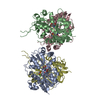
Movie
Movie Controller

[English] 日本語
 Yorodumi
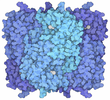
- PDB-9b64: GluA2 flip Q in complex with TARPgamma2 at pH5, class23, structur... -
+ Open data

- Basic information
| Entry | Database: PDB / ID: 9b64 | |||||||||||||||
|---|---|---|---|---|---|---|---|---|---|---|---|---|---|---|---|---|
| Title | GluA2 flip Q in complex with TARPgamma2 at pH5, class23, structure of LBD-TMD-TARPgamma2 | |||||||||||||||
 Components Components |
| |||||||||||||||
 Keywords Keywords | TRANSPORT PROTEIN / AMPA receptor / ionotropic glutamate receptor / ion channel / auxiliary subunit | |||||||||||||||
| Function / homology |  Function and homology information Function and homology informationPresynaptic depolarization and calcium channel opening / LGI-ADAM interactions / Trafficking of AMPA receptors / eye blink reflex / positive regulation of protein localization to basolateral plasma membrane / positive regulation of AMPA receptor activity / cerebellar mossy fiber / postsynaptic neurotransmitter receptor diffusion trapping / membrane hyperpolarization / regulation of AMPA receptor activity ...Presynaptic depolarization and calcium channel opening / LGI-ADAM interactions / Trafficking of AMPA receptors / eye blink reflex / positive regulation of protein localization to basolateral plasma membrane / positive regulation of AMPA receptor activity / cerebellar mossy fiber / postsynaptic neurotransmitter receptor diffusion trapping / membrane hyperpolarization / regulation of AMPA receptor activity / channel regulator activity / protein targeting to membrane / nervous system process / voltage-gated calcium channel complex / regulation of synaptic plasticity by chemical substance / spine synapse / dendritic spine neck / dendritic spine cytoplasm / dendritic spine head / cellular response to amine stimulus / Activation of AMPA receptors / neurotransmitter receptor localization to postsynaptic specialization membrane / ligand-gated monoatomic cation channel activity / perisynaptic space / Trafficking of GluR2-containing AMPA receptors / response to lithium ion / AMPA glutamate receptor activity / AMPA glutamate receptor clustering / regulation of receptor recycling / transmission of nerve impulse / neuromuscular junction development / kainate selective glutamate receptor activity / immunoglobulin binding / AMPA glutamate receptor complex / extracellularly glutamate-gated ion channel activity / ionotropic glutamate receptor complex / membrane depolarization / cellular response to glycine / asymmetric synapse / Unblocking of NMDA receptors, glutamate binding and activation / glutamate receptor binding / positive regulation of synaptic transmission / conditioned place preference / regulation of postsynaptic membrane neurotransmitter receptor levels / regulation of synaptic transmission, glutamatergic / voltage-gated calcium channel activity / response to fungicide / cytoskeletal protein binding / extracellular ligand-gated monoatomic ion channel activity / glutamate-gated receptor activity / cellular response to brain-derived neurotrophic factor stimulus / regulation of long-term synaptic depression / positive regulation of synaptic transmission, glutamatergic / glutamate-gated calcium ion channel activity / somatodendritic compartment / presynaptic active zone membrane / ionotropic glutamate receptor binding / ionotropic glutamate receptor signaling pathway / dendrite cytoplasm / excitatory synapse / ligand-gated monoatomic ion channel activity involved in regulation of presynaptic membrane potential / dendrite membrane / positive regulation of excitatory postsynaptic potential / hippocampal mossy fiber to CA3 synapse / dendritic shaft / SNARE binding / synaptic membrane / PDZ domain binding / establishment of protein localization / synaptic transmission, glutamatergic / protein tetramerization / long-term synaptic potentiation / receptor internalization / cerebral cortex development / transmitter-gated monoatomic ion channel activity involved in regulation of postsynaptic membrane potential / response to calcium ion / regulation of membrane potential / postsynaptic density membrane / modulation of chemical synaptic transmission / Schaffer collateral - CA1 synapse / terminal bouton / synaptic vesicle membrane / synaptic vesicle / presynapse / amyloid-beta binding / growth cone / signaling receptor activity / scaffold protein binding / presynaptic membrane / chemical synaptic transmission / dendritic spine / perikaryon / postsynaptic membrane / postsynaptic density / neuron projection / external side of plasma membrane / axon / neuronal cell body / synapse / dendrite Similarity search - Function | |||||||||||||||
| Biological species |   Mus musculus (house mouse) Mus musculus (house mouse) Rattus norvegicus (Norway rat) Rattus norvegicus (Norway rat) | |||||||||||||||
| Method | ELECTRON MICROSCOPY / single particle reconstruction / cryo EM / Resolution: 3.56 Å | |||||||||||||||
 Authors Authors | Nakagawa, T. / Greger, I.H. | |||||||||||||||
| Funding support |  United States, United States,  United Kingdom, 4items United Kingdom, 4items
| |||||||||||||||
 Citation Citation | Journal: Nat Struct Mol Biol / Year: 2024 Title: Proton-triggered rearrangement of the AMPA receptor N-terminal domains impacts receptor kinetics and synaptic localization. Authors: Josip Ivica / Nejc Kejzar / Hinze Ho / Imogen Stockwell / Viktor Kuchtiak / Alexander M Scrutton / Terunaga Nakagawa / Ingo H Greger /  Abstract: AMPA glutamate receptors (AMPARs) are ion channel tetramers that mediate the majority of fast excitatory synaptic transmission. They are composed of four subunits (GluA1-GluA4); the GluA2 subunit ...AMPA glutamate receptors (AMPARs) are ion channel tetramers that mediate the majority of fast excitatory synaptic transmission. They are composed of four subunits (GluA1-GluA4); the GluA2 subunit dominates AMPAR function throughout the forebrain. Its extracellular N-terminal domain (NTD) determines receptor localization at the synapse, ensuring reliable synaptic transmission and plasticity. This synaptic anchoring function requires a compact NTD tier, stabilized by a GluA2-specific NTD interface. Here we show that low pH conditions, which accompany synaptic activity, rupture this interface. All-atom molecular dynamics simulations reveal that protonation of an interfacial histidine residue (H208) centrally contributes to NTD rearrangement. Moreover, in stark contrast to their canonical compact arrangement at neutral pH, GluA2 cryo-electron microscopy structures exhibit a wide spectrum of NTD conformations under acidic conditions. We show that the consequences of this pH-dependent conformational control are twofold: rupture of the NTD tier slows recovery from desensitized states and increases receptor mobility at mouse hippocampal synapses. Therefore, a proton-triggered NTD switch will shape both AMPAR location and kinetics, thereby impacting synaptic signal transmission. | |||||||||||||||
| History |
|
- Structure visualization
| Structure viewer | Molecule: MolmilJmol/JSmol |
|---|
- Downloads & links
-Download
| PDBx/mmCIF format | 9b64.cif.gz | 452.6 KB | Display | PDBx/mmCIF format |
|---|---|---|---|---|
| PDB format | pdb9b64.ent.gz | 344.4 KB | Display | PDB format |
| PDBx/mmJSON format | 9b64.json.gz | Tree view | PDBx/mmJSON format | |
| Others |  Other downloads Other downloads |
-Validation report
| Arichive directory | https://data.pdbj.org/pub/pdb/validation_reports/b6/9b64ftp://data.pdbj.org/pub/pdb/validation_reports/b6/9b64 | HTTPS FTP |
|---|
-Related structure data
| Related structure data |  44245MC 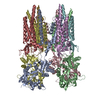 9b5zC 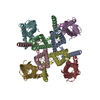 9b60C 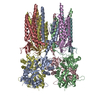 9b61C 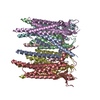 9b63C 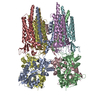 9b67C 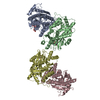 9b68C 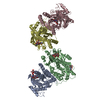 9b69C 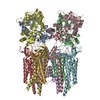 9b6aC C: citing same article ( M: map data used to model this data |
|---|---|
| Similar structure data |


-Links
 PDBj
PDBj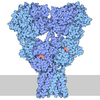
- Assembly
| Deposited unit | 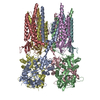
|
|---|---|
| 1 |
|
-Components
| #1: Protein | Mass: 35938.746 Da / Num. of mol.: 4 Source method: isolated from a genetically manipulated source Source: (gene. exp.) Mus musculus (house mouse) / Gene: Cacng2, Stg / Cell line (production host): HEK / Production host:  Homo sapiens (human) / References: UniProt: O88602 Homo sapiens (human) / References: UniProt: O88602#2: Protein | Mass: 99617.492 Da / Num. of mol.: 4 Source method: isolated from a genetically manipulated source Details: A FLAG epitope tag is inserted near the C-terminus / Source: (gene. exp.) Rattus norvegicus (Norway rat) / Gene: Gria2, Glur2 / Cell line (production host): HEK / Production host: Homo sapiens (human) / References: UniProt: P19491Has protein modification | Y | |
|---|
-Experimental details
-Experiment
| Experiment | Method: ELECTRON MICROSCOPY |
|---|---|
| EM experiment | Aggregation state: PARTICLE / 3D reconstruction method: single particle reconstruction |
- Sample preparation
| Component | Name: GluA2 (flip-Q isoform) in complex with TARPgamma2 at 4:4 stoichiometry Type: COMPLEX / Entity ID: all / Source: MULTIPLE SOURCES | ||||||||||||||||||||
|---|---|---|---|---|---|---|---|---|---|---|---|---|---|---|---|---|---|---|---|---|---|
| Molecular weight | Value: 0.5 MDa / Experimental value: NO | ||||||||||||||||||||
| Buffer solution | pH: 8 Details: Tris adjusted to pH 8 using HCl. 4 micro litter of protein in buffer was mixed with 1 micro litter of 50mM citric acid buffer (the 50mM citric acid buffer was prepared by diluting 0.5M ...Details: Tris adjusted to pH 8 using HCl. 4 micro litter of protein in buffer was mixed with 1 micro litter of 50mM citric acid buffer (the 50mM citric acid buffer was prepared by diluting 0.5M citric acid/sodium citrate buffer at pH4.0) immediately before applying the sample to the grid. | ||||||||||||||||||||
| Buffer component |
| ||||||||||||||||||||
| Specimen | Conc.: 10 mg/ml / Embedding applied: NO / Shadowing applied: NO / Staining applied: NO / Vitrification applied: YES | ||||||||||||||||||||
| Specimen support | Grid material: GOLD / Grid mesh size: 300 divisions/in. / Grid type: UltrAuFoil R1.2/1.3 | ||||||||||||||||||||
| Vitrification | Instrument: FEI VITROBOT MARK IV / Cryogen name: ETHANE / Humidity: 100 % / Chamber temperature: 277.15 K |
- Electron microscopy imaging
| Experimental equipment |  Model: Titan Krios / Image courtesy: FEI Company |
|---|---|
| Microscopy | Model: TFS KRIOS |
| Electron gun | Electron source:  FIELD EMISSION GUN / Accelerating voltage: 300 kV / Illumination mode: FLOOD BEAM FIELD EMISSION GUN / Accelerating voltage: 300 kV / Illumination mode: FLOOD BEAM |
| Electron lens | Mode: BRIGHT FIELD / Nominal defocus max: 2400 nm / Nominal defocus min: 1000 nm / Alignment procedure: COMA FREE |
| Specimen holder | Cryogen: NITROGEN |
| Image recording | Electron dose: 55.6 e/Å2 / Film or detector model: GATAN K3 BIOQUANTUM (6k x 4k) / Num. of grids imaged: 1 / Num. of real images: 19684 |
- Processing
| EM software |
| ||||||||||||||||||||||||||||||||||||||||
|---|---|---|---|---|---|---|---|---|---|---|---|---|---|---|---|---|---|---|---|---|---|---|---|---|---|---|---|---|---|---|---|---|---|---|---|---|---|---|---|---|---|
| CTF correction | Type: PHASE FLIPPING AND AMPLITUDE CORRECTION | ||||||||||||||||||||||||||||||||||||||||
| Particle selection | Details: Relion Autopick | ||||||||||||||||||||||||||||||||||||||||
| Symmetry | Point symmetry: C1 (asymmetric) | ||||||||||||||||||||||||||||||||||||||||
| 3D reconstruction | Resolution: 3.56 Å / Resolution method: FSC 0.143 CUT-OFF / Num. of particles: 29945 / Algorithm: FOURIER SPACE / Num. of class averages: 1 / Symmetry type: POINT | ||||||||||||||||||||||||||||||||||||||||
| Atomic model building | Space: REAL | ||||||||||||||||||||||||||||||||||||||||
| Atomic model building |
| ||||||||||||||||||||||||||||||||||||||||
| Refine LS restraints |
|