 Movie
Movie Controller


+ Open data

- Basic information
| Entry | Database: PDB / ID: 8zwo | |||||||||||||||||||||||||||
|---|---|---|---|---|---|---|---|---|---|---|---|---|---|---|---|---|---|---|---|---|---|---|---|---|---|---|---|---|
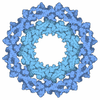
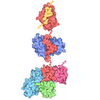
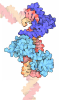
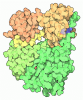
| Title | Structure of CTF18-PCNA with ATP | |||||||||||||||||||||||||||
 Components Components |
| |||||||||||||||||||||||||||
 Keywords Keywords | DNA BINDING PROTEIN / CTF18-RFC / human clamp loader / PCNA / sliding clamp / complex / ATP | |||||||||||||||||||||||||||
| Function / homology |  Function and homology information Function and homology informationpositive regulation of DNA-directed DNA polymerase activity / Elg1 RFC-like complex / DNA replication factor C complex / Ctf18 RFC-like complex / dinucleotide insertion or deletion binding / PCNA-p21 complex / mitotic telomere maintenance via semi-conservative replication / purine-specific mismatch base pair DNA N-glycosylase activity / DNA clamp loader activity / nuclear lamina ...positive regulation of DNA-directed DNA polymerase activity / Elg1 RFC-like complex / DNA replication factor C complex / Ctf18 RFC-like complex / dinucleotide insertion or deletion binding / PCNA-p21 complex / mitotic telomere maintenance via semi-conservative replication / purine-specific mismatch base pair DNA N-glycosylase activity / DNA clamp loader activity / nuclear lamina / Polymerase switching / Processive synthesis on the lagging strand / PCNA complex / DNA replication checkpoint signaling / replisome / Removal of the Flap Intermediate / MutLalpha complex binding / Telomere C-strand (Lagging Strand) Synthesis / Mismatch repair (MMR) directed by MSH2:MSH3 (MutSbeta) / Mismatch repair (MMR) directed by MSH2:MSH6 (MutSalpha) / Transcription of E2F targets under negative control by DREAM complex / Polymerase switching on the C-strand of the telomere / mitotic DNA replication / response to L-glutamate / Processive synthesis on the C-strand of the telomere / Removal of the Flap Intermediate from the C-strand / response to dexamethasone / DNA strand elongation involved in DNA replication / HDR through Single Strand Annealing (SSA) / histone acetyltransferase binding / DNA synthesis involved in DNA repair / leading strand elongation / DNA polymerase processivity factor activity / G1/S-Specific Transcription / Impaired BRCA2 binding to RAD51 / nuclear replication fork / SUMOylation of DNA replication proteins / PCNA-Dependent Long Patch Base Excision Repair / DNA repair-dependent chromatin remodeling / replication fork processing / response to cadmium ion / Presynaptic phase of homologous DNA pairing and strand exchange / ATP-dependent activity, acting on DNA / Activation of ATR in response to replication stress / estrous cycle / mismatch repair / cyclin-dependent protein kinase holoenzyme complex / DNA polymerase binding / epithelial cell differentiation / translesion synthesis / liver regeneration / TP53 Regulates Transcription of Genes Involved in G2 Cell Cycle Arrest / positive regulation of DNA replication / nuclear estrogen receptor binding / positive regulation of DNA repair / Translesion synthesis by REV1 / Translesion synthesis by POLK / Translesion synthesis by POLI / Gap-filling DNA repair synthesis and ligation in GG-NER / replication fork / Termination of translesion DNA synthesis / Translesion Synthesis by POLH / receptor tyrosine kinase binding / Recognition of DNA damage by PCNA-containing replication complex / G2/M DNA damage checkpoint / DNA-templated DNA replication / cellular response to hydrogen peroxide / HDR through Homologous Recombination (HRR) / Dual Incision in GG-NER / heart development / cellular response to UV / Dual incision in TC-NER / Gap-filling DNA repair synthesis and ligation in TC-NER / response to estradiol / E3 ubiquitin ligases ubiquitinate target proteins / Processing of DNA double-strand break ends / chromatin organization / Regulation of TP53 Activity through Phosphorylation / damaged DNA binding / chromosome, telomeric region / DNA replication / DNA repair / centrosome / chromatin binding / chromatin / protein-containing complex binding / enzyme binding / ATP hydrolysis activity / DNA binding / extracellular exosome / nucleoplasm / ATP binding / membrane / identical protein binding / nucleus / cytoplasm Similarity search - Function | |||||||||||||||||||||||||||
| Biological species |  Homo sapiens (human) Homo sapiens (human) | |||||||||||||||||||||||||||
| Method | ELECTRON MICROSCOPY / single particle reconstruction / cryo EM / Resolution: 2.99 Å | |||||||||||||||||||||||||||
 Authors Authors | Briola, G.R. / Tehseen, M. / Al-Amodi, A. / Nguyen, P.Q. / Savva, C.G. / Hamdan, S.M. / De Biasio, A. | |||||||||||||||||||||||||||
| Funding support |  Saudi Arabia, 1items Saudi Arabia, 1items
| |||||||||||||||||||||||||||
 Citation Citation | Journal: Elife / Year: 2026 Title: Structure of the human CTF18-RFC clamp loader bound to PCNA. Authors: Giuseppina R Briola / Mohammad Tehseen / Amani Al-Amodi / Grace Young / Ammar U Danazumi / Phong Quoc Nguyen / Christos G Savva / Mark Hedglin / Samir M Hamdan / Alfredo De Biasio /  Abstract: Sliding clamps like PCNA are crucial processivity factors for replicative polymerases, requiring specific clamp loaders for loading onto DNA. The human alternative clamp loader CTF18-RFC interacts ...Sliding clamps like PCNA are crucial processivity factors for replicative polymerases, requiring specific clamp loaders for loading onto DNA. The human alternative clamp loader CTF18-RFC interacts with the leading strand polymerase Pol ε and loads PCNA onto primer/template DNA using its RFC pentameric module. Here, we provide a structural characterization of the human CTF18-RFC complex and its interaction with PCNA. Our cryo-EM data support that the Ctf8 and Dcc1 subunits of CTF18-RFC, which form the regulatory module interacting with Pol ε, are flexibly tethered to the RFC module. A 2.9 Å cryo-EM structure shows the RFC module bound to PCNA in an autoinhibited conformation similar to the canonical RFC loader, marking the initial step of the clamp-loading reaction. The unique RFC1 (Ctf18) large subunit of CTF18-RFC, which based on the cryo-EM map shows high relative flexibility, is anchored to PCNA through an atypical low-affinity PIP box in the AAA+ domain and engages the RFC5 subunit using a novel β-hairpin at the disordered N-terminus. We show that deletion of this β-hairpin impairs the CTF18-RFC-PCNA complex stability, slows down clamp loading, and decreases the rate of primer synthesis by Pol ε. Our research identifies distinctive structural characteristics of the human CTF18-RFC complex, providing insights into its role in PCNA loading and the stimulation of leading strand synthesis by Pol ε. #1: Journal: bioRxiv / Year: 2025 Title: Structure of the human CTF18-RFC clamp loader bound to PCNA. Authors: Giuseppina R Briola / Muhammad Tehseen / Amani Al-Amodi / Grace Young / Ammar U Danazumi / Phong Quoc Nguyen / Christos G Savva / Mark Hedglin / Samir M Hamdan / Alfredo De Biasio / Abstract: Sliding clamps like PCNA are crucial processivity factors for replicative polymerases, requiring specific clamp loaders for loading onto DNA. The human alternative clamp loader CTF18-RFC interacts ...Sliding clamps like PCNA are crucial processivity factors for replicative polymerases, requiring specific clamp loaders for loading onto DNA. The human alternative clamp loader CTF18-RFC interacts with the leading strand polymerase Pol ε and loads PCNA onto primer/template DNA using its RFC pentameric module. Here, we provide a structural characterization of the human CTF18-RFC complex and its interaction with PCNA. Our cryo-EM data support that the Ctf8 and Dcc1 subunits of CTF18-RFC, which form the regulatory module interacting with Pol ε, are flexibly tethered to the RFC module. A 2.9 Å cryo-EM structure shows the RFC module bound to PCNA in an autoinhibited conformation similar to the canonical RFC loader, marking the initial step of the clamp-loading reaction. The unique RFC1 (Ctf18) large subunit of CTF18-RFC, which based on the cryo-EM map shows high relative flexibility, is anchored to PCNA through an atypical low-affinity PIP box in the AAA+ domain and engages the RFC5 subunit using a novel β-hairpin at the disordered N-terminus. We show that deletion of this β-hairpin impairs the CTF18-RFC-PCNA complex stability, slows down clamp loading, and decreases the rate of primer synthesis by Pol ε. Our research identifies distinctive structural characteristics of the human CTF18-RFC complex, providing insights into its role in PCNA loading and the stimulation of leading strand synthesis by Pol ε. | |||||||||||||||||||||||||||
| History |
|
- Structure visualization
| Structure viewer | Molecule: MolmilJmol/JSmol |
|---|
- Downloads & links
-Download
| PDBx/mmCIF format | 8zwo.cif.gz | 459.4 KB | Display | PDBx/mmCIF format |
|---|---|---|---|---|
| PDB format | pdb8zwo.ent.gz | 360.9 KB | Display | PDB format |
| PDBx/mmJSON format | 8zwo.json.gz | Tree view | PDBx/mmJSON format | |
| Others |  Other downloads Other downloads |
-Validation report
| Arichive directory | https://data.pdbj.org/pub/pdb/validation_reports/zw/8zwoftp://data.pdbj.org/pub/pdb/validation_reports/zw/8zwo | HTTPS FTP |
|---|
-Related structure data
| Related structure data |  60534MC  9iinC M: map data used to model this data C: citing same article ( |
|---|---|
| Similar structure data |

-Links
 PDBj
PDBj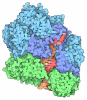


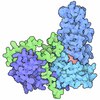
- Assembly
| Deposited unit | 
|
|---|---|
| 1 |
|
-Components
-Protein , 2 types, 4 molecules AFGH
| #1: Protein | Mass: 111407.070 Da / Num. of mol.: 1 Source method: isolated from a genetically manipulated source Details: 8ZWO: -35 INITIAL M 8ZWO: from -34 to 0 is the expression tag Source: (gene. exp.) Homo sapiens (human) / Gene: CHTF18, C16orf41, CTF18 / Production host:   Spodoptera frugiperda (fall armyworm) / References: UniProt: Q8WVB6 Spodoptera frugiperda (fall armyworm) / References: UniProt: Q8WVB6 |
|---|---|
| #6: Protein | Mass: 29617.672 Da / Num. of mol.: 3 Source method: isolated from a genetically manipulated source Details: 8ZWO: M -5, initiation metihionine 8ZWO: -4 to 0, expression tag Source: (gene. exp.) Homo sapiens (human) / Gene: PCNA / Production host:   Escherichia coli (E. coli) / References: UniProt: P12004 Escherichia coli (E. coli) / References: UniProt: P12004 |
-Replication factor C subunit ... , 4 types, 4 molecules BCDE
| #2: Protein | Mass: 39203.207 Da / Num. of mol.: 1 Source method: isolated from a genetically manipulated source Source: (gene. exp.) Homo sapiens (human) / Gene: RFC2 / Production host: Spodoptera frugiperda (fall armyworm) / References: UniProt: P35250 |
|---|---|
| #3: Protein | Mass: 38545.512 Da / Num. of mol.: 1 Source method: isolated from a genetically manipulated source Details: 8ZWO: M-5 INITIATING METHIONINE 8ZWO: from -4 to 0 is the expression tag Source: (gene. exp.) Homo sapiens (human) / Gene: RFC5 / Production host: Spodoptera frugiperda (fall armyworm) / References: UniProt: P40937 |
| #4: Protein | Mass: 39735.711 Da / Num. of mol.: 1 Source method: isolated from a genetically manipulated source Source: (gene. exp.) Homo sapiens (human) / Gene: RFC4 / Production host: Spodoptera frugiperda (fall armyworm) / References: UniProt: P35249 |
| #5: Protein | Mass: 41436.258 Da / Num. of mol.: 1 Source method: isolated from a genetically manipulated source Source: (gene. exp.) Homo sapiens (human) / Gene: RFC3 / Production host: Spodoptera frugiperda (fall armyworm) / References: UniProt: P40938 |
-Non-polymers , 2 types, 4 molecules 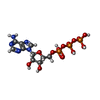
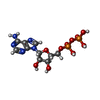
| #7: Chemical | 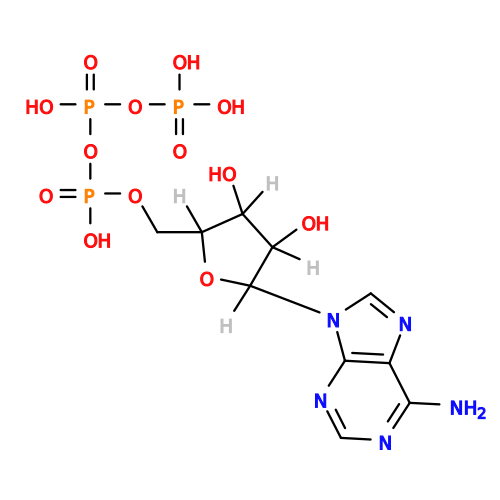 Mass: 507.181 Da / Num. of mol.: 3 / Source method: obtained synthetically / Formula: C10H16N5O13P3 / Feature type: SUBJECT OF INVESTIGATION / Comment: ATP, energy-carrying molecule*YM Mass: 507.181 Da / Num. of mol.: 3 / Source method: obtained synthetically / Formula: C10H16N5O13P3 / Feature type: SUBJECT OF INVESTIGATION / Comment: ATP, energy-carrying molecule*YM#8: Chemical | ChemComp-ADP / | 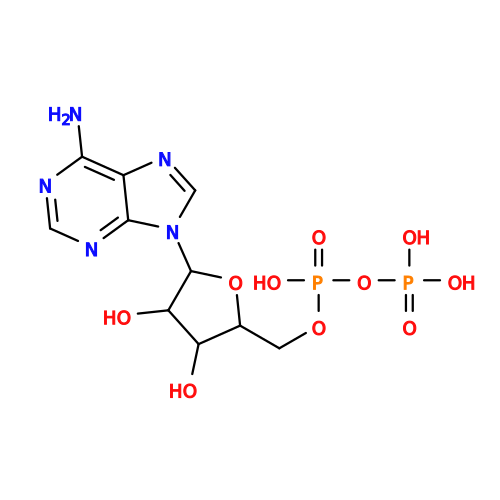 Mass: 427.201 Da / Num. of mol.: 1 / Source method: obtained synthetically / Formula: C10H15N5O10P2 / Feature type: SUBJECT OF INVESTIGATION / Comment: ADP, energy-carrying molecule*YM Mass: 427.201 Da / Num. of mol.: 1 / Source method: obtained synthetically / Formula: C10H15N5O10P2 / Feature type: SUBJECT OF INVESTIGATION / Comment: ADP, energy-carrying molecule*YM |
|---|
-Details
| Has ligand of interest | Y |
|---|---|
| Has protein modification | N |
-Experimental details
-Experiment
| Experiment | Method: ELECTRON MICROSCOPY |
|---|---|
| EM experiment | Aggregation state: PARTICLE / 3D reconstruction method: single particle reconstruction |
- Sample preparation
| Component | Name: CTF18-PCNA / Type: COMPLEX / Details: CTF18 in complex with PCNA, in presence of ATP / Entity ID: #1-#6 / Source: RECOMBINANT |
|---|---|
| Molecular weight | Value: 0.323 MDa / Experimental value: NO |
| Source (natural) | Organism: Homo sapiens (human) |
| Source (recombinant) | Organism: Spodoptera frugiperda (fall armyworm) |
| Buffer solution | pH: 7.5 / Details: 50 mM Tris-HCl, 200 mM NaCl, 1 mM DTT |
| Specimen | Embedding applied: NO / Shadowing applied: NO / Staining applied: NO / Vitrification applied: YES |
| Specimen support | Details: 30 mA / Grid material: GOLD / Grid mesh size: 300 divisions/in. / Grid type: UltrAuFoil R1.2/1.3 |
| Vitrification | Instrument: FEI VITROBOT MARK IV / Cryogen name: ETHANE / Humidity: 100 % / Chamber temperature: 277 K |
- Electron microscopy imaging
| Experimental equipment |  Model: Titan Krios / Image courtesy: FEI Company |
|---|---|
| Microscopy | Model: TFS KRIOS |
| Electron gun | Electron source:  FIELD EMISSION GUN / Accelerating voltage: 300 kV / Illumination mode: FLOOD BEAM FIELD EMISSION GUN / Accelerating voltage: 300 kV / Illumination mode: FLOOD BEAM |
| Electron lens | Mode: BRIGHT FIELD / Nominal magnification: 130000 X / Nominal defocus max: 2700 nm / Nominal defocus min: 1500 nm / Cs: 2.7 mm / C2 aperture diameter: 50 µm / Alignment procedure: ZEMLIN TABLEAU |
| Specimen holder | Cryogen: NITROGEN / Specimen holder model: FEI TITAN KRIOS AUTOGRID HOLDER / Temperature (min): 83 K |
| Image recording | Average exposure time: 5 sec. / Electron dose: 43 e/Å2 / Film or detector model: FEI FALCON IV (4k x 4k) / Num. of grids imaged: 1 / Num. of real images: 7907 |
| EM imaging optics | Energyfilter name: TFS Selectris X / Energyfilter slit width: 10 eV |
| Image scans | Sampling size: 14 µm / Width: 4096 / Height: 4096 |
- Processing
| EM software |
| ||||||||||||||||||||||||||||||||||||
|---|---|---|---|---|---|---|---|---|---|---|---|---|---|---|---|---|---|---|---|---|---|---|---|---|---|---|---|---|---|---|---|---|---|---|---|---|---|
| CTF correction | Type: PHASE FLIPPING AND AMPLITUDE CORRECTION | ||||||||||||||||||||||||||||||||||||
| Particle selection | Num. of particles selected: 2043120 | ||||||||||||||||||||||||||||||||||||
| Symmetry | Point symmetry: C1 (asymmetric) | ||||||||||||||||||||||||||||||||||||
| 3D reconstruction | Resolution: 2.99 Å / Resolution method: FSC 0.143 CUT-OFF / Num. of particles: 527527 / Num. of class averages: 2 / Symmetry type: POINT | ||||||||||||||||||||||||||||||||||||
| Atomic model building | Protocol: RIGID BODY FIT / Space: REAL | ||||||||||||||||||||||||||||||||||||
| Atomic model building | PDB-ID: 6VVO Accession code: 6VVO / Source name: PDB / Type: experimental model | ||||||||||||||||||||||||||||||||||||
| Refine LS restraints |
|

