 Movie
Movie Controller


+ Open data

- Basic information
| Entry | Database: PDB / ID: 8z3y | ||||||||||||||||||||||||
|---|---|---|---|---|---|---|---|---|---|---|---|---|---|---|---|---|---|---|---|---|---|---|---|---|---|
| Title | Cryo-EM structure of of hGPR4-Gs complex in pH6.8 | ||||||||||||||||||||||||
 Components Components |
| ||||||||||||||||||||||||
 Keywords Keywords | MEMBRANE PROTEIN/IMMUNE SYSTEM / pH6.8 / hGPR4 / MEMBRANE PROTEIN / MEMBRANE PROTEIN-IMMUNE SYSTEM complex | ||||||||||||||||||||||||
| Function / homology |  Function and homology information Function and homology informationregulation of vascular permeability / Class A/1 (Rhodopsin-like receptors) / response to acidic pH / positive regulation of Rho protein signal transduction / regulation of cell adhesion / cellular response to acidic pH / G protein-coupled receptor activity / positive regulation of inflammatory response / phospholipase C-activating G protein-coupled receptor signaling pathway / Olfactory Signaling Pathway ...regulation of vascular permeability / Class A/1 (Rhodopsin-like receptors) / response to acidic pH / positive regulation of Rho protein signal transduction / regulation of cell adhesion / cellular response to acidic pH / G protein-coupled receptor activity / positive regulation of inflammatory response / phospholipase C-activating G protein-coupled receptor signaling pathway / Olfactory Signaling Pathway / Activation of the phototransduction cascade / G protein-coupled acetylcholine receptor signaling pathway / G beta:gamma signalling through PLC beta / Presynaptic function of Kainate receptors / Thromboxane signalling through TP receptor / Activation of G protein gated Potassium channels / Inhibition of voltage gated Ca2+ channels via Gbeta/gamma subunits / G-protein activation / Glucagon signaling in metabolic regulation / G beta:gamma signalling through CDC42 / Prostacyclin signalling through prostacyclin receptor / Synthesis, secretion, and inactivation of Glucagon-like Peptide-1 (GLP-1) / G beta:gamma signalling through BTK / photoreceptor disc membrane / ADP signalling through P2Y purinoceptor 12 / Glucagon-type ligand receptors / Sensory perception of sweet, bitter, and umami (glutamate) taste / Adrenaline,noradrenaline inhibits insulin secretion / Vasopressin regulates renal water homeostasis via Aquaporins / Glucagon-like Peptide-1 (GLP1) regulates insulin secretion / G alpha (z) signalling events / cellular response to catecholamine stimulus / ADP signalling through P2Y purinoceptor 1 / G beta:gamma signalling through PI3Kgamma / ADORA2B mediated anti-inflammatory cytokines production / adenylate cyclase-activating dopamine receptor signaling pathway / cellular response to prostaglandin E stimulus / Cooperation of PDCL (PhLP1) and TRiC/CCT in G-protein beta folding / GPER1 signaling / heterotrimeric G-protein complex / Inactivation, recovery and regulation of the phototransduction cascade / G alpha (12/13) signalling events / G-protein beta-subunit binding / extracellular vesicle / Thrombin signalling through proteinase activated receptors (PARs) / signaling receptor complex adaptor activity / adenylate cyclase-activating G protein-coupled receptor signaling pathway / GTPase binding / Ca2+ pathway / High laminar flow shear stress activates signaling by PIEZO1 and PECAM1:CDH5:KDR in endothelial cells / G alpha (i) signalling events / G alpha (s) signalling events / G alpha (q) signalling events / Ras protein signal transduction / Extra-nuclear estrogen signaling / G protein-coupled receptor signaling pathway / lysosomal membrane / GTPase activity / synapse / protein-containing complex binding / signal transduction / extracellular exosome / membrane / plasma membrane / cytosol / cytoplasm Similarity search - Function | ||||||||||||||||||||||||
| Biological species |  Homo sapiens (human) Homo sapiens (human)synthetic construct (others) | ||||||||||||||||||||||||
| Method | ELECTRON MICROSCOPY / single particle reconstruction / cryo EM / Resolution: 3.2 Å | ||||||||||||||||||||||||
 Authors Authors | Zhong, Y.N. / Guo, L.L. | ||||||||||||||||||||||||
| Funding support |  China, 1items China, 1items
| ||||||||||||||||||||||||
 Citation Citation | Journal: Mol Cell / Year: 2025 Title: Structural basis and biased signaling of proton sensation by GPCRs mediated by extracellular histidine rearrangement. Authors: Lulu Guo / Kongkai Zhu / Ya-Ni Zhong / Mingxin Gao / Junyan Liu / Zhimin Qi / Zili Liu / Naikang Rong / Minghui Zhang / Dongfang Li / Qiyue Zhang / Gongming Yang / Xinxin Zhang / Mingyue ...Authors: Lulu Guo / Kongkai Zhu / Ya-Ni Zhong / Mingxin Gao / Junyan Liu / Zhimin Qi / Zili Liu / Naikang Rong / Minghui Zhang / Dongfang Li / Qiyue Zhang / Gongming Yang / Xinxin Zhang / Mingyue Zhang / Ning Ding / Yu-Qi Ping / Zhao Yang / Peng Xiao / Ming Xia / Xiao Yu / Alatan Gaole / Jin-Peng Sun / Fan Yang / Abstract: Proton sensing by G protein-coupled receptors (GPCRs) is crucial in many life activities. However, its underlying mechanism remains unclear. Here, we report 8 cryoelectron microscopy (cryo-EM) ...Proton sensing by G protein-coupled receptors (GPCRs) is crucial in many life activities. However, its underlying mechanism remains unclear. Here, we report 8 cryoelectron microscopy (cryo-EM) structures of human GPR4 and GPR68 at different pH values and in complex with Gs or Gq trimers or in apo state. Structural inspection, structure-based pKa calculations, and mutational and computational analyses revealed that protonation of two conserved extracellular histidines induced polar network formation and other conformational changes to tether 7-transmembrane (TM7) to second extracellular loop (ECL2), and these changes constitute the central mechanisms of proton-induced activation of GPR4 and GPR68. Unexpectedly, proton sensation by specific extracellular histidine determined biased G protein coupling of GPR4. Moreover, GPR68's additional pH-sensing H84 enhances its function in a more acidic optimal pH range. The propagation path connecting proton-sensing histidines to the toggle switch was characterized. Collectively, we provide structural insights into the proton sensing, activation, and downstream effector coupling mechanisms of proton-sensing GPCRs. | ||||||||||||||||||||||||
| History |
|
- Structure visualization
| Structure viewer | Molecule: MolmilJmol/JSmol |
|---|
- Downloads & links
-Download
| PDBx/mmCIF format | 8z3y.cif.gz | 230 KB | Display | PDBx/mmCIF format |
|---|---|---|---|---|
| PDB format | pdb8z3y.ent.gz | 173.3 KB | Display | PDB format |
| PDBx/mmJSON format | 8z3y.json.gz | Tree view | PDBx/mmJSON format | |
| Others |  Other downloads Other downloads |
-Validation report
| Arichive directory | https://data.pdbj.org/pub/pdb/validation_reports/z3/8z3yftp://data.pdbj.org/pub/pdb/validation_reports/z3/8z3y | HTTPS FTP |
|---|
-Related structure data
| Related structure data |  39757MC M: map data used to model this data C: citing same article ( |
|---|---|
| Similar structure data |
-Links
 PDBj
PDBj

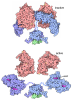


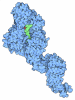


- Assembly
| Deposited unit | 
|
|---|---|
| 1 |
|
-Components
| #1: Protein | Mass: 41879.465 Da / Num. of mol.: 1 Source method: isolated from a genetically manipulated source Source: (gene. exp.) Homo sapiens (human) / Production host:   Spodoptera frugiperda (fall armyworm) Spodoptera frugiperda (fall armyworm) |
|---|---|
| #2: Protein | Mass: 41055.867 Da / Num. of mol.: 1 Source method: isolated from a genetically manipulated source Source: (gene. exp.) Homo sapiens (human) / Gene: GNB1 / Production host: Spodoptera frugiperda (fall armyworm) / References: UniProt: P62873 |
| #3: Protein | Mass: 6504.446 Da / Num. of mol.: 1 Source method: isolated from a genetically manipulated source Source: (gene. exp.) Homo sapiens (human) / Gene: GNG2 / Production host: Spodoptera frugiperda (fall armyworm) / References: UniProt: P59768 |
| #4: Antibody | Mass: 30363.043 Da / Num. of mol.: 1 Source method: isolated from a genetically manipulated source Source: (gene. exp.) synthetic construct (others) / Production host: Spodoptera frugiperda (fall armyworm) |
| #5: Protein | Mass: 41026.664 Da / Num. of mol.: 1 Source method: isolated from a genetically manipulated source Source: (gene. exp.) Homo sapiens (human) / Gene: GPR4 / Production host: Spodoptera frugiperda (fall armyworm) / References: UniProt: P46093 |
| Has protein modification | Y |
-Experimental details
-Experiment
| Experiment | Method: ELECTRON MICROSCOPY |
|---|---|
| EM experiment | Aggregation state: PARTICLE / 3D reconstruction method: single particle reconstruction |
- Sample preparation
| Component | Name: Cryo-EM structure of the hGPR4-Gs complex in pH6.8 / Type: COMPLEX / Entity ID: all / Source: RECOMBINANT |
|---|---|
| Source (natural) | Organism: Homo sapiens (human) |
| Source (recombinant) | Organism: Spodoptera frugiperda (fall armyworm) |
| Buffer solution | pH: 6.8 |
| Specimen | Embedding applied: NO / Shadowing applied: NO / Staining applied: NO / Vitrification applied: YES |
| Vitrification | Cryogen name: ETHANE |
- Electron microscopy imaging
| Experimental equipment |  Model: Titan Krios / Image courtesy: FEI Company |
|---|---|
| Microscopy | Model: FEI TITAN KRIOS |
| Electron gun | Electron source:  FIELD EMISSION GUN / Accelerating voltage: 300 kV / Illumination mode: FLOOD BEAM FIELD EMISSION GUN / Accelerating voltage: 300 kV / Illumination mode: FLOOD BEAM |
| Electron lens | Mode: DIFFRACTION / Nominal defocus max: 1500 nm / Nominal defocus min: 1000 nm |
| Image recording | Electron dose: 1.875 e/Å2 / Film or detector model: GATAN K3 (6k x 4k) |
- Processing
| EM software | Name: PHENIX / Version: 1.18.2_3874: / Category: model refinement | ||||||||||||||||||||||||
|---|---|---|---|---|---|---|---|---|---|---|---|---|---|---|---|---|---|---|---|---|---|---|---|---|---|
| CTF correction | Type: NONE | ||||||||||||||||||||||||
| 3D reconstruction | Resolution: 3.2 Å / Resolution method: FSC 0.143 CUT-OFF / Num. of particles: 282290 / Symmetry type: POINT | ||||||||||||||||||||||||
| Refine LS restraints |
|
