 Movie
Movie Controller


+ Open data

- Basic information
| Entry |  | |||||||||
|---|---|---|---|---|---|---|---|---|---|---|
| Title | Cryo-EM structure of of hGPR4-Gs complex in pH6.8 | |||||||||
 Map data Map data | ||||||||||
 Sample Sample |
| |||||||||
 Keywords Keywords | pH6.8 / hGPR4 / MEMBRANE PROTEIN / MEMBRANE PROTEIN-IMMUNE SYSTEM complex | |||||||||
| Function / homology |  Function and homology information Function and homology informationregulation of vascular permeability / Class A/1 (Rhodopsin-like receptors) / response to acidic pH / positive regulation of Rho protein signal transduction / regulation of cell adhesion / cellular response to acidic pH / G protein-coupled receptor activity / positive regulation of inflammatory response / Olfactory Signaling Pathway / phospholipase C-activating G protein-coupled receptor signaling pathway ...regulation of vascular permeability / Class A/1 (Rhodopsin-like receptors) / response to acidic pH / positive regulation of Rho protein signal transduction / regulation of cell adhesion / cellular response to acidic pH / G protein-coupled receptor activity / positive regulation of inflammatory response / Olfactory Signaling Pathway / phospholipase C-activating G protein-coupled receptor signaling pathway / Activation of the phototransduction cascade / G protein-coupled acetylcholine receptor signaling pathway / G beta:gamma signalling through PLC beta / Presynaptic function of Kainate receptors / Thromboxane signalling through TP receptor / Activation of G protein gated Potassium channels / Inhibition of voltage gated Ca2+ channels via Gbeta/gamma subunits / G-protein activation / Glucagon signaling in metabolic regulation / G beta:gamma signalling through CDC42 / Prostacyclin signalling through prostacyclin receptor / Synthesis, secretion, and inactivation of Glucagon-like Peptide-1 (GLP-1) / photoreceptor disc membrane / G beta:gamma signalling through BTK / ADP signalling through P2Y purinoceptor 12 / Sensory perception of sweet, bitter, and umami (glutamate) taste / Glucagon-type ligand receptors / Adrenaline,noradrenaline inhibits insulin secretion / Vasopressin regulates renal water homeostasis via Aquaporins / G alpha (z) signalling events / Glucagon-like Peptide-1 (GLP1) regulates insulin secretion / ADP signalling through P2Y purinoceptor 1 / cellular response to catecholamine stimulus / G beta:gamma signalling through PI3Kgamma / ADORA2B mediated anti-inflammatory cytokines production / adenylate cyclase-activating dopamine receptor signaling pathway / cellular response to prostaglandin E stimulus / Cooperation of PDCL (PhLP1) and TRiC/CCT in G-protein beta folding / GPER1 signaling / heterotrimeric G-protein complex / G alpha (12/13) signalling events / Inactivation, recovery and regulation of the phototransduction cascade / G-protein beta-subunit binding / extracellular vesicle / Thrombin signalling through proteinase activated receptors (PARs) / adenylate cyclase-activating G protein-coupled receptor signaling pathway / signaling receptor complex adaptor activity / GTPase binding / Ca2+ pathway / High laminar flow shear stress activates signaling by PIEZO1 and PECAM1:CDH5:KDR in endothelial cells / G alpha (i) signalling events / G alpha (s) signalling events / G alpha (q) signalling events / Ras protein signal transduction / Extra-nuclear estrogen signaling / G protein-coupled receptor signaling pathway / lysosomal membrane / GTPase activity / synapse / protein-containing complex binding / signal transduction / extracellular exosome / membrane / plasma membrane / cytosol Similarity search - Function | |||||||||
| Biological species |  Homo sapiens (human) / synthetic construct (others) Homo sapiens (human) / synthetic construct (others) | |||||||||
| Method | single particle reconstruction / cryo EM / Resolution: 3.2 Å | |||||||||
 Authors Authors | Zhong YN / Guo LL | |||||||||
| Funding support |  China, 1 items China, 1 items
| |||||||||
 Citation Citation | Journal: Mol Cell / Year: 2025 Title: Structural basis and biased signaling of proton sensation by GPCRs mediated by extracellular histidine rearrangement. Authors: Lulu Guo / Kongkai Zhu / Ya-Ni Zhong / Mingxin Gao / Junyan Liu / Zhimin Qi / Zili Liu / Naikang Rong / Minghui Zhang / Dongfang Li / Qiyue Zhang / Gongming Yang / Xinxin Zhang / Mingyue ...Authors: Lulu Guo / Kongkai Zhu / Ya-Ni Zhong / Mingxin Gao / Junyan Liu / Zhimin Qi / Zili Liu / Naikang Rong / Minghui Zhang / Dongfang Li / Qiyue Zhang / Gongming Yang / Xinxin Zhang / Mingyue Zhang / Ning Ding / Yu-Qi Ping / Zhao Yang / Peng Xiao / Ming Xia / Xiao Yu / Alatan Gaole / Jin-Peng Sun / Fan Yang / Abstract: Proton sensing by G protein-coupled receptors (GPCRs) is crucial in many life activities. However, its underlying mechanism remains unclear. Here, we report 8 cryoelectron microscopy (cryo-EM) ...Proton sensing by G protein-coupled receptors (GPCRs) is crucial in many life activities. However, its underlying mechanism remains unclear. Here, we report 8 cryoelectron microscopy (cryo-EM) structures of human GPR4 and GPR68 at different pH values and in complex with Gs or Gq trimers or in apo state. Structural inspection, structure-based pKa calculations, and mutational and computational analyses revealed that protonation of two conserved extracellular histidines induced polar network formation and other conformational changes to tether 7-transmembrane (TM7) to second extracellular loop (ECL2), and these changes constitute the central mechanisms of proton-induced activation of GPR4 and GPR68. Unexpectedly, proton sensation by specific extracellular histidine determined biased G protein coupling of GPR4. Moreover, GPR68's additional pH-sensing H84 enhances its function in a more acidic optimal pH range. The propagation path connecting proton-sensing histidines to the toggle switch was characterized. Collectively, we provide structural insights into the proton sensing, activation, and downstream effector coupling mechanisms of proton-sensing GPCRs. | |||||||||
| History |
|
- Structure visualization
| Supplemental images |
|---|

- Downloads & links
-EMDB archive
| Map data | emd_39757.map.gz | 110.7 MB | EMDB map data format | |
|---|---|---|---|---|
| Header (meta data) | emd-39757-v30.xmlemd-39757.xml | 23.7 KB 23.7 KB | Display Display | EMDB header |
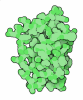
| Images |  emd_39757.png emd_39757.png | 94.7 KB | ||
| Filedesc metadata | emd-39757.cif.gz | 7 KB | ||
| Others | emd_39757_half_map_1.map.gzemd_39757_half_map_2.map.gz | 115.9 MB 115.9 MB | ||
| Archive directory |  https://data.pdbj.org/pub/emdb/structures/EMD-39757ftp://data.pdbj.org/pub/emdb/structures/EMD-39757 https://data.pdbj.org/pub/emdb/structures/EMD-39757ftp://data.pdbj.org/pub/emdb/structures/EMD-39757 | HTTPS FTP |
-Related structure data
| Related structure data |  8z3yMC M: atomic model generated by this map C: citing same article ( |
|---|---|
| Similar structure data |
-Links
| EMDB pages | EMDB (EBI/PDBe) / EMDataResource |
|---|---|
| Related items in Molecule of the Month |
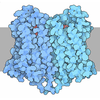
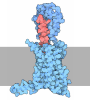
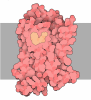
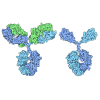




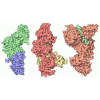
-Map
| File | Download / File: emd_39757.map.gz / Format: CCP4 / Size: 125 MB / Type: IMAGE STORED AS FLOATING POINT NUMBER (4 BYTES) | ||||||||||||||||||||||||||||||||||||
|---|---|---|---|---|---|---|---|---|---|---|---|---|---|---|---|---|---|---|---|---|---|---|---|---|---|---|---|---|---|---|---|---|---|---|---|---|---|
| Projections & slices | Image control
Images are generated by Spider. | ||||||||||||||||||||||||||||||||||||
| Voxel size | X=Y=Z: 0.74 Å | ||||||||||||||||||||||||||||||||||||
| Density |
| ||||||||||||||||||||||||||||||||||||
| Symmetry | Space group: 1 | ||||||||||||||||||||||||||||||||||||
| Details | EMDB XML:
|
 Z (Sec.)
 Y (Row.)
 X (Col.)






-Supplemental data
-Half map: #2
| File | emd_39757_half_map_1.map | ||||||||||||
|---|---|---|---|---|---|---|---|---|---|---|---|---|---|
| Projections & Slices |
| ||||||||||||
| Density Histograms |


-Half map: #1
| File | emd_39757_half_map_2.map | ||||||||||||
|---|---|---|---|---|---|---|---|---|---|---|---|---|---|
| Projections & Slices |
| ||||||||||||
| Density Histograms |




- Sample components
-Entire : Cryo-EM structure of the hGPR4-Gs complex in pH6.8
| Entire | Name: Cryo-EM structure of the hGPR4-Gs complex in pH6.8 |
|---|---|
| Components |
|
-Supramolecule #1: Cryo-EM structure of the hGPR4-Gs complex in pH6.8
| Supramolecule | Name: Cryo-EM structure of the hGPR4-Gs complex in pH6.8 / type: complex / ID: 1 / Parent: 0 / Macromolecule list: all |
|---|---|
| Source (natural) | Organism: Homo sapiens (human) |
-Macromolecule #1: Guanine nucleotide-binding protein G(s) subunit alpha isoforms short
| Macromolecule | Name: Guanine nucleotide-binding protein G(s) subunit alpha isoforms short type: protein_or_peptide / ID: 1 / Number of copies: 1 / Enantiomer: LEVO |
|---|---|
| Source (natural) | Organism: Homo sapiens (human) |
| Molecular weight | Theoretical: 41.879465 KDa |
| Recombinant expression | Organism:   Spodoptera frugiperda (fall armyworm) Spodoptera frugiperda (fall armyworm) |
| Sequence | String: MGCTLSAEDK AAVERSKMIE KQLQKDKQVY RATHRLLLLG ADNSGKSTIV KQMRIYHVNG YSEEECKQYK AVVYSNTIQS IIAIIRAMG RLKIDFGDSA RADDARQLFV LAGAAEEGFM TAELAGVIKR LWKDSGVQAC FNRSREYQLN DSAAYYLNDL D RIAQPNYI ...String: MGCTLSAEDK AAVERSKMIE KQLQKDKQVY RATHRLLLLG ADNSGKSTIV KQMRIYHVNG YSEEECKQYK AVVYSNTIQS IIAIIRAMG RLKIDFGDSA RADDARQLFV LAGAAEEGFM TAELAGVIKR LWKDSGVQAC FNRSREYQLN DSAAYYLNDL D RIAQPNYI PTQQDVLRTR VKTSGIFETK FQVDKVNFHM FDVGAQRDER RKWIQCFNDV TAIIFVVDSS DYNRLQEALN DF KSIWNNR WLRTISVILF LNKQDLLAEK VLAGKSKIED YFPEFARYTT PEDATPEPGE DPRVTRAKYF IRDEFLRIST ASG DGRHYC YPHFTCSVDT ENARRIFNDC RDIIQRMHLR QYELL |
-Macromolecule #2: Guanine nucleotide-binding protein G(I)/G(S)/G(T) subunit beta-1
| Macromolecule | Name: Guanine nucleotide-binding protein G(I)/G(S)/G(T) subunit beta-1 type: protein_or_peptide / ID: 2 / Number of copies: 1 / Enantiomer: LEVO |
|---|---|
| Source (natural) | Organism: Homo sapiens (human) |
| Molecular weight | Theoretical: 41.055867 KDa |
| Recombinant expression | Organism: Spodoptera frugiperda (fall armyworm) |
| Sequence | String: MHHHHHHGSL LQSELDQLRQ EAEQLKNQIR DARKACADAT LSQITNNIDP VGRIQMRTRR TLRGHLAKIY AMHWGTDSRL LVSASQDGK LIIWDSYTTN KVHAIPLRSS WVMTCAYAPS GNYVACGGLD NICSIYNLKT REGNVRVSRE LAGHTGYLSC C RFLDDNQI ...String: MHHHHHHGSL LQSELDQLRQ EAEQLKNQIR DARKACADAT LSQITNNIDP VGRIQMRTRR TLRGHLAKIY AMHWGTDSRL LVSASQDGK LIIWDSYTTN KVHAIPLRSS WVMTCAYAPS GNYVACGGLD NICSIYNLKT REGNVRVSRE LAGHTGYLSC C RFLDDNQI VTSSGDTTCA LWDIETGQQT TTFTGHTGDV MSLSLAPDTR LFVSGACDAS AKLWDVREGM CRQTFTGHES DI NAICFFP NGNAFATGSD DATCRLFDLR ADQELMTYSH DNIICGITSV SFSKSGRLLL AGYDDFNCNV WDALKADRAG VLA GHDNRV SCLGVTDDGM AVATGSWDSF LKIWNGSSGG GGSGGGGSSG VSGWRLFKKI S UniProtKB: Guanine nucleotide-binding protein G(I)/G(S)/G(T) subunit beta-1 |
-Macromolecule #3: Guanine nucleotide-binding protein G(I)/G(S)/G(O) subunit gamma-2
| Macromolecule | Name: Guanine nucleotide-binding protein G(I)/G(S)/G(O) subunit gamma-2 type: protein_or_peptide / ID: 3 / Number of copies: 1 / Enantiomer: LEVO |
|---|---|
| Source (natural) | Organism: Homo sapiens (human) |
| Molecular weight | Theoretical: 6.504446 KDa |
| Recombinant expression | Organism: Spodoptera frugiperda (fall armyworm) |
| Sequence | String: NTASIAQARK LVEQLKMEAN IDRIKVSKAA ADLMAYCEAH AKEDPLLTPV PASENPFRE UniProtKB: Guanine nucleotide-binding protein G(I)/G(S)/G(O) subunit gamma-2 |
-Macromolecule #4: scFv16
| Macromolecule | Name: scFv16 / type: protein_or_peptide / ID: 4 / Number of copies: 1 / Enantiomer: LEVO |
|---|---|
| Source (natural) | Organism: synthetic construct (others) |
| Molecular weight | Theoretical: 30.363043 KDa |
| Recombinant expression | Organism: Spodoptera frugiperda (fall armyworm) |
| Sequence | String: MLLVNQSHQG FNKEHTSKMV SAIVLYVLLA AAAHSAFAVQ LVESGGGLVQ PGGSRKLSCS ASGFAFSSFG MHWVRQAPEK GLEWVAYIS SGSGTIYYAD TVKGRFTISR DDPKNTLFLQ MTSLRSEDTA MYYCVRSIYY YGSSPFDFWG QGTTLTVSAG G GGSGGGGS ...String: MLLVNQSHQG FNKEHTSKMV SAIVLYVLLA AAAHSAFAVQ LVESGGGLVQ PGGSRKLSCS ASGFAFSSFG MHWVRQAPEK GLEWVAYIS SGSGTIYYAD TVKGRFTISR DDPKNTLFLQ MTSLRSEDTA MYYCVRSIYY YGSSPFDFWG QGTTLTVSAG G GGSGGGGS GGGGSADIVM TQATSSVPVT PGESVSISCR SSKSLLHSNG NTYLYWFLQR PGQSPQLLIY RMSNLASGVP DR FSGSGSG TAFTLTISRL EAEDVGVYYC MQHLEYPLTF GAGTKLEL |
-Macromolecule #5: G-protein coupled receptor 4
| Macromolecule | Name: G-protein coupled receptor 4 / type: protein_or_peptide / ID: 5 / Number of copies: 1 / Enantiomer: LEVO |
|---|---|
| Source (natural) | Organism: Homo sapiens (human) |
| Molecular weight | Theoretical: 41.026664 KDa |
| Recombinant expression | Organism: Spodoptera frugiperda (fall armyworm) |
| Sequence | String: MGNHTWEGCH VDSRVDHLFP PSLYIFVIGV GLPTNCLALW AAYRQVQQRN ELGVYLMNLS IADLLYICTL PLWVDYFLHH DNWIHGPGS CKLFGFIFYT NIYISIAFLC CISVDRYLAV AHPLRFARLR RVKTAVAVSS VVWATELGAN SAPLFHDELF R DRYNHTFC ...String: MGNHTWEGCH VDSRVDHLFP PSLYIFVIGV GLPTNCLALW AAYRQVQQRN ELGVYLMNLS IADLLYICTL PLWVDYFLHH DNWIHGPGS CKLFGFIFYT NIYISIAFLC CISVDRYLAV AHPLRFARLR RVKTAVAVSS VVWATELGAN SAPLFHDELF R DRYNHTFC FEKFPMEGWV AWMNLYRVFV GFLFPWALML LSYRGILRAV RGSVSTERQE KAKIKRLALS LIAIVLVCFA PY HVLLLSR SAIYLGRPWD CGFEERVFSA YHSSLAFTSL NCVADPILYC LVNEGARSDV AKALHNLLRF LASDKPQEMA NAS LTLETP LTSKRNSTAK AMTGSWAATP PSQGDQVQLK MLPPAQ UniProtKB: G protein-coupled receptor 4 |
-Experimental details
-Structure determination
| Method | cryo EM |
|---|---|
 Processing Processing | single particle reconstruction |
| Aggregation state | particle |
-Sample preparation
| Buffer | pH: 6.8 |
|---|---|
| Vitrification | Cryogen name: ETHANE |
- Electron microscopy
| Microscope | FEI TITAN KRIOS |
|---|---|
| Image recording | Film or detector model: GATAN K3 (6k x 4k) / Average electron dose: 1.875 e/Å2 |
| Electron beam | Acceleration voltage: 300 kV / Electron source:  FIELD EMISSION GUN FIELD EMISSION GUN |
| Electron optics | Illumination mode: FLOOD BEAM / Imaging mode: DIFFRACTION / Nominal defocus max: 1.5 µm / Nominal defocus min: 1.0 µm |
| Experimental equipment |  Model: Titan Krios / Image courtesy: FEI Company |
