 Movie
Movie Controller

[English] 日本語
 Yorodumi
- PDB-8w9b: CryoEM structure of human PI3K-alpha (P85/P110-H1047R) with QR-85... -
+ Open data

- Basic information
| Entry | Database: PDB / ID: 8w9b | ||||||
|---|---|---|---|---|---|---|---|
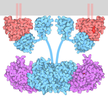
| Title | CryoEM structure of human PI3K-alpha (P85/P110-H1047R) with QR-8557 binding at an allosteric site | ||||||
 Components Components |
| ||||||
 Keywords Keywords | ONCOPROTEIN / PI3K-alpha / lipid kinase / allosteric inhibition | ||||||
| Function / homology |  Function and homology information Function and homology informationperinuclear endoplasmic reticulum membrane / regulation of toll-like receptor 4 signaling pathway / response to muscle inactivity / 1-phosphatidylinositol-3-kinase regulator activity / T follicular helper cell differentiation / positive regulation of endoplasmic reticulum unfolded protein response / phosphatidylinositol kinase activity / regulation of actin filament organization / negative regulation of actin filament depolymerization / phosphatidylinositol 3-kinase activator activity ...perinuclear endoplasmic reticulum membrane / regulation of toll-like receptor 4 signaling pathway / response to muscle inactivity / 1-phosphatidylinositol-3-kinase regulator activity / T follicular helper cell differentiation / positive regulation of endoplasmic reticulum unfolded protein response / phosphatidylinositol kinase activity / regulation of actin filament organization / negative regulation of actin filament depolymerization / phosphatidylinositol 3-kinase activator activity / phosphatidylinositol 3-kinase regulator activity / response to butyrate / IRS-mediated signalling / interleukin-18-mediated signaling pathway / phosphatidylinositol 3-kinase regulatory subunit binding / PI3K events in ERBB4 signaling / neurotrophin TRKA receptor binding / response to L-leucine / positive regulation of focal adhesion disassembly / cellular response to hydrostatic pressure / Activated NTRK2 signals through PI3K / cis-Golgi network / ErbB-3 class receptor binding / transmembrane receptor protein tyrosine kinase adaptor activity / negative regulation of stress fiber assembly / Activated NTRK3 signals through PI3K / phosphatidylinositol 3-kinase complex, class IB / phosphatidylinositol 3-kinase complex / TORC2 signaling / Co-stimulation by ICOS / RHOD GTPase cycle / positive regulation of protein localization to membrane / Signaling by cytosolic FGFR1 fusion mutants / vasculature development / Nephrin family interactions / positive regulation of filopodium assembly / anoikis / kinase activator activity / Signaling by LTK in cancer / RHOF GTPase cycle / 1-phosphatidylinositol-4-phosphate 3-kinase activity / Signaling by LTK / RND1 GTPase cycle / phosphatidylinositol 3-kinase complex, class IA / RND2 GTPase cycle / MET activates PI3K/AKT signaling / PI3K/AKT activation / RND3 GTPase cycle / phosphatidylinositol-4,5-bisphosphate 3-kinase / 1-phosphatidylinositol-4,5-bisphosphate 3-kinase activity / natural killer cell mediated cytotoxicity / growth hormone receptor signaling pathway / relaxation of cardiac muscle / insulin binding / phosphatidylinositol 3-kinase / phosphatidylinositol-3-phosphate biosynthetic process / Signaling by ALK / cardiac muscle cell contraction / RHOV GTPase cycle / RHOB GTPase cycle / vascular endothelial growth factor signaling pathway / GP1b-IX-V activation signalling / 1-phosphatidylinositol-3-kinase activity / Erythropoietin activates Phosphoinositide-3-kinase (PI3K) / PI-3K cascade:FGFR3 / response to dexamethasone / negative regulation of macroautophagy / PI-3K cascade:FGFR2 / PI-3K cascade:FGFR4 / PI-3K cascade:FGFR1 / RHOC GTPase cycle / RHOJ GTPase cycle / phosphatidylinositol phosphate biosynthetic process / Synthesis of PIPs at the plasma membrane / positive regulation of protein kinase activity / RHOU GTPase cycle / response to muscle stretch / phosphatidylinositol-mediated signaling / CDC42 GTPase cycle / RET signaling / negative regulation of anoikis / T cell differentiation / Interleukin-3, Interleukin-5 and GM-CSF signaling / PI3K events in ERBB2 signaling / RHOG GTPase cycle / insulin receptor substrate binding / PI3K Cascade / Role of LAT2/NTAL/LAB on calcium mobilization / RAC3 GTPase cycle / RHOA GTPase cycle / CD28 dependent PI3K/Akt signaling / intercalated disc / RAC2 GTPase cycle / Interleukin receptor SHC signaling / positive regulation of TOR signaling / Role of phospholipids in phagocytosis / GAB1 signalosome / endothelial cell migration / enzyme-substrate adaptor activity / substrate adhesion-dependent cell spreading Similarity search - Function | ||||||
| Biological species |  Homo sapiens (human) Homo sapiens (human) | ||||||
| Method | ELECTRON MICROSCOPY / single particle reconstruction / cryo EM / Resolution: 3 Å | ||||||
 Authors Authors | Huang, X. / Ren, X. / Zhong, W. | ||||||
| Funding support | 1items
| ||||||
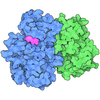
 Citation Citation | Journal: Structure / Year: 2024 Title: Cryo-EM structures reveal two allosteric inhibition modes of PI3Kα involving a re-shaping of the activation loop. Authors: Xiuliang Huang / Kailiang Wang / Jing Han / Xiumei Chen / Zhenglin Wang / Tianlun Wu / Bo Yu / Feng Zhao / Xinjuan Wang / Huijuan Li / Zhi Xie / Xiaotian Zhu / Wenge Zhong / Xiaoming Ren /   Abstract: PI3Kα is a lipid kinase that phosphorylates PIP2 and generates PIP3. The hyperactive PI3Kα mutation, H1047R, accounts for about 14% of breast cancer, making it a highly attractive target for drug ...PI3Kα is a lipid kinase that phosphorylates PIP2 and generates PIP3. The hyperactive PI3Kα mutation, H1047R, accounts for about 14% of breast cancer, making it a highly attractive target for drug discovery. Here, we report the cryo-EM structures of PI3Kα bound to two different allosteric inhibitors QR-7909 and QR-8557 at a global resolution of 2.7 Å and 3.0 Å, respectively. The structures reveal two distinct binding pockets on the opposite sides of the activation loop. Structural and MD simulation analyses show that the allosteric binding of QR-7909 and QR-8557 inhibit PI3Kα hyper-activity by reducing the fluctuation and mobility of the activation loop. Our work provides a strong rational basis for a further optimization and development of highly selective drug candidates to treat PI3Kα-driven cancers. | ||||||
| History |
|
- Structure visualization
| Structure viewer | Molecule: MolmilJmol/JSmol |
|---|
- Downloads & links
-Download
| PDBx/mmCIF format | 8w9b.cif.gz | 239.8 KB | Display | PDBx/mmCIF format |
|---|---|---|---|---|
| PDB format | pdb8w9b.ent.gz | 187.5 KB | Display | PDB format |
| PDBx/mmJSON format | 8w9b.json.gz | Tree view | PDBx/mmJSON format | |
| Others |  Other downloads Other downloads |
-Validation report
| Arichive directory | https://data.pdbj.org/pub/pdb/validation_reports/w9/8w9bftp://data.pdbj.org/pub/pdb/validation_reports/w9/8w9b | HTTPS FTP |
|---|
-Related structure data
| Related structure data |  37363MC 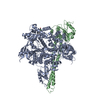 8w9aC M: map data used to model this data C: citing same article ( |
|---|---|
| Similar structure data |

-Links
 PDBj
PDBj





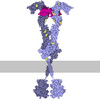

- Assembly
| Deposited unit | 
|
|---|---|
| 1 |
|
-Components
| #1: Protein | Mass: 124230.750 Da / Num. of mol.: 1 Source method: isolated from a genetically manipulated source Source: (gene. exp.) Homo sapiens (human) / Gene: PIK3CA / Production host:  Trichoplusia ni (cabbage looper) Trichoplusia ni (cabbage looper)References: UniProt: P42336, phosphatidylinositol 3-kinase, phosphatidylinositol-4,5-bisphosphate 3-kinase, non-specific serine/threonine protein kinase |
|---|---|
| #2: Protein | Mass: 33666.961 Da / Num. of mol.: 1 Source method: isolated from a genetically manipulated source Source: (gene. exp.) Homo sapiens (human) / Gene: PIK3R1, GRB1 / Production host: Trichoplusia ni (cabbage looper) / References: UniProt: P27986 |
| #3: Chemical | ChemComp-UJ3 / Mass: 395.427 Da / Num. of mol.: 1 / Source method: obtained synthetically / Formula: C22H22FN3O3 / Feature type: SUBJECT OF INVESTIGATION |
| Has ligand of interest | Y |
-Experimental details
-Experiment
| Experiment | Method: ELECTRON MICROSCOPY |
|---|---|
| EM experiment | Aggregation state: PARTICLE / 3D reconstruction method: single particle reconstruction |
- Sample preparation
| Component | Name: human PI3K-alpha (P85/P110-H1047R) with QR-8557 binding at an allosteric site Type: COMPLEX / Entity ID: #1-#2 / Source: MULTIPLE SOURCES |
|---|---|
| Source (natural) | Organism: Homo sapiens (human) |
| Source (recombinant) | Organism: Trichoplusia ni (cabbage looper) |
| Buffer solution | pH: 8 |
| Specimen | Embedding applied: NO / Shadowing applied: NO / Staining applied: NO / Vitrification applied: YES |
| Specimen support | Grid material: GOLD / Grid mesh size: 400 divisions/in. / Grid type: Quantifoil R1.2/1.3 |
| Vitrification | Cryogen name: ETHANE |
- Electron microscopy imaging
| Experimental equipment |  Model: Titan Krios / Image courtesy: FEI Company |
|---|---|
| Microscopy | Model: FEI TITAN KRIOS |
| Electron gun | Electron source:  FIELD EMISSION GUN / Accelerating voltage: 300 kV / Illumination mode: FLOOD BEAM FIELD EMISSION GUN / Accelerating voltage: 300 kV / Illumination mode: FLOOD BEAM |
| Electron lens | Mode: DIFFRACTION / Nominal defocus max: 1500 nm / Nominal defocus min: 1000 nm |
| Image recording | Electron dose: 48.5 e/Å2 / Film or detector model: FEI FALCON IV (4k x 4k) |
- Processing
| EM software | Name: PHENIX / Version: 1.13_2998: / Category: model refinement |
|---|---|
| CTF correction | Type: NONE |
| 3D reconstruction | Resolution: 3 Å / Resolution method: FSC 0.143 CUT-OFF / Num. of particles: 326253 / Symmetry type: POINT |
