 Movie
Movie Controller


+ Open data

- Basic information
| Entry | Database: PDB / ID: 8tsb | ||||||
|---|---|---|---|---|---|---|---|
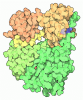
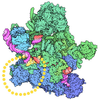
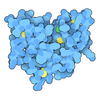
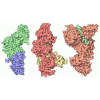
| Title | Human PI3K p85alpha/p110alpha bound to compound 2 | ||||||
 Components Components |
| ||||||
 Keywords Keywords | SIGNALING PROTEIN/INHIBITOR / Lipid kinase / SIGNALING PROTEIN / SIGNALING PROTEIN-INHIBITOR complex | ||||||
| Function / homology |  Function and homology information Function and homology informationperinuclear endoplasmic reticulum membrane / regulation of toll-like receptor 4 signaling pathway / response to muscle inactivity / 1-phosphatidylinositol-3-kinase regulator activity / T follicular helper cell differentiation / positive regulation of endoplasmic reticulum unfolded protein response / phosphatidylinositol kinase activity / regulation of actin filament organization / negative regulation of actin filament depolymerization / phosphatidylinositol 3-kinase activator activity ...perinuclear endoplasmic reticulum membrane / regulation of toll-like receptor 4 signaling pathway / response to muscle inactivity / 1-phosphatidylinositol-3-kinase regulator activity / T follicular helper cell differentiation / positive regulation of endoplasmic reticulum unfolded protein response / phosphatidylinositol kinase activity / regulation of actin filament organization / negative regulation of actin filament depolymerization / phosphatidylinositol 3-kinase activator activity / phosphatidylinositol 3-kinase regulator activity / response to butyrate / IRS-mediated signalling / interleukin-18-mediated signaling pathway / phosphatidylinositol 3-kinase regulatory subunit binding / PI3K events in ERBB4 signaling / neurotrophin TRKA receptor binding / response to L-leucine / positive regulation of focal adhesion disassembly / cellular response to hydrostatic pressure / Activated NTRK2 signals through PI3K / cis-Golgi network / ErbB-3 class receptor binding / transmembrane receptor protein tyrosine kinase adaptor activity / negative regulation of stress fiber assembly / Activated NTRK3 signals through PI3K / phosphatidylinositol 3-kinase complex, class IB / phosphatidylinositol 3-kinase complex / TORC2 signaling / Co-stimulation by ICOS / RHOD GTPase cycle / positive regulation of protein localization to membrane / Signaling by cytosolic FGFR1 fusion mutants / vasculature development / Nephrin family interactions / positive regulation of filopodium assembly / anoikis / kinase activator activity / Signaling by LTK in cancer / RHOF GTPase cycle / 1-phosphatidylinositol-4-phosphate 3-kinase activity / Signaling by LTK / RND1 GTPase cycle / phosphatidylinositol 3-kinase complex, class IA / RND2 GTPase cycle / MET activates PI3K/AKT signaling / PI3K/AKT activation / RND3 GTPase cycle / phosphatidylinositol-4,5-bisphosphate 3-kinase / 1-phosphatidylinositol-4,5-bisphosphate 3-kinase activity / natural killer cell mediated cytotoxicity / growth hormone receptor signaling pathway / relaxation of cardiac muscle / insulin binding / phosphatidylinositol 3-kinase / phosphatidylinositol-3-phosphate biosynthetic process / Signaling by ALK / cardiac muscle cell contraction / RHOV GTPase cycle / RHOB GTPase cycle / vascular endothelial growth factor signaling pathway / GP1b-IX-V activation signalling / 1-phosphatidylinositol-3-kinase activity / Erythropoietin activates Phosphoinositide-3-kinase (PI3K) / PI-3K cascade:FGFR3 / response to dexamethasone / negative regulation of macroautophagy / PI-3K cascade:FGFR2 / PI-3K cascade:FGFR4 / PI-3K cascade:FGFR1 / RHOC GTPase cycle / RHOJ GTPase cycle / phosphatidylinositol phosphate biosynthetic process / Synthesis of PIPs at the plasma membrane / positive regulation of protein kinase activity / RHOU GTPase cycle / response to muscle stretch / phosphatidylinositol-mediated signaling / CDC42 GTPase cycle / RET signaling / negative regulation of anoikis / T cell differentiation / Interleukin-3, Interleukin-5 and GM-CSF signaling / PI3K events in ERBB2 signaling / RHOG GTPase cycle / insulin receptor substrate binding / PI3K Cascade / Role of LAT2/NTAL/LAB on calcium mobilization / RAC3 GTPase cycle / RHOA GTPase cycle / CD28 dependent PI3K/Akt signaling / intercalated disc / RAC2 GTPase cycle / Interleukin receptor SHC signaling / positive regulation of TOR signaling / Role of phospholipids in phagocytosis / GAB1 signalosome / endothelial cell migration / enzyme-substrate adaptor activity / substrate adhesion-dependent cell spreading Similarity search - Function | ||||||
| Biological species |  Homo sapiens (human) Homo sapiens (human) | ||||||
| Method |  X-RAY DIFFRACTION / SYNCHROTRON / MOLECULAR REPLACEMENT / Resolution: 3.53 Å X-RAY DIFFRACTION / SYNCHROTRON / MOLECULAR REPLACEMENT / Resolution: 3.53 Å | ||||||
 Authors Authors | Holliday, M. / Tang, Y. / Bulku, A. / Wilbur, J. / Fraser, J. | ||||||
| Funding support | 1items
| ||||||
 Citation Citation | Journal: Cancer Discov / Year: 2024 Title: Discovery and Clinical Proof-of-Concept of RLY-2608, a First-in-Class Mutant-Selective Allosteric PI3Kα Inhibitor That Decouples Antitumor Activity from Hyperinsulinemia. Authors: Andreas Varkaris / Ermira Pazolli / Hakan Gunaydin / Qi Wang / Levi Pierce / Alessandro A Boezio / Artemisa Bulku / Lucian DiPietro / Cary Fridrich / Adam Frost / Fabrizio Giordanetto / ...Authors: Andreas Varkaris / Ermira Pazolli / Hakan Gunaydin / Qi Wang / Levi Pierce / Alessandro A Boezio / Artemisa Bulku / Lucian DiPietro / Cary Fridrich / Adam Frost / Fabrizio Giordanetto / Erika P Hamilton / Katherine Harris / Michael Holliday / Tamieka L Hunter / Amanda Iskandar / Yongli Ji / Alexandre Larivée / Jonathan R LaRochelle / André Lescarbeau / Fabien Llambi / Brenda Lormil / Mary M Mader / Brenton G Mar / Iain Martin / Thomas H McLean / Klaus Michelsen / Yakov Pechersky / Erika Puente-Poushnejad / Kevin Raynor / Dipali Rogala / Ramin Samadani / Alison M Schram / Kelley Shortsleeves / Sweta Swaminathan / Shahein Tajmir / Gege Tan / Yong Tang / Roberto Valverde / Bryan Wehrenberg / Jeremy Wilbur / Bret R Williams / Hongtao Zeng / Hanmo Zhang / W Patrick Walters / Beni B Wolf / David E Shaw / Donald A Bergstrom / James Watters / James S Fraser / Pascal D Fortin / D Randal Kipp /   Abstract: PIK3CA (PI3Kα) is a lipid kinase commonly mutated in cancer, including ∼40% of hormone receptor-positive breast cancer. The most frequently observed mutants occur in the kinase and helical domains. ...PIK3CA (PI3Kα) is a lipid kinase commonly mutated in cancer, including ∼40% of hormone receptor-positive breast cancer. The most frequently observed mutants occur in the kinase and helical domains. Orthosteric PI3Kα inhibitors suffer from poor selectivity leading to undesirable side effects, most prominently hyperglycemia due to inhibition of wild-type (WT) PI3Kα. Here, we used molecular dynamics simulations and cryo-electron microscopy to identify an allosteric network that provides an explanation for how mutations favor PI3Kα activation. A DNA-encoded library screen leveraging electron microscopy-optimized constructs, differential enrichment, and an orthosteric-blocking compound led to the identification of RLY-2608, a first-in-class allosteric mutant-selective inhibitor of PI3Kα. RLY-2608 inhibited tumor growth in PIK3CA-mutant xenograft models with minimal impact on insulin, a marker of dysregulated glucose homeostasis. RLY-2608 elicited objective tumor responses in two patients diagnosed with advanced hormone receptor-positive breast cancer with kinase or helical domain PIK3CA mutations, with no observed WT PI3Kα-related toxicities. SIGNIFICANCE: Treatments for PIK3CA-mutant cancers are limited by toxicities associated with the inhibition of WT PI3Kα. Molecular dynamics, cryo-electron microscopy, and DNA-encoded libraries were ...SIGNIFICANCE: Treatments for PIK3CA-mutant cancers are limited by toxicities associated with the inhibition of WT PI3Kα. Molecular dynamics, cryo-electron microscopy, and DNA-encoded libraries were used to develop RLY-2608, a first-in-class inhibitor that demonstrates mutant selectivity in patients. This marks the advance of clinical mutant-selective inhibition that overcomes limitations of orthosteric PI3Kα inhibitors. See related commentary by Gong and Vanhaesebroeck, p. 204 . See related article by Varkaris et al., p. 227 . This article is featured in Selected Articles from This Issue, p. 201. | ||||||
| History |
|
- Structure visualization
| Structure viewer | Molecule: MolmilJmol/JSmol |
|---|
- Downloads & links
-Download
| PDBx/mmCIF format | 8tsb.cif.gz | 933.8 KB | Display | PDBx/mmCIF format |
|---|---|---|---|---|
| PDB format | pdb8tsb.ent.gz | 653.1 KB | Display | PDB format |
| PDBx/mmJSON format | 8tsb.json.gz | Tree view | PDBx/mmJSON format | |
| Others |  Other downloads Other downloads |
-Validation report
| Arichive directory | https://data.pdbj.org/pub/pdb/validation_reports/ts/8tsbftp://data.pdbj.org/pub/pdb/validation_reports/ts/8tsb | HTTPS FTP |
|---|
-Related structure data
| Related structure data | 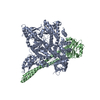 8ts7C  8ts8C  8ts9C 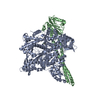 8tsaC  8tscC 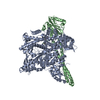 8tsdC 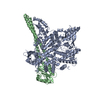 8tu6C C: citing same article ( |
|---|---|
| Similar structure data |
-Links
 PDBj
PDBj


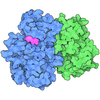
- Assembly
| Deposited unit | 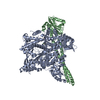
| ||||||||||||
|---|---|---|---|---|---|---|---|---|---|---|---|---|---|
| 1 |
| ||||||||||||
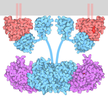
| Unit cell |
|
-Components
| #1: Protein | Mass: 123229.391 Da / Num. of mol.: 1 Source method: isolated from a genetically manipulated source Source: (gene. exp.) Homo sapiens (human) / Gene: PIK3CA / Cell line (production host): Sf21 / Production host:   Spodoptera frugiperda (fall armyworm) / References: UniProt: P42336 Spodoptera frugiperda (fall armyworm) / References: UniProt: P42336 |
|---|---|
| #2: Protein | Mass: 35960.137 Da / Num. of mol.: 1 / Fragment: residues 318-615 Source method: isolated from a genetically manipulated source Source: (gene. exp.) Homo sapiens (human) / Gene: PIK3R1 / Cell line (production host): Sf21 / Production host: Spodoptera frugiperda (fall armyworm) / References: UniProt: P27986 |
| #3: Chemical | ChemComp-UIW / 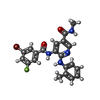  Mass: 457.296 Da / Num. of mol.: 1 / Source method: obtained synthetically / Formula: C21H18BrFN4O2 / Feature type: SUBJECT OF INVESTIGATION Mass: 457.296 Da / Num. of mol.: 1 / Source method: obtained synthetically / Formula: C21H18BrFN4O2 / Feature type: SUBJECT OF INVESTIGATION |
| Has ligand of interest | Y |
-Experimental details
-Experiment
| Experiment | Method: X-RAY DIFFRACTION / Number of used crystals: 1 |
|---|
- Sample preparation
| Crystal | Density Matthews: 3.34 Å3/Da / Density % sol: 63.18 % |
|---|---|
| Crystal grow | Temperature: 293 K / Method: vapor diffusion, sitting drop / pH: 7.5 / Details: 0.1 M Hepes pH 7.5, 9% PEG-3350 |
-Data collection
| Diffraction | Mean temperature: 100 K / Serial crystal experiment: N |
|---|---|
| Diffraction source | Source: SYNCHROTRON / Site: APS / Beamline: 17-ID / Wavelength: 1 Å |
| Detector | Type: DECTRIS EIGER2 X 9M / Detector: PIXEL / Date: May 30, 2022 |
| Radiation | Protocol: SINGLE WAVELENGTH / Monochromatic (M) / Laue (L): M / Scattering type: x-ray |
| Radiation wavelength | Wavelength: 1 Å / Relative weight: 1 |
| Reflection | Resolution: 3.53→101.32 Å / Num. obs: 24449 / % possible obs: 96.8 % / Redundancy: 6.6 % / Biso Wilson estimate: 140.1 Å2 / CC1/2: 0.998 / Rmerge(I) obs: 0.082 / Rpim(I) all: 0.046 / Rrim(I) all: 0.089 / Net I/σ(I): 12.8 |
| Reflection shell | Resolution: 3.53→3.73 Å / Redundancy: 6.8 % / Num. unique obs: 2827 / CC1/2: 0.893 / % possible all: 78.6 |
- Processing
| Software |
| ||||||||||||||||||||||||||||||||||||||||||||||||||||||||||||||||||||||
|---|---|---|---|---|---|---|---|---|---|---|---|---|---|---|---|---|---|---|---|---|---|---|---|---|---|---|---|---|---|---|---|---|---|---|---|---|---|---|---|---|---|---|---|---|---|---|---|---|---|---|---|---|---|---|---|---|---|---|---|---|---|---|---|---|---|---|---|---|---|---|---|
| Refinement | Method to determine structure: MOLECULAR REPLACEMENT / Resolution: 3.53→49.54 Å / SU ML: 0.3766 / Cross valid method: FREE R-VALUE / σ(F): 1.35 / Phase error: 28.3257 Stereochemistry target values: GeoStd + Monomer Library + CDL v1.2
| ||||||||||||||||||||||||||||||||||||||||||||||||||||||||||||||||||||||
| Solvent computation | Shrinkage radii: 0.9 Å / VDW probe radii: 1.1 Å / Solvent model: FLAT BULK SOLVENT MODEL | ||||||||||||||||||||||||||||||||||||||||||||||||||||||||||||||||||||||
| Displacement parameters | Biso mean: 168.87 Å2 | ||||||||||||||||||||||||||||||||||||||||||||||||||||||||||||||||||||||
| Refinement step | Cycle: LAST / Resolution: 3.53→49.54 Å
| ||||||||||||||||||||||||||||||||||||||||||||||||||||||||||||||||||||||
| Refine LS restraints |
| ||||||||||||||||||||||||||||||||||||||||||||||||||||||||||||||||||||||
| LS refinement shell |
| ||||||||||||||||||||||||||||||||||||||||||||||||||||||||||||||||||||||
| Refinement TLS params. | Method: refined / Origin x: 11.9125989402 Å / Origin y: -4.32737593019 Å / Origin z: -19.3776496126 Å
| ||||||||||||||||||||||||||||||||||||||||||||||||||||||||||||||||||||||
| Refinement TLS group | Selection details: all |
