 Movie
Movie Controller


+ Open data

- Basic information
| Entry | Database: PDB / ID: 8sej | ||||||
|---|---|---|---|---|---|---|---|
| Title | Type I beta-amyloid 42 Filaments from Down syndrome | ||||||
 Components Components | Amyloid-beta protein 42 | ||||||
 Keywords Keywords | NEUROPEPTIDE / Beta Amyloid filaments / Down Syndrome / Human Trisomy 21 | ||||||
| Function / homology |  Function and homology information Function and homology informationamyloid-beta complex / growth cone lamellipodium / Aggregated β-amyloid induces FXII autocatalysis / cellular response to norepinephrine stimulus / collateral sprouting in absence of injury / growth cone filopodium / hippocampal neuron apoptotic process / microglia development / regulation of Wnt signaling pathway / Formyl peptide receptors bind formyl peptides and many other ligands ...amyloid-beta complex / growth cone lamellipodium / Aggregated β-amyloid induces FXII autocatalysis / cellular response to norepinephrine stimulus / collateral sprouting in absence of injury / growth cone filopodium / hippocampal neuron apoptotic process / microglia development / regulation of Wnt signaling pathway / Formyl peptide receptors bind formyl peptides and many other ligands / axo-dendritic transport / Aggregated β-amyloid interacts with fibrinogen / axon midline choice point recognition / regulation of synapse structure or activity / positive regulation of synaptic transmission, cholinergic / astrocyte activation involved in immune response / NMDA selective glutamate receptor signaling pathway / regulation of spontaneous synaptic transmission / mating behavior / growth factor receptor binding / Insertion of tail-anchored proteins into the endoplasmic reticulum membrane / positive regulation of amyloid fibril formation / peptidase activator activity / PTB domain binding / Golgi-associated vesicle / Lysosome Vesicle Biogenesis / Deregulated CDK5 triggers multiple neurodegenerative pathways in Alzheimer's disease models / neuron remodeling / astrocyte projection / regulation of multicellular organism growth / nuclear envelope lumen / dendrite development / TRAF6 mediated NF-kB activation / positive regulation of protein metabolic process / negative regulation of long-term synaptic potentiation / signaling receptor activator activity / transition metal ion binding / Advanced glycosylation endproduct receptor signaling / The NLRP3 inflammasome / intracellular copper ion homeostasis / modulation of excitatory postsynaptic potential / main axon / ECM proteoglycans / positive regulation of T cell migration / response to insulin-like growth factor stimulus / regulation of presynapse assembly / extracellular matrix organization / swimming behavior / adult locomotory behavior / regulation of long-term neuronal synaptic plasticity / neuronal dense core vesicle / Purinergic signaling in leishmaniasis infection / positive regulation of calcium-mediated signaling / positive regulation of chemokine production / positive regulation of mitotic cell cycle / axonogenesis / cellular response to manganese ion / neuron projection maintenance / clathrin-coated pit / cellular response to cAMP / visual learning / astrocyte activation / synaptic cleft / Mitochondrial protein degradation / platelet alpha granule lumen / regulation of neuron apoptotic process / positive regulation of glycolytic process / Regulation of clotting cascade / response to interleukin-1 / learning / ionotropic glutamate receptor signaling pathway / locomotory behavior / cellular response to copper ion / endosome lumen / positive regulation of interleukin-1 beta production / central nervous system development / positive regulation of long-term synaptic potentiation / serine-type endopeptidase inhibitor activity / protein serine/threonine kinase binding / dendritic shaft / Post-translational protein phosphorylation / trans-Golgi network membrane / endocytosis / microglial cell activation / cellular response to nerve growth factor stimulus / positive regulation of non-canonical NF-kappaB signal transduction / positive regulation of interleukin-6 production / positive regulation of JNK cascade / synapse organization / TAK1-dependent IKK and NF-kappa-B activation / regulation of translation / Golgi lumen / recycling endosome / response to lead ion / cognition / Regulation of Insulin-like Growth Factor (IGF) transport and uptake by Insulin-like Growth Factor Binding Proteins (IGFBPs) / cellular response to amyloid-beta / neuron projection development / regulation of gene expression / calcium ion transport Similarity search - Function | ||||||
| Biological species |  Homo sapiens (human) Homo sapiens (human) | ||||||
| Method | ELECTRON MICROSCOPY / helical reconstruction / cryo EM / Resolution: 3.17 Å | ||||||
 Authors Authors | Hoq, M.R. / Bharath, S.R. / Vago, F.S. / Jiang, W. | ||||||
| Funding support |  United States, 1items United States, 1items
| ||||||
 Citation Citation | Journal: Nat Struct Mol Biol / Year: 2024 Title: Cryo-EM structures of amyloid-β and tau filaments in Down syndrome. Authors: Anllely Fernandez / Md Rejaul Hoq / Grace I Hallinan / Daoyi Li / Sakshibeedu R Bharath / Frank S Vago / Xiaoqi Zhang / Kadir A Ozcan / Kathy L Newell / Holly J Garringer / Wen Jiang / ...Authors: Anllely Fernandez / Md Rejaul Hoq / Grace I Hallinan / Daoyi Li / Sakshibeedu R Bharath / Frank S Vago / Xiaoqi Zhang / Kadir A Ozcan / Kathy L Newell / Holly J Garringer / Wen Jiang / Bernardino Ghetti / Ruben Vidal / Abstract: Adult individuals with Down syndrome (DS) develop Alzheimer disease (AD). Whether there is a difference between AD in DS and AD regarding the structure of amyloid-β (Aβ) and tau filaments is ...Adult individuals with Down syndrome (DS) develop Alzheimer disease (AD). Whether there is a difference between AD in DS and AD regarding the structure of amyloid-β (Aβ) and tau filaments is unknown. Here we report the structure of Aβ and tau filaments from two DS brains. We found two Aβ filaments (types IIIa and IIIb) that differ from those previously reported in sporadic AD and two types of Aβ filaments (I and II) identical to those found in sporadic and familial AD. Tau filaments (paired helical filaments and straight filaments) were identical to those in AD, supporting the notion of a common mechanism through which amyloids trigger aggregation of tau. This knowledge is important for understanding AD in DS and assessing whether adults with DS could be included in AD clinical trials. | ||||||
| History |
|
- Structure visualization
| Structure viewer | Molecule: MolmilJmol/JSmol |
|---|
- Downloads & links
-Download
| PDBx/mmCIF format | 8sej.cif.gz | 63.8 KB | Display | PDBx/mmCIF format |
|---|---|---|---|---|
| PDB format | pdb8sej.ent.gz | 50.1 KB | Display | PDB format |
| PDBx/mmJSON format | 8sej.json.gz | Tree view | PDBx/mmJSON format | |
| Others |  Other downloads Other downloads |
-Validation report
| Arichive directory | https://data.pdbj.org/pub/pdb/validation_reports/se/8sejftp://data.pdbj.org/pub/pdb/validation_reports/se/8sej | HTTPS FTP |
|---|
-Related structure data
| Related structure data | 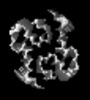 40416MC 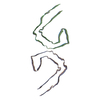 8sehC 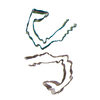 8seiC  8sekC 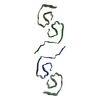 8selC M: map data used to model this data C: citing same article ( |
|---|---|
| Similar structure data |
-Links
 PDBj
PDBj

- Assembly
| Deposited unit | 
|
|---|---|
| 1 |
|
-Components
| #1: Protein/peptide | Mass: 3560.128 Da / Num. of mol.: 10 / Source method: isolated from a natural source Details: Type I beta-amyloid 42 filaments from Down syndrome Case 2 Source: (natural) Homo sapiens (human) / References: UniProt: P05067 |
|---|
-Experimental details
-Experiment
| Experiment | Method: ELECTRON MICROSCOPY |
|---|---|
| EM experiment | Aggregation state: FILAMENT / 3D reconstruction method: helical reconstruction |
- Sample preparation
| Component | Name: Type I beta amyloid 42 / Type: TISSUE / Entity ID: all / Source: NATURAL |
|---|---|
| Source (natural) | Organism: Homo sapiens (human) |
| Buffer solution | pH: 7.2 |
| Specimen | Conc.: 1 mg/ml / Embedding applied: NO / Shadowing applied: NO / Staining applied: NO / Vitrification applied: YES |
| Vitrification | Cryogen name: ETHANE |
- Electron microscopy imaging
| Experimental equipment |  Model: Titan Krios / Image courtesy: FEI Company |
|---|---|
| Microscopy | Model: TFS KRIOS |
| Electron gun | Electron source:  FIELD EMISSION GUN / Accelerating voltage: 300 kV / Illumination mode: SPOT SCAN FIELD EMISSION GUN / Accelerating voltage: 300 kV / Illumination mode: SPOT SCAN |
| Electron lens | Mode: BRIGHT FIELD / Nominal magnification: 81000 X / Nominal defocus max: 5000 nm / Nominal defocus min: 500 nm / Cs: 2.7 mm / C2 aperture diameter: 100 µm |
| Specimen holder | Cryogen: NITROGEN |
| Image recording | Average exposure time: 1.103 sec. / Electron dose: 50.46 e/Å2 / Film or detector model: GATAN K3 (6k x 4k) |
- Processing
| EM software | Name: CTFFIND / Category: CTF correction |
|---|---|
| CTF correction | Type: PHASE FLIPPING AND AMPLITUDE CORRECTION |
| Helical symmerty | Angular rotation/subunit: 178.24 ° / Axial rise/subunit: 2.38 Å / Axial symmetry: C1 |
| 3D reconstruction | Resolution: 3.17 Å / Resolution method: FSC 0.143 CUT-OFF / Num. of particles: 45575 / Symmetry type: HELICAL |
