 Movie
Movie Controller

[English] 日本語
 Yorodumi
- PDB-8oj5: 60S ribosomal subunit bound to the E3-UFM1 complex - state 3 (in-... -
+ Open data

- Basic information
| Entry | Database: PDB / ID: 8oj5 | ||||||||||||||||||
|---|---|---|---|---|---|---|---|---|---|---|---|---|---|---|---|---|---|---|---|
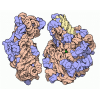
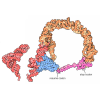
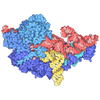
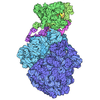
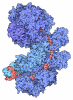
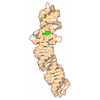
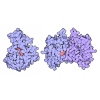
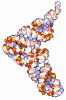
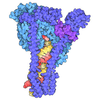
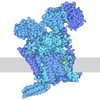
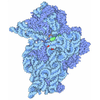
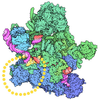
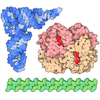
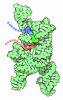
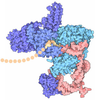
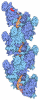
| Title | 60S ribosomal subunit bound to the E3-UFM1 complex - state 3 (in-vitro reconstitution) | ||||||||||||||||||
 Components Components |
| ||||||||||||||||||
 Keywords Keywords | RIBOSOME / ER / UFMylation / recycling | ||||||||||||||||||
| Function / homology |  Function and homology information Function and homology informationpositive regulation of I-kappaB phosphorylation / UFM1 ligase activity / UFM1-modified protein reader activity / positive regulation of reticulophagy / regulation of phosphatase activity / apoptotic nuclear changes / definitive erythrocyte differentiation / UFM1 transferase activity / negative regulation of protein serine/threonine kinase activity / negative regulation of protein kinase activity by regulation of protein phosphorylation ...positive regulation of I-kappaB phosphorylation / UFM1 ligase activity / UFM1-modified protein reader activity / positive regulation of reticulophagy / regulation of phosphatase activity / apoptotic nuclear changes / definitive erythrocyte differentiation / UFM1 transferase activity / negative regulation of protein serine/threonine kinase activity / negative regulation of protein kinase activity by regulation of protein phosphorylation / positive regulation of protein localization to endoplasmic reticulum / protein K69-linked ufmylation / protein ufmylation / : / positive regulation of plasma cell differentiation / negative regulation of IRE1-mediated unfolded protein response / regulation of proteasomal ubiquitin-dependent protein catabolic process / regulation of intracellular estrogen receptor signaling pathway / positive regulation of cell cycle G1/S phase transition / negative regulation of T cell mediated immune response to tumor cell / protein localization to endoplasmic reticulum / translation at presynapse / mitotic G2/M transition checkpoint / regulation of cyclin-dependent protein serine/threonine kinase activity / cartilage development / response to insecticide / Transferases; Acyltransferases; Aminoacyltransferases / regulation of translation involved in cellular response to UV / mitogen-activated protein kinase binding / eukaryotic 80S initiation complex / positive regulation of proteasomal protein catabolic process / ribosome disassembly / ribosomal protein import into nucleus / regulation of G1 to G0 transition / positive regulation of intrinsic apoptotic signaling pathway in response to DNA damage by p53 class mediator / regulation of canonical NF-kappaB signal transduction / reticulophagy / protein-DNA complex disassembly / regulation of neuron differentiation / negative regulation of formation of translation preinitiation complex / positive regulation of DNA damage response, signal transduction by p53 class mediator / negative regulation of protein import into nucleus / GAIT complex / TORC2 complex binding / G1 to G0 transition / Enterobacterial factors antagonize host defense / PD-L1(CD274) glycosylation and translocation to plasma membrane / negative regulation of MAP kinase activity / negative regulation of T cell activation / cytoplasmic side of rough endoplasmic reticulum membrane / negative regulation of PERK-mediated unfolded protein response / hematopoietic stem cell differentiation / mitotic G2 DNA damage checkpoint signaling / negative regulation of myoblast fusion / negative regulation of protein phosphorylation / PELO:HBS1L and ABCE1 dissociate a ribosome on a non-stop mRNA / male meiosis I / Dengue Virus Genome Translation and Replication / Maturation of DENV proteins / ZNF598 and the Ribosome-associated Quality Trigger (RQT) complex dissociate a ribosome stalled on a no-go mRNA / Protein hydroxylation / ubiquitin-like protein ligase binding / RHOA GTPase cycle / Peptide chain elongation / Selenocysteine synthesis / Formation of a pool of free 40S subunits / protein targeting / Eukaryotic Translation Termination / protein localization to nucleus / SRP-dependent cotranslational protein targeting to membrane / Response of EIF2AK4 (GCN2) to amino acid deficiency / AMPK-induced ERAD and lysosome mediated degradation of PD-L1(CD274) / negative regulation of ubiquitin-dependent protein catabolic process / ubiquitin ligase inhibitor activity / Viral mRNA Translation / NF-kappaB binding / Nonsense Mediated Decay (NMD) independent of the Exon Junction Complex (EJC) / positive regulation of signal transduction by p53 class mediator / GTP hydrolysis and joining of the 60S ribosomal subunit / embryo implantation / L13a-mediated translational silencing of Ceruloplasmin expression / Major pathway of rRNA processing in the nucleolus and cytosol / GSK3B-mediated proteasomal degradation of PD-L1(CD274) / SPOP-mediated proteasomal degradation of PD-L1(CD274) / ubiquitin-like ligase-substrate adaptor activity / maturation of LSU-rRNA / Nonsense Mediated Decay (NMD) enhanced by the Exon Junction Complex (EJC) / protein-RNA complex assembly / endoplasmic reticulum unfolded protein response / rough endoplasmic reticulum / Ribosome Quality Control (RQC) complex extracts and degrades nascent peptide / mRNA Polyadenylation / negative regulation of protein ubiquitination / endomembrane system / rescue of stalled cytosolic ribosome / DNA damage checkpoint signaling / negative regulation of proteasomal ubiquitin-dependent protein catabolic process / Maturation of protein E / Maturation of protein E / MDM2/MDM4 family protein binding Similarity search - Function | ||||||||||||||||||
| Biological species |  Homo sapiens (human) Homo sapiens (human) | ||||||||||||||||||
| Method | ELECTRON MICROSCOPY / single particle reconstruction / cryo EM / Resolution: 2.9 Å | ||||||||||||||||||
 Authors Authors | Penchev, I. / DaRosa, P.A. / Peter, J.J. / Kulathu, Y. / Becker, T. / Beckmann, R. / Kopito, R. | ||||||||||||||||||
| Funding support | European Union,  Germany, Germany,  United Kingdom, United Kingdom,  United States, 5items United States, 5items
| ||||||||||||||||||
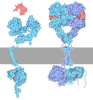
 Citation Citation | Journal: Nature / Year: 2024 Title: UFM1 E3 ligase promotes recycling of 60S ribosomal subunits from the ER. Authors: Paul A DaRosa / Ivan Penchev / Samantha C Gumbin / Francesco Scavone / Magda Wąchalska / Joao A Paulo / Alban Ordureau / Joshua J Peter / Yogesh Kulathu / J Wade Harper / Thomas Becker / ...Authors: Paul A DaRosa / Ivan Penchev / Samantha C Gumbin / Francesco Scavone / Magda Wąchalska / Joao A Paulo / Alban Ordureau / Joshua J Peter / Yogesh Kulathu / J Wade Harper / Thomas Becker / Roland Beckmann / Ron R Kopito / Abstract: Reversible modification of target proteins by ubiquitin and ubiquitin-like proteins (UBLs) is widely used by eukaryotic cells to control protein fate and cell behaviour. UFM1 is a UBL that ...Reversible modification of target proteins by ubiquitin and ubiquitin-like proteins (UBLs) is widely used by eukaryotic cells to control protein fate and cell behaviour. UFM1 is a UBL that predominantly modifies a single lysine residue on a single ribosomal protein, uL24 (also called RPL26), on ribosomes at the cytoplasmic surface of the endoplasmic reticulum (ER). UFM1 conjugation (UFMylation) facilitates the rescue of 60S ribosomal subunits (60S) that are released after ribosome-associated quality-control-mediated splitting of ribosomes that stall during co-translational translocation of secretory proteins into the ER. Neither the molecular mechanism by which the UFMylation machinery achieves such precise target selection nor how this ribosomal modification promotes 60S rescue is known. Here we show that ribosome UFMylation in vivo occurs on free 60S and we present sequential cryo-electron microscopy snapshots of the heterotrimeric UFM1 E3 ligase (E3(UFM1)) engaging its substrate uL24. E3(UFM1) binds the L1 stalk, empty transfer RNA-binding sites and the peptidyl transferase centre through carboxy-terminal domains of UFL1, which results in uL24 modification more than 150 Å away. After catalysing UFM1 transfer, E3(UFM1) remains stably bound to its product, UFMylated 60S, forming a C-shaped clamp that extends all the way around the 60S from the transfer RNA-binding sites to the polypeptide tunnel exit. Our structural and biochemical analyses suggest a role for E3(UFM1) in post-termination release and recycling of the large ribosomal subunit from the ER membrane. | ||||||||||||||||||
| History |
|
- Structure visualization
| Structure viewer | Molecule: MolmilJmol/JSmol |
|---|
- Downloads & links
-Download
| PDBx/mmCIF format | 8oj5.cif.gz | 3.6 MB | Display | PDBx/mmCIF format |
|---|---|---|---|---|
| PDB format | pdb8oj5.ent.gz | Display | PDB format | |
| PDBx/mmJSON format | 8oj5.json.gz | Tree view | PDBx/mmJSON format | |
| Others |  Other downloads Other downloads |
-Validation report
| Arichive directory | https://data.pdbj.org/pub/pdb/validation_reports/oj/8oj5ftp://data.pdbj.org/pub/pdb/validation_reports/oj/8oj5 | HTTPS FTP |
|---|
-Related structure data
| Related structure data |  16905MC  8ohdC  8oj0C  8oj8C C: citing same article ( M: map data used to model this data |
|---|---|
| Similar structure data |



-Links
 PDBj
PDBj




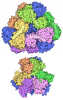
- Assembly
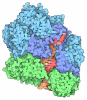
| Deposited unit | 
|
|---|---|
| 1 |
|
-Components
-RNA chain , 3 types, 3 molecules 578
| #1: RNA chain | Mass: 1640166.875 Da / Num. of mol.: 1 / Source method: isolated from a natural source / Source: (natural) Homo sapiens (human) / Cell line: HEK293T |
|---|---|
| #2: RNA chain | Mass: 38998.078 Da / Num. of mol.: 1 / Source method: isolated from a natural source / Source: (natural) Homo sapiens (human) / Cell line: HEK293T / References: GenBank: 23898 |
| #3: RNA chain | Mass: 50449.812 Da / Num. of mol.: 1 / Source method: isolated from a natural source / Source: (natural) Homo sapiens (human) / Cell line: HEK293T / References: GenBank: 555853 |
-Protein , 6 types, 6 molecules ABCDLILm
| #4: Protein | Mass: 89722.203 Da / Num. of mol.: 1 Source method: isolated from a genetically manipulated source Source: (gene. exp.) Homo sapiens (human) / Gene: UFL1, KIAA0776, MAXER, NLBP, RCAD / Production host:   Escherichia coli BL21 (bacteria) Escherichia coli BL21 (bacteria)References: UniProt: O94874, Transferases; Acyltransferases; Aminoacyltransferases |
|---|---|
| #5: Protein | Mass: 56977.395 Da / Num. of mol.: 1 Source method: isolated from a genetically manipulated source Source: (gene. exp.) Homo sapiens (human) / Gene: CDK5RAP3, IC53, LZAP, MSTP016, OK/SW-cl.114, PP1553 / Production host: Escherichia coli BL21 (bacteria) / References: UniProt: Q96JB5 |
| #6: Protein | Mass: 35663.840 Da / Num. of mol.: 1 Source method: isolated from a genetically manipulated source Source: (gene. exp.) Homo sapiens (human) / Gene: DDRGK1, C20orf116, UFBP1 / Production host: Escherichia coli BL21 (bacteria) / References: UniProt: Q96HY6 |
| #7: Protein | Mass: 9128.552 Da / Num. of mol.: 1 Source method: isolated from a genetically manipulated source Source: (gene. exp.) Homo sapiens (human) / Gene: UFM1, C13orf20, BM-002 / Production host: Escherichia coli BL21(DE3) (bacteria) / References: UniProt: P61960 |
| #16: Protein | Mass: 24552.910 Da / Num. of mol.: 1 / Source method: isolated from a natural source / Source: (natural) Homo sapiens (human) / Cell line: HEK293T / References: UniProt: Q96L21 |
| #45: Protein | Mass: 14758.394 Da / Num. of mol.: 1 / Source method: isolated from a natural source / Source: (natural) Homo sapiens (human) / Cell line: HEK293T / References: UniProt: P62987 |
+60S ribosomal protein ... , 40 types, 40 molecules LALBLCLDLELFLGLHLJLLLMLNLOLPLQLRLSLTLULVLWLXLYLZLaLbLcLdLeLf...
-Non-polymers , 2 types, 225 molecules 

| #50: Chemical | ChemComp-MG /  Mass: 24.305 Da / Num. of mol.: 220 / Source method: obtained synthetically / Formula: Mg Mass: 24.305 Da / Num. of mol.: 220 / Source method: obtained synthetically / Formula: Mg#51: Chemical | ChemComp-ZN /  Mass: 65.409 Da / Num. of mol.: 5 / Source method: obtained synthetically / Formula: Zn Mass: 65.409 Da / Num. of mol.: 5 / Source method: obtained synthetically / Formula: Zn |
|---|
-Details
| Has ligand of interest | N |
|---|
-Experimental details
-Experiment
| Experiment | Method: ELECTRON MICROSCOPY |
|---|---|
| EM experiment | Aggregation state: PARTICLE / 3D reconstruction method: single particle reconstruction |
- Sample preparation
| Component | Name: E3-UFM1 complex bound to the 60S ribosome / Type: RIBOSOME / Entity ID: #1-#49 / Source: NATURAL |
|---|---|
| Molecular weight | Experimental value: NO |
| Source (natural) | Organism: Homo sapiens (human) |
| Buffer solution | pH: 7 |
| Specimen | Embedding applied: NO / Shadowing applied: NO / Staining applied: NO / Vitrification applied: YES |
| Vitrification | Instrument: FEI VITROBOT MARK IV / Cryogen name: ETHANE |
- Electron microscopy imaging
| Experimental equipment |  Model: Titan Krios / Image courtesy: FEI Company |
|---|---|
| Microscopy | Model: FEI TITAN KRIOS |
| Electron gun | Electron source:  FIELD EMISSION GUN / Accelerating voltage: 300 kV / Illumination mode: OTHER FIELD EMISSION GUN / Accelerating voltage: 300 kV / Illumination mode: OTHER |
| Electron lens | Mode: BRIGHT FIELD / Nominal defocus max: 2000 nm / Nominal defocus min: 800 nm |
| Image recording | Electron dose: 50 e/Å2 / Film or detector model: GATAN K3 BIOQUANTUM (6k x 4k) |
- Processing
| CTF correction | Type: PHASE FLIPPING AND AMPLITUDE CORRECTION |
|---|---|
| 3D reconstruction | Resolution: 2.9 Å / Resolution method: FSC 0.143 CUT-OFF / Num. of particles: 35935 / Symmetry type: POINT |
| Atomic model building | Protocol: AB INITIO MODEL |
