 Movie
Movie Controller


+ Open data

- Basic information
| Entry | Database: PDB / ID: 8g7d | |||||||||||||||||||||
|---|---|---|---|---|---|---|---|---|---|---|---|---|---|---|---|---|---|---|---|---|---|---|
| Title | Cryo-EM structure of full length Neuroligin-2 from Mouse | |||||||||||||||||||||
 Components Components | Neuroligin-1,Neuroligin-2 | |||||||||||||||||||||
 Keywords Keywords | MEMBRANE PROTEIN / Neuroligin-2 | |||||||||||||||||||||
| Function / homology |  Function and homology information Function and homology informationregulation of presynapse organization / neurexin clustering involved in presynaptic membrane assembly / cell-cell adhesion involved in synapse maturation / positive regulation of presynaptic active zone assembly / cytoskeletal matrix organization at active zone / positive regulation of circadian sleep/wake cycle, wakefulness / positive regulation of neuromuscular synaptic transmission / Neurexins and neuroligins / jump response / neurotransmitter-gated ion channel clustering ...regulation of presynapse organization / neurexin clustering involved in presynaptic membrane assembly / cell-cell adhesion involved in synapse maturation / positive regulation of presynaptic active zone assembly / cytoskeletal matrix organization at active zone / positive regulation of circadian sleep/wake cycle, wakefulness / positive regulation of neuromuscular synaptic transmission / Neurexins and neuroligins / jump response / neurotransmitter-gated ion channel clustering / positive regulation of t-SNARE clustering / neuron to neuron synapse / postsynaptic specialization assembly / positive regulation of synaptic vesicle exocytosis / negative regulation of dendritic spine morphogenesis / terminal button organization / gephyrin clustering involved in postsynaptic density assembly / postsynaptic density protein 95 clustering / regulation of respiratory gaseous exchange by nervous system process / synapse maturation / postsynaptic membrane assembly / excitatory synapse assembly / positive regulation of synaptic vesicle clustering / presynaptic membrane assembly / neurexin family protein binding / maintenance of synapse structure / : / synaptic vesicle clustering / thigmotaxis / synaptic membrane adhesion / presynapse assembly / receptor localization to synapse / insulin metabolic process / NMDA glutamate receptor clustering / filopodium tip / cell adhesion mediator activity / ribbon synapse / calcium-dependent cell-cell adhesion / positive regulation of synaptic transmission, GABAergic / positive regulation of synaptic vesicle endocytosis / regulation of postsynaptic density assembly / inhibitory synapse / neuron cell-cell adhesion / neuron projection arborization / protein localization to synapse / dopaminergic synapse / neuromuscular process controlling balance / positive regulation of synapse assembly / protein localization to cell surface / glycinergic synapse / AMPA selective glutamate receptor signaling pathway / positive regulation of filopodium assembly / inhibitory synapse assembly / heterophilic cell-cell adhesion / positive regulation of inhibitory postsynaptic potential / positive regulation of ruffle assembly / NMDA selective glutamate receptor signaling pathway / regulation of NMDA receptor activity / regulation of neuron differentiation / synaptic transmission, GABAergic / postsynaptic specialization membrane / positive regulation of protein localization to synapse / positive regulation of dendritic spine development / synaptic vesicle transport / AMPA glutamate receptor clustering / locomotory exploration behavior / positive regulation of intracellular signal transduction / social behavior / protein targeting / regulation of presynapse assembly / synaptic cleft / neuron projection morphogenesis / positive regulation of synaptic transmission, glutamatergic / sensory perception of pain / synapse assembly / cell adhesion molecule binding / cellular response to calcium ion / excitatory synapse / positive regulation of excitatory postsynaptic potential / dendritic shaft / PDZ domain binding / establishment of protein localization / neuromuscular junction / positive regulation of neuron projection development / positive regulation of insulin secretion / synapse organization / modulation of chemical synaptic transmission / long-term synaptic potentiation / GABA-ergic synapse / neuron projection development / rhythmic process / nervous system development / presynapse / signaling receptor activity / presynaptic membrane / scaffold protein binding / dendritic spine / signaling receptor complex / postsynaptic membrane / postsynaptic density Similarity search - Function | |||||||||||||||||||||
| Biological species |   Mus musculus (house mouse) Mus musculus (house mouse) | |||||||||||||||||||||
| Method | ELECTRON MICROSCOPY / single particle reconstruction / cryo EM / Resolution: 3.28 Å | |||||||||||||||||||||
 Authors Authors | Boyd, R. / Wang, W. | |||||||||||||||||||||
| Funding support |  United States, 2items United States, 2items
| |||||||||||||||||||||
 Citation Citation | Journal: Sci Adv / Year: 2026 Title: Weaker neuroligin 2-neurexin β1 interaction tethers membranes and recruits gephyrin at membrane junctions through clustering. Authors: Robbie Boyd / Khuloud Jaqaman / Weiwei Wang / Abstract: Single-pass transmembrane proteins neuroligin (NL) and neurexin (NRX) constitute a pair of synaptic adhesion molecules that are essential for the formation of functional synapses. Binding affinities ...Single-pass transmembrane proteins neuroligin (NL) and neurexin (NRX) constitute a pair of synaptic adhesion molecules that are essential for the formation of functional synapses. Binding affinities vary by ~1000-fold between combinations of NL and NRX subtypes, which contribute to chemical and spatial specificities. Among major NL-NRX subtypes, NL2 and NRXβ1 have the lowest affinity. Here, we report structures of NL2 in complex with NRXβ1 in several conformations, along with NL2 alone. We identify mechanisms underlying the modulation of NL-NRX affinities and how the weaker NL2-NRXβ1 interaction alone is capable of tethering lipid membranes. We further show that NL2 and NRXβ1 cluster at intercellular junctions and recruit the master postsynaptic scaffolding protein gephyrin, which further clusters neurotransmitter receptors. These findings suggest a dual role of the NL2-NRXβ1 interaction-both as mechanical tether and as signaling receptor-to ensure correct spatial and chemical coordination between two cells to generate functional synapses. | |||||||||||||||||||||
| History |
|
- Structure visualization
| Structure viewer | Molecule: MolmilJmol/JSmol |
|---|
- Downloads & links
-Download
| PDBx/mmCIF format | 8g7d.cif.gz | 231.8 KB | Display | PDBx/mmCIF format |
|---|---|---|---|---|
| PDB format | pdb8g7d.ent.gz | 174.2 KB | Display | PDB format |
| PDBx/mmJSON format | 8g7d.json.gz | Tree view | PDBx/mmJSON format | |
| Others |  Other downloads Other downloads |
-Validation report
| Arichive directory | https://data.pdbj.org/pub/pdb/validation_reports/g7/8g7dftp://data.pdbj.org/pub/pdb/validation_reports/g7/8g7d | HTTPS FTP |
|---|
-Related structure data
| Related structure data |  29811MC  8g7yC  8g7zC  8g80C  8g81C M: map data used to model this data C: citing same article ( |
|---|---|
| Similar structure data |


-Links
 PDBj
PDBj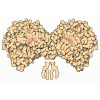
- Assembly
| Deposited unit | 
|
|---|---|
| 1 |
|
-Components
| #1: Protein | Mass: 95226.797 Da / Num. of mol.: 2 Source method: isolated from a genetically manipulated source Source: (gene. exp.) Mus musculus (house mouse) / Gene: Nlgn1, Kiaa1070, Nlgn2, Kiaa1366 / Production host:  Homo sapiens (human) / References: UniProt: Q99K10, UniProt: Q69ZK9 Homo sapiens (human) / References: UniProt: Q99K10, UniProt: Q69ZK9#2: Sugar | ChemComp-NAG /  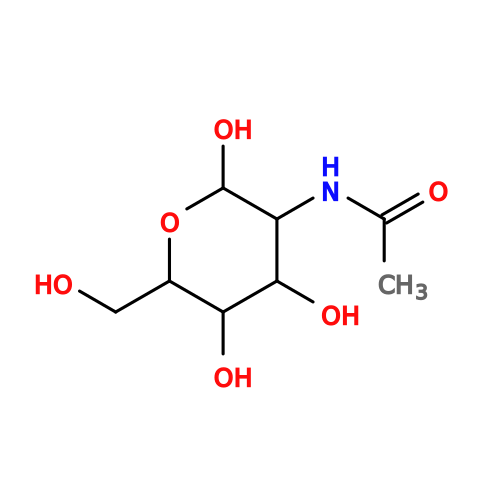 Type: D-saccharide, beta linking / Mass: 221.208 Da / Num. of mol.: 4 / Source method: obtained synthetically / Formula: C8H15NO6 / Feature type: SUBJECT OF INVESTIGATION Type: D-saccharide, beta linking / Mass: 221.208 Da / Num. of mol.: 4 / Source method: obtained synthetically / Formula: C8H15NO6 / Feature type: SUBJECT OF INVESTIGATIONHas ligand of interest | Y | Has protein modification | Y | |
|---|
-Experimental details
-Experiment
| Experiment | Method: ELECTRON MICROSCOPY |
|---|---|
| EM experiment | Aggregation state: PARTICLE / 3D reconstruction method: single particle reconstruction |
- Sample preparation
| Component | Name: Neuroligin-2 Dimer / Type: COMPLEX / Entity ID: #1 / Source: RECOMBINANT | ||||||||||||||||||||||||||||||
|---|---|---|---|---|---|---|---|---|---|---|---|---|---|---|---|---|---|---|---|---|---|---|---|---|---|---|---|---|---|---|---|
| Source (natural) | Organism: Mus musculus (house mouse) | ||||||||||||||||||||||||||||||
| Source (recombinant) | Organism: Homo sapiens (human) | ||||||||||||||||||||||||||||||
| Buffer solution | pH: 7.4 | ||||||||||||||||||||||||||||||
| Buffer component |
| ||||||||||||||||||||||||||||||
| Specimen | Conc.: 5.2 mg/ml / Embedding applied: NO / Shadowing applied: NO / Staining applied: NO / Vitrification applied: YES | ||||||||||||||||||||||||||||||
| Specimen support | Grid material: GOLD / Grid mesh size: 400 divisions/in. / Grid type: Quantifoil R1.2/1.3 | ||||||||||||||||||||||||||||||
| Vitrification | Instrument: FEI VITROBOT MARK IV / Cryogen name: ETHANE / Humidity: 100 % / Chamber temperature: 298 K / Details: Blot force 20, blot time 5s, single blot |
- Electron microscopy imaging
| Microscopy | Model: FEI TITAN |
|---|---|
| Electron gun | Electron source:  FIELD EMISSION GUN / Accelerating voltage: 300 kV / Illumination mode: FLOOD BEAM FIELD EMISSION GUN / Accelerating voltage: 300 kV / Illumination mode: FLOOD BEAM |
| Electron lens | Mode: BRIGHT FIELD / Nominal magnification: 105000 X / Calibrated magnification: 105000 X / Nominal defocus max: 2500 nm / Nominal defocus min: 1000 nm / Calibrated defocus max: 3000 nm / Cs: 0 mm / C2 aperture diameter: 70 µm / Alignment procedure: COMA FREE |
| Specimen holder | Cryogen: NITROGEN / Specimen holder model: FEI TITAN KRIOS AUTOGRID HOLDER |
| Image recording | Electron dose: 90 e/Å2 / Film or detector model: GATAN K3 (6k x 4k) / Num. of grids imaged: 1 / Num. of real images: 4989 |
| Image scans | Width: 5760 / Height: 4092 |
- Processing
| EM software |
| ||||||||||||||||||||||||||||||||||||||||
|---|---|---|---|---|---|---|---|---|---|---|---|---|---|---|---|---|---|---|---|---|---|---|---|---|---|---|---|---|---|---|---|---|---|---|---|---|---|---|---|---|---|
| CTF correction | Type: PHASE FLIPPING AND AMPLITUDE CORRECTION | ||||||||||||||||||||||||||||||||||||||||
| Particle selection | Num. of particles selected: 674761 | ||||||||||||||||||||||||||||||||||||||||
| Symmetry | Point symmetry: C1 (asymmetric) | ||||||||||||||||||||||||||||||||||||||||
| 3D reconstruction | Resolution: 3.28 Å / Resolution method: FSC 0.143 CUT-OFF / Num. of particles: 77577 / Algorithm: BACK PROJECTION / Num. of class averages: 1 / Symmetry type: POINT | ||||||||||||||||||||||||||||||||||||||||
| Atomic model building | Protocol: RIGID BODY FIT / Space: REAL | ||||||||||||||||||||||||||||||||||||||||
| Atomic model building | PDB-ID: 3BL8 Accession code: 3BL8 / Source name: PDB / Type: experimental model | ||||||||||||||||||||||||||||||||||||||||
| Refine LS restraints |
|

