National Institutes of Health/National Cancer Institute (NIH/NCI)
1R25Gm146860
United States
McKnight Foundation
2022 Scholar Award
United States
Citation
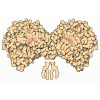
Journal: Sci Adv / Year: 2026 Title: Weaker neuroligin 2-neurexin β1 interaction tethers membranes and recruits gephyrin at membrane junctions through clustering. Authors: Robbie Boyd / Khuloud Jaqaman / Weiwei Wang / Abstract: Single-pass transmembrane proteins neuroligin (NL) and neurexin (NRX) constitute a pair of synaptic adhesion molecules that are essential for the formation of functional synapses. Binding affinities ...Single-pass transmembrane proteins neuroligin (NL) and neurexin (NRX) constitute a pair of synaptic adhesion molecules that are essential for the formation of functional synapses. Binding affinities vary by ~1000-fold between combinations of NL and NRX subtypes, which contribute to chemical and spatial specificities. Among major NL-NRX subtypes, NL2 and NRXβ1 have the lowest affinity. Here, we report structures of NL2 in complex with NRXβ1 in several conformations, along with NL2 alone. We identify mechanisms underlying the modulation of NL-NRX affinities and how the weaker NL2-NRXβ1 interaction alone is capable of tethering lipid membranes. We further show that NL2 and NRXβ1 cluster at intercellular junctions and recruit the master postsynaptic scaffolding protein gephyrin, which further clusters neurotransmitter receptors. These findings suggest a dual role of the NL2-NRXβ1 interaction-both as mechanical tether and as signaling receptor-to ensure correct spatial and chemical coordination between two cells to generate functional synapses.
Model: Quantifoil R1.2/1.3 / Material: GOLD / Mesh: 400 / Support film - Material: CARBON / Support film - topology: HOLEY / Pretreatment - Type: GLOW DISCHARGE / Pretreatment - Time: 60 sec. / Pretreatment - Atmosphere: AIR / Pretreatment - Pressure: 38.0 kPa
Vitrification
Cryogen name: ETHANE / Chamber humidity: 100 % / Chamber temperature: 298 K / Instrument: FEI VITROBOT MARK IV / Details: Blot force 20, blot time 5s, single blot.
-
Electron microscopy
Microscope
FEI TITAN
Image recording
Film or detector model: GATAN K3 (6k x 4k) / Digitization - Dimensions - Width: 5760 pixel / Digitization - Dimensions - Height: 4092 pixel / Number grids imaged: 1 / Number real images: 4989 / Average electron dose: 90.0 e/Å2
Electron beam
Acceleration voltage: 300 kV / Electron source: FIELD EMISSION GUN
In the structure databanks used in Yorodumi, some data are registered as the other names, "COVID-19 virus" and "2019-nCoV". Here are the details of the virus and the list of structure data.
Jan 31, 2019. EMDB accession codes are about to change! (news from PDBe EMDB page)
EMDB accession codes are about to change! (news from PDBe EMDB page)
The allocation of 4 digits for EMDB accession codes will soon come to an end. Whilst these codes will remain in use, new EMDB accession codes will include an additional digit and will expand incrementally as the available range of codes is exhausted. The current 4-digit format prefixed with “EMD-” (i.e. EMD-XXXX) will advance to a 5-digit format (i.e. EMD-XXXXX), and so on. It is currently estimated that the 4-digit codes will be depleted around Spring 2019, at which point the 5-digit format will come into force.
The EM Navigator/Yorodumi systems omit the EMD- prefix.
Related info.:Q: What is EMD? / ID/Accession-code notation in Yorodumi/EM Navigator
Yorodumi is a browser for structure data from EMDB, PDB, SASBDB, etc.
This page is also the successor to EM Navigator detail page, and also detail information page/front-end page for Omokage search.
The word "yorodu" (or yorozu) is an old Japanese word meaning "ten thousand". "mi" (miru) is to see.
Related info.:EMDB / PDB / SASBDB / Comparison of 3 databanks / Yorodumi Search / Aug 31, 2016. New EM Navigator & Yorodumi / Yorodumi Papers / Jmol/JSmol / Function and homology information / Changes in new EM Navigator and Yorodumi
 Movie
Movie Controller


 Open data
 Basic information
 Map data
 Sample
 Keywords
 Function and homology information
 Mus musculus (house mouse)
 Authors
 United States, 2 items
  Citation
 Structure visualization
 Downloads & links
 emd_29811.png
 http://ftp.pdbj.org/pub/emdb/structures/EMD-29811


 Z (Sec.)
 Y (Row.)
 X (Col.)


 Sample components
 Homo sapiens (human)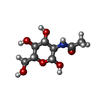
 Processing
 Electron microscopy
 FIELD EMISSION GUN
