 Movie
Movie Controller

[English] 日本語
 Yorodumi
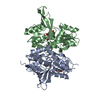
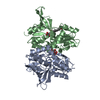
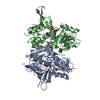
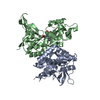
- PDB-6ove: Crystal structure of GluN1/GluN2A NMDA receptor agonist binding d... -
+ Open data

- Basic information
| Entry | Database: PDB / ID: 6ove | |||||||||
|---|---|---|---|---|---|---|---|---|---|---|
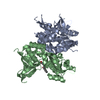
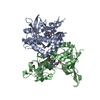
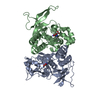
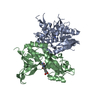
| Title | Crystal structure of GluN1/GluN2A NMDA receptor agonist binding domains with glycine and antagonist, 4-propylphenyl-ACEPC | |||||||||
 Components Components |
| |||||||||
 Keywords Keywords | PROTEIN TRANSPORT / NMDA RECEPTOR / ANTAGONIST / TRANSPORT PROTEIN / RECEPTOR | |||||||||
| Function / homology |  Function and homology information Function and homology informationregulation of response to alcohol / response to ammonium ion / response to environmental enrichment / mesencephalic trigeminal nucleus development / neurotransmitter receptor transport, plasma membrane to endosome / directional locomotion / receptor recycling / auditory behavior / response to carbohydrate / pons maturation ...regulation of response to alcohol / response to ammonium ion / response to environmental enrichment / mesencephalic trigeminal nucleus development / neurotransmitter receptor transport, plasma membrane to endosome / directional locomotion / receptor recycling / auditory behavior / response to carbohydrate / pons maturation / EPHB-mediated forward signaling / positive regulation of Schwann cell migration / Assembly and cell surface presentation of NMDA receptors / regulation of cell communication / protein localization to postsynaptic membrane / conditioned taste aversion / cellular response to magnesium ion / sleep / serotonin metabolic process / suckling behavior / positive regulation of mitochondrial calcium ion concentration / olfactory learning / response to other organism / response to hydrogen sulfide / response to methylmercury / dendritic branch / regulation of ARF protein signal transduction / locomotion / cellular response to dsRNA / response to manganese ion / response to glycoside / transmitter-gated monoatomic ion channel activity / cellular response to lipid / dendritic spine organization / regulation of respiratory gaseous exchange / propylene metabolic process / response to glycine / neurotransmitter receptor complex / positive regulation of inhibitory postsynaptic potential / RAF/MAP kinase cascade / regulation of NMDA receptor activity / response to amine / Synaptic adhesion-like molecules / NMDA glutamate receptor activity / regulation of monoatomic cation transmembrane transport / spinal cord development / cellular response to zinc ion / neuromuscular process / NMDA selective glutamate receptor complex / glutamate binding / regulation of axonogenesis / ligand-gated sodium channel activity / startle response / voltage-gated monoatomic cation channel activity / regulation of synapse assembly / calcium ion transmembrane import into cytosol / response to morphine / positive regulation of reactive oxygen species biosynthetic process / dopamine metabolic process / male mating behavior / protein heterotetramerization / regulation of dendrite morphogenesis / glycine binding / glutamate receptor signaling pathway / response to lithium ion / parallel fiber to Purkinje cell synapse / positive regulation of calcium ion transport into cytosol / associative learning / response to light stimulus / hypothalamus development / regulation of neuronal synaptic plasticity / social behavior / regulation of postsynaptic membrane potential / multicellular organismal response to stress / action potential / modulation of excitatory postsynaptic potential / positive regulation of dendritic spine maintenance / monoatomic cation transmembrane transport / positive regulation of protein targeting to membrane / cellular response to glycine / Unblocking of NMDA receptors, glutamate binding and activation / monoatomic cation transport / calcium ion homeostasis / glutamate receptor binding / prepulse inhibition / neurogenesis / phosphatase binding / conditioned place preference / long-term memory / adult locomotory behavior / regulation of long-term neuronal synaptic plasticity / response to fungicide / postsynaptic density, intracellular component / monoatomic cation channel activity / sensory perception of pain / glutamate-gated receptor activity / cellular response to manganese ion / response to amphetamine / positive regulation of synaptic transmission, glutamatergic / glutamate-gated calcium ion channel activity Similarity search - Function | |||||||||
| Biological species |   Rattus norvegicus (Norway rat) Rattus norvegicus (Norway rat) | |||||||||
| Method |  X-RAY DIFFRACTION / SYNCHROTRON / MOLECULAR REPLACEMENT / Resolution: 2 Å X-RAY DIFFRACTION / SYNCHROTRON / MOLECULAR REPLACEMENT / Resolution: 2 Å | |||||||||
 Authors Authors | Syrenne, J.T. / Mou, T.C. / Tamborini, L. / Pinto, A. / Sprang, S.R. / Hansen, K.B. | |||||||||
| Funding support |  United States, 2items United States, 2items
| |||||||||
 Citation Citation | Journal: To Be Published Title: Crystal structure of GluN1/GluN2A NMDA receptor agonist binding domains with glycine and antagonist, 3-ethylphenyl-ACEPC Authors: Syrenne, J.T. / Mou, T.C. / Tamborini, L. / Pinto, A. / Sprang, S.R. / Hansen, K.B. | |||||||||
| History |
|
- Structure visualization
| Structure viewer | Molecule: MolmilJmol/JSmol |
|---|
- Downloads & links
-Download
| PDBx/mmCIF format | 6ove.cif.gz | 135 KB | Display | PDBx/mmCIF format |
|---|---|---|---|---|
| PDB format | pdb6ove.ent.gz | 101.6 KB | Display | PDB format |
| PDBx/mmJSON format | 6ove.json.gz | Tree view | PDBx/mmJSON format | |
| Others |  Other downloads Other downloads |
-Validation report
| Arichive directory | https://data.pdbj.org/pub/pdb/validation_reports/ov/6oveftp://data.pdbj.org/pub/pdb/validation_reports/ov/6ove | HTTPS FTP |
|---|
-Related structure data
| Related structure data | 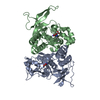 6ovdC 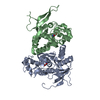 5i57S S: Starting model for refinement C: citing same article ( |
|---|---|
| Similar structure data |
-Links
 PDBj
PDBj
- Assembly
| Deposited unit | 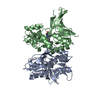
| ||||||||
|---|---|---|---|---|---|---|---|---|---|
| 1 |
| ||||||||
| 2 | 
| ||||||||
| 3 | 
| ||||||||
| Unit cell |
|
-Components
| #1: Protein | Mass: 33340.031 Da / Num. of mol.: 1 Source method: isolated from a genetically manipulated source Source: (gene. exp.) Rattus norvegicus (Norway rat) / Gene: Grin1, Nmdar1 / Production host:   Escherichia coli (E. coli) / References: UniProt: P35439 Escherichia coli (E. coli) / References: UniProt: P35439 |
|---|---|
| #2: Protein | Mass: 31671.197 Da / Num. of mol.: 1 Source method: isolated from a genetically manipulated source Source: (gene. exp.) Rattus norvegicus (Norway rat) / Gene: Grin2a / Production host: Escherichia coli (E. coli) / References: UniProt: Q00959 |
| #3: Chemical | ChemComp-GLY / 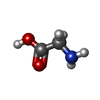 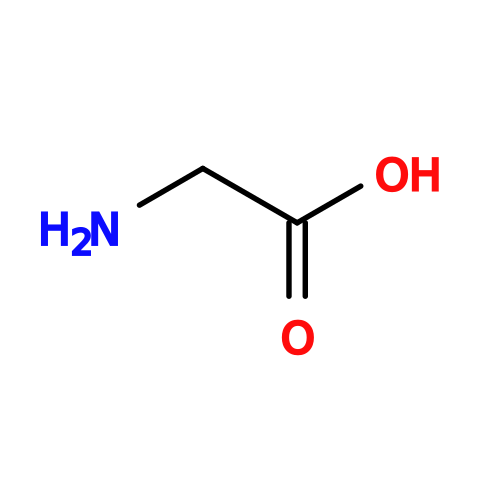 Type: peptide linking / Mass: 75.067 Da / Num. of mol.: 1 / Source method: obtained synthetically / Formula: C2H5NO2 / Feature type: SUBJECT OF INVESTIGATION Type: peptide linking / Mass: 75.067 Da / Num. of mol.: 1 / Source method: obtained synthetically / Formula: C2H5NO2 / Feature type: SUBJECT OF INVESTIGATION |
| #4: Chemical | ChemComp-N9D / (  Mass: 321.372 Da / Num. of mol.: 1 / Source method: obtained synthetically / Formula: C16H23N3O4 / Feature type: SUBJECT OF INVESTIGATION Mass: 321.372 Da / Num. of mol.: 1 / Source method: obtained synthetically / Formula: C16H23N3O4 / Feature type: SUBJECT OF INVESTIGATION |
| #5: Water | ChemComp-HOH /  Mass: 18.015 Da / Num. of mol.: 379 / Source method: isolated from a natural source / Formula: H2O Mass: 18.015 Da / Num. of mol.: 379 / Source method: isolated from a natural source / Formula: H2O |
| Has protein modification | Y |
| Sequence details | THE SEQUENCE CORRESPONDS TO THE NCBI REFERENCE NP_036705.3 FOR GLUN2A. RESIDUE THR242 IN THIS ...THE SEQUENCE CORRESPOND |
-Experimental details
-Experiment
| Experiment | Method: X-RAY DIFFRACTION / Number of used crystals: 1 |
|---|
- Sample preparation
| Crystal | Density Matthews: 2.35 Å3/Da / Density % sol: 47.77 % |
|---|---|
| Crystal grow | Temperature: 293 K / Method: vapor diffusion / Details: 0.2 M AMMONIUM SULFATE AND 16-22% PEG 4000 |
-Data collection
| Diffraction | Mean temperature: 100 K / Serial crystal experiment: N |
|---|---|
| Diffraction source | Source: SYNCHROTRON / Site: SSRL / Beamline: BL12-2 / Wavelength: 0.979 Å |
| Detector | Type: DECTRIS PILATUS 6M / Detector: PIXEL / Date: Apr 10, 2019 |
| Radiation | Protocol: SINGLE WAVELENGTH / Monochromatic (M) / Laue (L): M / Scattering type: x-ray |
| Radiation wavelength | Wavelength: 0.979 Å / Relative weight: 1 |
| Reflection | Resolution: 2→46.03 Å / Num. obs: 39766 / % possible obs: 99.16 % / Redundancy: 9.8 % / Biso Wilson estimate: 24.61 Å2 / CC1/2: 0.998 / Rmerge(I) obs: 0.1152 / Rpim(I) all: 0.03666 / Rrim(I) all: 0.1211 / Net I/σ(I): 13.91 |
| Reflection shell | Resolution: 2→2.072 Å / Redundancy: 5.3 % / Rmerge(I) obs: 0.5764 / Mean I/σ(I) obs: 2.75 / Num. unique obs: 3732 / CC1/2: 0.663 / Rpim(I) all: 0.2531 / Rrim(I) all: 0.6334 / % possible all: 94.77 |
- Processing
| Software |
| |||||||||||||||||||||||||||||||||||||||||||||||||||||||||||||||||||||||||||||||||||||||||||||||||||||||||
|---|---|---|---|---|---|---|---|---|---|---|---|---|---|---|---|---|---|---|---|---|---|---|---|---|---|---|---|---|---|---|---|---|---|---|---|---|---|---|---|---|---|---|---|---|---|---|---|---|---|---|---|---|---|---|---|---|---|---|---|---|---|---|---|---|---|---|---|---|---|---|---|---|---|---|---|---|---|---|---|---|---|---|---|---|---|---|---|---|---|---|---|---|---|---|---|---|---|---|---|---|---|---|---|---|---|---|
| Refinement | Method to determine structure: MOLECULAR REPLACEMENT Starting model: 5I57 Resolution: 2→46.03 Å / SU ML: 0.22 / Cross valid method: FREE R-VALUE / σ(F): 1.38 / Phase error: 21.34
| |||||||||||||||||||||||||||||||||||||||||||||||||||||||||||||||||||||||||||||||||||||||||||||||||||||||||
| Solvent computation | Shrinkage radii: 0.9 Å / VDW probe radii: 1.11 Å | |||||||||||||||||||||||||||||||||||||||||||||||||||||||||||||||||||||||||||||||||||||||||||||||||||||||||
| Refinement step | Cycle: LAST / Resolution: 2→46.03 Å
| |||||||||||||||||||||||||||||||||||||||||||||||||||||||||||||||||||||||||||||||||||||||||||||||||||||||||
| Refine LS restraints |
| |||||||||||||||||||||||||||||||||||||||||||||||||||||||||||||||||||||||||||||||||||||||||||||||||||||||||
| LS refinement shell |
|
