 Movie
Movie Controller

[English] 日本語
 Yorodumi
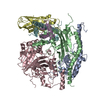
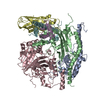
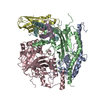
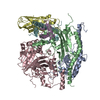
- PDB-6o22: Structure of Asf1-H3:H4-Rtt109-Vps75 histone chaperone-lysine ace... -
+ Open data

- Basic information
| Entry | Database: PDB / ID: 6o22 | ||||||
|---|---|---|---|---|---|---|---|
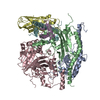
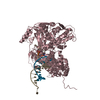
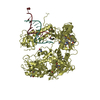
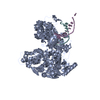
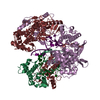
| Title | Structure of Asf1-H3:H4-Rtt109-Vps75 histone chaperone-lysine acetyltransferase complex with the histone substrate. | ||||||
 Components Components |
| ||||||
 Keywords Keywords | CHAPERONE | ||||||
| Function / homology |  Function and homology information Function and homology informationhistone H3K23 acetyltransferase activity / histone H3K56 acetyltransferase activity / Formation of Senescence-Associated Heterochromatin Foci (SAHF) / regulation of double-strand break repair via nonhomologous end joining / H3 histone acetyltransferase complex / histone H3K14 acetyltransferase activity / histone H3K9 acetyltransferase activity / maintenance of rDNA / replication-born double-strand break repair via sister chromatid exchange / transposable element silencing ...histone H3K23 acetyltransferase activity / histone H3K56 acetyltransferase activity / Formation of Senescence-Associated Heterochromatin Foci (SAHF) / regulation of double-strand break repair via nonhomologous end joining / H3 histone acetyltransferase complex / histone H3K14 acetyltransferase activity / histone H3K9 acetyltransferase activity / maintenance of rDNA / replication-born double-strand break repair via sister chromatid exchange / transposable element silencing / acetyltransferase activator activity / histone H3 acetyltransferase activity / DNA replication-dependent chromatin assembly / histone H3K27 acetyltransferase activity / silent mating-type cassette heterochromatin formation / nucleosome disassembly / cellular response to stress / negative regulation of DNA damage checkpoint / regulation of protein phosphorylation / subtelomeric heterochromatin formation / protein-lysine-acetyltransferase activity / histone acetyltransferase / regulation of DNA repair / positive regulation of transcription elongation by RNA polymerase II / double-strand break repair via nonhomologous end joining / nucleosomal DNA binding / structural constituent of chromatin / regulation of gene expression / nucleosome / nucleosome assembly / protein transport / heterochromatin formation / histone binding / chromatin organization / chromosome, telomeric region / chromatin remodeling / protein heterodimerization activity / chromatin binding / regulation of transcription by RNA polymerase II / DNA damage response / chromatin / DNA binding / DNA-templated transcription / nucleoplasm / identical protein binding / nucleus / cytosol Similarity search - Function | ||||||
| Biological species |   Saccharomyces cerevisiae (brewer's yeast) Saccharomyces cerevisiae (brewer's yeast) Xenopus laevis (African clawed frog) Xenopus laevis (African clawed frog) | ||||||
| Method | SOLUTION NMR /  SOLUTION SCATTERING / simulated annealing SOLUTION SCATTERING / simulated annealing | ||||||
 Authors Authors | Danilenko, N. / Carlomagno, T. / Kirkpatrick, J.P. | ||||||
 Citation Citation | Journal: Nat Commun / Year: 2019 Title: Histone chaperone exploits intrinsic disorder to switch acetylation specificity. Authors: Nataliya Danilenko / Lukas Lercher / John Kirkpatrick / Frank Gabel / Luca Codutti / Teresa Carlomagno /   Abstract: Histones, the principal protein components of chromatin, contain long disordered sequences, which are extensively post-translationally modified. Although histone chaperones are known to control both ...Histones, the principal protein components of chromatin, contain long disordered sequences, which are extensively post-translationally modified. Although histone chaperones are known to control both the activity and specificity of histone-modifying enzymes, the mechanisms promoting modification of highly disordered substrates, such as lysine-acetylation within the N-terminal tail of histone H3, are not understood. Here, to understand how histone chaperones Asf1 and Vps75 together promote H3 K9-acetylation, we establish the solution structural model of the acetyltransferase Rtt109 in complex with Asf1 and Vps75 and the histone dimer H3:H4. We show that Vps75 promotes K9-acetylation by engaging the H3 N-terminal tail in fuzzy electrostatic interactions with its disordered C-terminal domain, thereby confining the H3 tail to a wide central cavity faced by the Rtt109 active site. These fuzzy interactions between disordered domains achieve localization of lysine residues in the H3 tail to the catalytic site with minimal loss of entropy, and may represent a common mechanism of enzymatic reactions involving highly disordered substrates. | ||||||
| History |
|
- Structure visualization
| Structure viewer | Molecule: MolmilJmol/JSmol |
|---|
- Downloads & links
-Download
| PDBx/mmCIF format | 6o22.cif.gz | 411.6 KB | Display | PDBx/mmCIF format |
|---|---|---|---|---|
| PDB format | pdb6o22.ent.gz | 329.5 KB | Display | PDB format |
| PDBx/mmJSON format | 6o22.json.gz | Tree view | PDBx/mmJSON format | |
| Others |  Other downloads Other downloads |
-Validation report
| Arichive directory | https://data.pdbj.org/pub/pdb/validation_reports/o2/6o22ftp://data.pdbj.org/pub/pdb/validation_reports/o2/6o22 | HTTPS FTP |
|---|
-Related structure data
| Related structure data | C: citing same article ( |
|---|---|
| Similar structure data | |
| Other databases |
|

-Links
 PDBj
PDBj
- Assembly
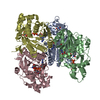
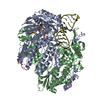
| Deposited unit | 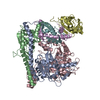
| |||||||||
|---|---|---|---|---|---|---|---|---|---|---|
| 1 |
| |||||||||
| NMR ensembles |
|
-Components
| #1: Protein | Mass: 30656.084 Da / Num. of mol.: 2 Source method: isolated from a genetically manipulated source Source: (gene. exp.) Saccharomyces cerevisiae (strain ATCC 204508 / S288c) (yeast)Strain: ATCC 204508 / S288c / Gene: VPS75, YNL246W, N0890 / Production host:   Escherichia coli (E. coli) / References: UniProt: P53853 Escherichia coli (E. coli) / References: UniProt: P53853#2: Protein | | Mass: 50765.434 Da / Num. of mol.: 1 Source method: isolated from a genetically manipulated source Source: (gene. exp.) Saccharomyces cerevisiae (strain ATCC 204508 / S288c) (yeast)Strain: ATCC 204508 / S288c / Gene: RTT109, KIM2, REM50, YLL002W, L1377 / Production host: Escherichia coli (E. coli) / References: UniProt: Q07794, histone acetyltransferase#3: Protein | | Mass: 31585.139 Da / Num. of mol.: 1 Source method: isolated from a genetically manipulated source Source: (gene. exp.) Saccharomyces cerevisiae (strain ATCC 204508 / S288c) (yeast)Strain: ATCC 204508 / S288c / Gene: ASF1, CIA1, YJL115W, J0755 / Production host: Escherichia coli (E. coli) / References: UniProt: P32447#4: Protein | | Mass: 15421.101 Da / Num. of mol.: 1 Source method: isolated from a genetically manipulated source Source: (gene. exp.) Xenopus laevis (African clawed frog) / Production host: Escherichia coli (E. coli) / References: UniProt: P84233#5: Protein | | Mass: 11394.426 Da / Num. of mol.: 1 Source method: isolated from a genetically manipulated source Source: (gene. exp.) Xenopus laevis (African clawed frog) / Production host: Escherichia coli (E. coli) / References: UniProt: P62799 |
|---|
-Experimental details
-Experiment
| Experiment |
| ||||||||||||||||||||||||||||||||||||||||||||||||
|---|---|---|---|---|---|---|---|---|---|---|---|---|---|---|---|---|---|---|---|---|---|---|---|---|---|---|---|---|---|---|---|---|---|---|---|---|---|---|---|---|---|---|---|---|---|---|---|---|---|
| NMR experiment |
|
- Sample preparation
| Details |
|
|---|