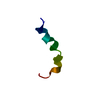
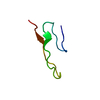
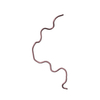
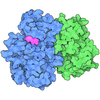
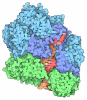
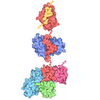
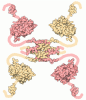
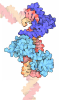
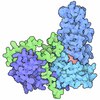
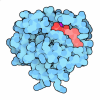
- PDB-6cej: Solution structure of a 14mer fragment of the p21 protein -
+
Open data
ID or keywords:
Loading...
-
Basic information
Entry
Database: PDB / ID: 6cej
Title
Solution structure of a 14mer fragment of the p21 protein
Components
Cyclin-dependent kinase inhibitor 1
Keywords
CELL CYCLE / PIP-box motif / p21 / PCNA
Function / homology
Function and homology information
negative regulation of cardiac muscle tissue regeneration / negative regulation of DNA biosynthetic process / FOXO-mediated transcription of cell cycle genes / TFAP2 (AP-2) family regulates transcription of cell cycle factors / cellular response to cell-matrix adhesion / import into nucleus / regulation of cell cycle G1/S phase transition / PCNA-p21 complex / Transcriptional regulation by RUNX2 / tissue regeneration ...negative regulation of cardiac muscle tissue regeneration / negative regulation of DNA biosynthetic process / FOXO-mediated transcription of cell cycle genes / TFAP2 (AP-2) family regulates transcription of cell cycle factors / cellular response to cell-matrix adhesion / import into nucleus / regulation of cell cycle G1/S phase transition / PCNA-p21 complex / Transcriptional regulation by RUNX2 / tissue regeneration / cyclin-dependent protein serine/threonine kinase inhibitor activity / oncogene-induced cell senescence / Transcriptional activation of cell cycle inhibitor p21 / positive regulation of programmed cell death / AKT phosphorylates targets in the cytosol / RUNX3 regulates CDKN1A transcription / stress-induced premature senescence / molecular function inhibitor activity / cellular response to UV-B / STAT5 activation downstream of FLT3 ITD mutants / negative regulation of G1/S transition of mitotic cell cycle / positive regulation of protein kinase activity / p53-Dependent G1 DNA Damage Response / Constitutive Signaling by AKT1 E17K in Cancer / mitotic G2 DNA damage checkpoint signaling / Defective binding of RB1 mutants to E2F1,(E2F2, E2F3) / protein kinase inhibitor activity / keratinocyte proliferation / replicative senescence / negative regulation of vascular associated smooth muscle cell proliferation / intrinsic apoptotic signaling pathway in response to DNA damage by p53 class mediator / keratinocyte differentiation / TP53 Regulates Transcription of Genes Involved in G1 Cell Cycle Arrest / Regulation of MITF-M-dependent genes involved in cell cycle and proliferation / Cyclin E associated events during G1/S transition / regulation of G2/M transition of mitotic cell cycle / Cyclin A:Cdk2-associated events at S phase entry / cyclin-dependent protein kinase holoenzyme complex / regulation of G1/S transition of mitotic cell cycle / positive regulation of B cell proliferation / mitotic G1 DNA damage checkpoint signaling / Signaling by FLT3 fusion proteins / intrinsic apoptotic signaling pathway / cyclin binding / positive regulation of DNA replication / molecular function activator activity / cellular response to amino acid starvation / protein serine/threonine kinase binding / cellular response to ionizing radiation / DNA damage response, signal transduction by p53 class mediator / wound healing / protein sequestering activity / G1/S transition of mitotic cell cycle / cellular response to gamma radiation / negative regulation of cell growth / protein import into nucleus / DNA Damage/Telomere Stress Induced Senescence / positive regulation of fibroblast proliferation / positive regulation of reactive oxygen species metabolic process / cellular senescence / Transcriptional regulation of granulopoiesis / SCF(Skp2)-mediated degradation of p27/p21 / Cyclin D associated events in G1 / The role of GTSE1 in G2/M progression after G2 checkpoint / Signaling by ALK fusions and activated point mutants / KEAP1-NFE2L2 pathway / heart development / in utero embryonic development / Neddylation / fibroblast proliferation / Senescence-Associated Secretory Phenotype (SASP) / Interleukin-4 and Interleukin-13 signaling / Ras protein signal transduction / regulation of cell cycle / nuclear body / negative regulation of cell population proliferation / negative regulation of gene expression / ubiquitin protein ligase binding / DNA damage response / protein kinase binding / nucleolus / protein-containing complex binding / protein-containing complex / zinc ion binding / nucleoplasm / nucleus / cytosol / cytoplasm Similarity search - Function
In the structure databanks used in Yorodumi, some data are registered as the other names, "COVID-19 virus" and "2019-nCoV". Here are the details of the virus and the list of structure data.
Jan 31, 2019. EMDB accession codes are about to change! (news from PDBe EMDB page)
EMDB accession codes are about to change! (news from PDBe EMDB page)
The allocation of 4 digits for EMDB accession codes will soon come to an end. Whilst these codes will remain in use, new EMDB accession codes will include an additional digit and will expand incrementally as the available range of codes is exhausted. The current 4-digit format prefixed with “EMD-” (i.e. EMD-XXXX) will advance to a 5-digit format (i.e. EMD-XXXXX), and so on. It is currently estimated that the 4-digit codes will be depleted around Spring 2019, at which point the 5-digit format will come into force.
The EM Navigator/Yorodumi systems omit the EMD- prefix.
Related info.:Q: What is EMD? / ID/Accession-code notation in Yorodumi/EM Navigator
Yorodumi is a browser for structure data from EMDB, PDB, SASBDB, etc.
This page is also the successor to EM Navigator detail page, and also detail information page/front-end page for Omokage search.
The word "yorodu" (or yorozu) is an old Japanese word meaning "ten thousand". "mi" (miru) is to see.
Related info.:EMDB / PDB / SASBDB / Comparison of 3 databanks / Yorodumi Search / Aug 31, 2016. New EM Navigator & Yorodumi / Yorodumi Papers / Jmol/JSmol / Function and homology information / Changes in new EM Navigator and Yorodumi