Mass: 11220.585 Da / Num. of mol.: 1 / Fragment: UNP residues 28-126 Source method: isolated from a genetically manipulated source Source: (gene. exp.) Homo sapiens (human) / Gene: ELAVL1, HUR / Plasmid: RP1B Details (production host): Recombinant protein expressed in fusion with a Thio6His6 expression/purification tag, followed by a TEV protease cleavage site Production host: Escherichia coli (E. coli) / Strain (production host): BL21(DE3) / References: UniProt: Q15717
-
Experimental details
-
Experiment
Experiment
Method: SOLUTION NMR
NMR experiment
Conditions-ID
Experiment-ID
Solution-ID
Sample state
Spectrometer-ID
Type
1
1
1
isotropic
2
2D 1H-15N HSQC
1
2
2
isotropic
1
2D 1H-13C HSQC aliphatic
1
3
2
isotropic
1
2D 1H-13C HSQC aromatic
1
4
2
isotropic
1
3D HN(CA)CB
1
5
2
isotropic
1
3DCBCA(CO)NH
1
9
2
isotropic
1
3D HNCO
1
8
2
isotropic
1
3DHN(CA)CO
1
7
2
isotropic
1
3DHBHA(CO)NH
1
6
2
isotropic
2
3D (H)CC(CO)NH
1
10
2
isotropic
1
3D (H)CCH-TOCSY
1
11
2
isotropic
2
3D 1H-13C NOESY aromatic
-
Sample preparation
Details
Type
Solution-ID
Contents
Details (eV)
Label
Solvent system
solution
1
1.5 mM [U-15N] HuR_RRM1, 30 mM sodium phosphate, 100 mM sodium chloride, 10 mM DTT, 90% H2O/10% D2O
U-100% 15N; 1.5mM
RRM1_N15
90% H2O/10% D2O
solution
2
1.5 mM [U-100% 13C; U-100% 15N] HuR_RRM1, 30 mM sodium phosphate, 100 mM sodium chloride, 10 mM DTT, 90% H2O/10% D2O
U-100% 13C; U-100% 15N; 1.5mM
RRM1_N15_C13
90% H2O/10% D2O
Sample
Conc. (mg/ml)
Component
Isotopic labeling
Solution-ID
1.5mM
HuR_RRM1
[U-15N]
1
30mM
sodiumphosphate
naturalabundance
1
100mM
sodiumchloride
naturalabundance
1
10mM
DTT
naturalabundance
1
1.5mM
HuR_RRM1
[U-100% 13C; U-100% 15N]
2
30mM
sodiumphosphate
naturalabundance
2
100mM
sodiumchloride
naturalabundance
2
10mM
DTT
naturalabundance
2
Sample conditions
Ionic strength: 100 mM / Label: Conditions_RRM1 / pH: 6.0 Not defined / Pressure: 1 atm / Temperature: 298 K
-
NMR measurement
NMR spectrometer
Type
Manufacturer
Model
Field strength (MHz)
Spectrometer-ID
Bruker DRX
Bruker
DRX
600
1
Bruker AVANCE III
Bruker
AVANCEIII
800
2
-
Processing
NMR software
Name
Version
Developer
Classification
TopSpin
3.1
BrukerBiospin
processing
CARA
KellerandWuthrich
chemicalshiftassignment
CcpNMR
CCPN
dataanalysis
CNS
Brunger, Adams, Clore, Gros, NilgesandRead
refinement
CNS
Brunger, Adams, Clore, Gros, NilgesandRead
structurecalculation
Refinement
Method: simulated annealing / Software ordinal: 4
NMR representative
Selection criteria: lowest energy
NMR ensemble
Conformer selection criteria: structures with the lowest energy Conformers calculated total number: 400 / Conformers submitted total number: 20
+
About Yorodumi
-
News
-
Feb 9, 2022. New format data for meta-information of EMDB entries
New format data for meta-information of EMDB entries
Version 3 of the EMDB header file is now the official format.
The previous official version 1.9 will be removed from the archive.
In the structure databanks used in Yorodumi, some data are registered as the other names, "COVID-19 virus" and "2019-nCoV". Here are the details of the virus and the list of structure data.
Jan 31, 2019. EMDB accession codes are about to change! (news from PDBe EMDB page)
EMDB accession codes are about to change! (news from PDBe EMDB page)
The allocation of 4 digits for EMDB accession codes will soon come to an end. Whilst these codes will remain in use, new EMDB accession codes will include an additional digit and will expand incrementally as the available range of codes is exhausted. The current 4-digit format prefixed with “EMD-” (i.e. EMD-XXXX) will advance to a 5-digit format (i.e. EMD-XXXXX), and so on. It is currently estimated that the 4-digit codes will be depleted around Spring 2019, at which point the 5-digit format will come into force.
The EM Navigator/Yorodumi systems omit the EMD- prefix.
Related info.:Q: What is EMD? / ID/Accession-code notation in Yorodumi/EM Navigator
Yorodumi is a browser for structure data from EMDB, PDB, SASBDB, etc.
This page is also the successor to EM Navigator detail page, and also detail information page/front-end page for Omokage search.
The word "yorodu" (or yorozu) is an old Japanese word meaning "ten thousand". "mi" (miru) is to see.
Related info.:EMDB / PDB / SASBDB / Comparison of 3 databanks / Yorodumi Search / Aug 31, 2016. New EM Navigator & Yorodumi / Yorodumi Papers / Jmol/JSmol / Function and homology information / Changes in new EM Navigator and Yorodumi
 Movie
Movie Controller

 Yorodumi
 Open data
 Basic information
 Components
 Keywords
 Function and homology information
 Homo sapiens (human)
 Authors
 Brazil,
  United States, 3items
  Citation
 Structure visualization
 Downloads & links
 Other downloads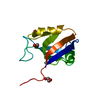

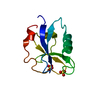
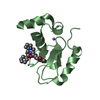

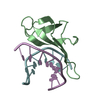
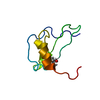
 PDBj
PDBj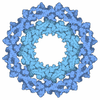
 Assembly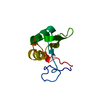

 Escherichia coli (E. coli) / Strain (production host): BL21(DE3) / References: UniProt: Q15717
 HSQC
HSQC Sample preparation
 Processing