negative regulation of cell-cell adhesion mediated by integrin / monoatomic cation homeostasis / chemokine (C-C motif) ligand 21 signaling pathway / lymphocyte migration into lymph node / positive regulation of termination of RNA polymerase II transcription / negative regulation of pancreatic juice secretion / negative regulation of sodium ion transport / protein insertion into ER membrane by stop-transfer membrane-anchor sequence / negative regulation of small GTPase mediated signal transduction / positive regulation of mitotic cytokinesis ...negative regulation of cell-cell adhesion mediated by integrin / monoatomic cation homeostasis / chemokine (C-C motif) ligand 21 signaling pathway / lymphocyte migration into lymph node / positive regulation of termination of RNA polymerase II transcription / negative regulation of pancreatic juice secretion / negative regulation of sodium ion transport / protein insertion into ER membrane by stop-transfer membrane-anchor sequence / negative regulation of small GTPase mediated signal transduction / positive regulation of mitotic cytokinesis / intracellular membraneless organelle / monoatomic ion homeostasis / regulation of mRNA export from nucleus / negative regulation of heterotypic cell-cell adhesion / negative regulation of kinase activity / positive regulation of potassium ion import across plasma membrane / positive regulation of T cell chemotaxis / potassium ion homeostasis / regulation of sodium ion transmembrane transport / cellular response to chemokine / negative regulation of leukocyte cell-cell adhesion / cellular hyperosmotic response / cell volume homeostasis / membraneless organelle assembly / potassium channel inhibitor activity / regulation of monoatomic cation transmembrane transport / regulation of sodium ion transport / positive regulation of systemic arterial blood pressure / monoatomic ion transport / negative regulation of protein localization to plasma membrane / protein kinase activator activity / protein serine/threonine kinase inhibitor activity / phosphatase binding / negative regulation of protein ubiquitination / cellular response to calcium ion / negative regulation of autophagy / sodium ion transmembrane transport / regulation of blood pressure / molecular condensate scaffold activity / GABA-ergic synapse / mitotic spindle / modulation of chemical synaptic transmission / T cell receptor signaling pathway / heart development / positive regulation of angiogenesis / positive regulation of canonical Wnt signaling pathway / protein autophosphorylation / protein kinase activity / protein phosphorylation / non-specific serine/threonine protein kinase / intracellular signal transduction / protein serine kinase activity / protein serine/threonine kinase activity / protein kinase binding / magnesium ion binding / signal transduction / ATP binding / membrane / nucleus / cytosol / cytoplasm Similarity search - Function
In the structure databanks used in Yorodumi, some data are registered as the other names, "COVID-19 virus" and "2019-nCoV". Here are the details of the virus and the list of structure data.
Jan 31, 2019. EMDB accession codes are about to change! (news from PDBe EMDB page)
EMDB accession codes are about to change! (news from PDBe EMDB page)
The allocation of 4 digits for EMDB accession codes will soon come to an end. Whilst these codes will remain in use, new EMDB accession codes will include an additional digit and will expand incrementally as the available range of codes is exhausted. The current 4-digit format prefixed with “EMD-” (i.e. EMD-XXXX) will advance to a 5-digit format (i.e. EMD-XXXXX), and so on. It is currently estimated that the 4-digit codes will be depleted around Spring 2019, at which point the 5-digit format will come into force.
The EM Navigator/Yorodumi systems omit the EMD- prefix.
Related info.:Q: What is EMD? / ID/Accession-code notation in Yorodumi/EM Navigator
Yorodumi is a browser for structure data from EMDB, PDB, SASBDB, etc.
This page is also the successor to EM Navigator detail page, and also detail information page/front-end page for Omokage search.
The word "yorodu" (or yorozu) is an old Japanese word meaning "ten thousand". "mi" (miru) is to see.
Related info.:EMDB / PDB / SASBDB / Comparison of 3 databanks / Yorodumi Search / Aug 31, 2016. New EM Navigator & Yorodumi / Yorodumi Papers / Jmol/JSmol / Function and homology information / Changes in new EM Navigator and Yorodumi
 Movie
Movie Controller


 Open data
 Basic information
 Components
 Keywords
 Function and homology information
 Rattus norvegicus (Norway rat)
 X-RAY DIFFRACTION /
  Authors
 Citation
 Structure visualization
 Downloads & links
 Other downloads
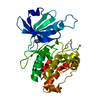

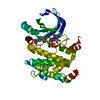

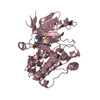
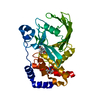
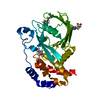

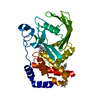
 PDBj
PDBj Assembly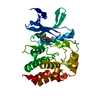

 Escherichia coli (E. coli)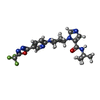
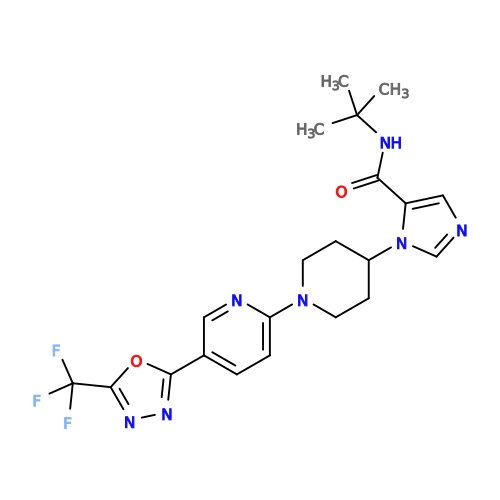 Mass: 463.456 Da / Num. of mol.: 1 / Source method: obtained synthetically / Formula: C21H24F3N7O2
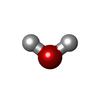 Mass: 18.015 Da / Num. of mol.: 254 / Source method: isolated from a natural source / Formula: H2O
 Sample preparation
 / Beamline: 17-ID / Wavelength: 1 Å
 Processing