 Movie
Movie Controller

[English] 日本語
 Yorodumi
- PDB-5a63: Cryo-EM structure of the human gamma-secretase complex at 3.4 ang... -
+ Open data

- Basic information
| Entry | Database: PDB / ID: 5a63 | ||||||||||||
|---|---|---|---|---|---|---|---|---|---|---|---|---|---|
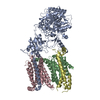
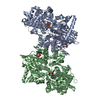
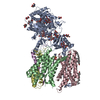
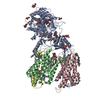
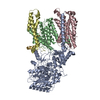
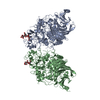
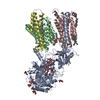
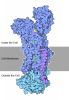
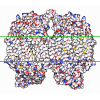
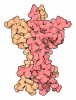
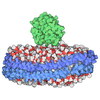
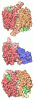
| Title | Cryo-EM structure of the human gamma-secretase complex at 3.4 angstrom resolution. | ||||||||||||
 Components Components |
| ||||||||||||
 Keywords Keywords | HYDROLASE / CRYO-EM / HUMAN GAMMA-SECRETASE / MEMBRANE PROTEIN | ||||||||||||
| Function / homology |  Function and homology information Function and homology informationpositive regulation of endopeptidase activity / gamma-secretase complex / aspartic endopeptidase activity, intramembrane cleaving / Noncanonical activation of NOTCH3 / protein catabolic process at postsynapse / TGFBR3 PTM regulation / Notch receptor processing / skin morphogenesis / membrane protein intracellular domain proteolysis / NOTCH4 Activation and Transmission of Signal to the Nucleus ...positive regulation of endopeptidase activity / gamma-secretase complex / aspartic endopeptidase activity, intramembrane cleaving / Noncanonical activation of NOTCH3 / protein catabolic process at postsynapse / TGFBR3 PTM regulation / Notch receptor processing / skin morphogenesis / membrane protein intracellular domain proteolysis / NOTCH4 Activation and Transmission of Signal to the Nucleus / ciliary rootlet / neural retina development / Regulated proteolysis of p75NTR / mitochondria-associated endoplasmic reticulum membrane contact site / aggresome / endoplasmic reticulum calcium ion homeostasis / amyloid precursor protein metabolic process / regulation of synaptic vesicle cycle / astrocyte activation involved in immune response / regulation of postsynapse organization / Notch signaling pathway / regulation of neuron projection development / regulation of canonical Wnt signaling pathway / Hydrolases; Acting on peptide bonds (peptidases); Aspartic endopeptidases / Golgi cisterna membrane / growth factor receptor binding / azurophil granule membrane / positive regulation of amyloid fibril formation / amyloid precursor protein catabolic process / positive regulation of dendritic spine development / amyloid-beta formation / membrane protein ectodomain proteolysis / positive regulation of receptor recycling / smooth endoplasmic reticulum / nuclear outer membrane / EPH-ephrin mediated repulsion of cells / cerebellum development / calcium ion homeostasis / Nuclear signaling by ERBB4 / endopeptidase activator activity / Degradation of the extracellular matrix / negative regulation of ubiquitin-dependent protein catabolic process / neuron projection maintenance / rough endoplasmic reticulum / astrocyte activation / positive regulation of glycolytic process / NOTCH2 Activation and Transmission of Signal to the Nucleus / NRIF signals cell death from the nucleus / Activated NOTCH1 Transmits Signal to the Nucleus / dendritic shaft / neuromuscular junction / PDZ domain binding / cell-cell adhesion / NOTCH3 Activation and Transmission of Signal to the Nucleus / protein processing / memory / sarcolemma / synapse organization / beta-catenin binding / kinetochore / cellular response to amyloid-beta / Constitutive Signaling by NOTCH1 PEST Domain Mutants / Constitutive Signaling by NOTCH1 HD+PEST Domain Mutants / regulation of gene expression / calcium channel activity / positive regulation of tumor necrosis factor production / melanosome / positive regulation of proteasomal ubiquitin-dependent protein catabolic process / negative regulation of neuron apoptotic process / synaptic vesicle / nuclear membrane / ATPase binding / growth cone / early endosome membrane / endopeptidase activity / presynaptic membrane / cell cortex / aspartic-type endopeptidase activity / molecular adaptor activity / early endosome / learning or memory / neuron projection / postsynapse / protein-macromolecule adaptor activity / intracellular signal transduction / mitochondrial inner membrane / apoptotic process / endosome membrane / cadherin binding / membrane raft / Amyloid fiber formation / negative regulation of gene expression / Golgi membrane / focal adhesion / lysosomal membrane / centrosome / neuronal cell body / positive regulation of gene expression / DNA damage response / negative regulation of apoptotic process Similarity search - Function | ||||||||||||
| Biological species |  Homo sapiens (human) Homo sapiens (human) | ||||||||||||
| Method | ELECTRON MICROSCOPY / single particle reconstruction / cryo EM / Resolution: 3.4 Å | ||||||||||||
 Authors Authors | Bai, X. / Yan, C. / Yang, G. / Lu, P. / Ma, D. / Sun, L. / Zhou, R. / Scheres, S.H.W. / Shi, Y. | ||||||||||||
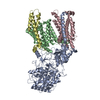
 Citation Citation | Journal: Nature / Year: 2015 Title: An atomic structure of human γ-secretase. Authors: Xiao-Chen Bai / Chuangye Yan / Guanghui Yang / Peilong Lu / Dan Ma / Linfeng Sun / Rui Zhou / Sjors H W Scheres / Yigong Shi /   Abstract: Dysfunction of the intramembrane protease γ-secretase is thought to cause Alzheimer's disease, with most mutations derived from Alzheimer's disease mapping to the catalytic subunit presenilin 1 (PS1) ...Dysfunction of the intramembrane protease γ-secretase is thought to cause Alzheimer's disease, with most mutations derived from Alzheimer's disease mapping to the catalytic subunit presenilin 1 (PS1). Here we report an atomic structure of human γ-secretase at 3.4 Å resolution, determined by single-particle cryo-electron microscopy. Mutations derived from Alzheimer's disease affect residues at two hotspots in PS1, each located at the centre of a distinct four transmembrane segment (TM) bundle. TM2 and, to a lesser extent, TM6 exhibit considerable flexibility, yielding a plastic active site and adaptable surrounding elements. The active site of PS1 is accessible from the convex side of the TM horseshoe, suggesting considerable conformational changes in nicastrin extracellular domain after substrate recruitment. Component protein APH-1 serves as a scaffold, anchoring the lone transmembrane helix from nicastrin and supporting the flexible conformation of PS1. Ordered phospholipids stabilize the complex inside the membrane. Our structure serves as a molecular basis for mechanistic understanding of γ-secretase function. | ||||||||||||
| History |
|
- Structure visualization
| Movie |
Movie viewer |
|---|---|
| Structure viewer | Molecule: MolmilJmol/JSmol |
- Downloads & links
-Download
| PDBx/mmCIF format | 5a63.cif.gz | 270.5 KB | Display | PDBx/mmCIF format |
|---|---|---|---|---|
| PDB format | pdb5a63.ent.gz | 211.6 KB | Display | PDB format |
| PDBx/mmJSON format | 5a63.json.gz | Tree view | PDBx/mmJSON format | |
| Others |  Other downloads Other downloads |
-Validation report
| Arichive directory | https://data.pdbj.org/pub/pdb/validation_reports/a6/5a63ftp://data.pdbj.org/pub/pdb/validation_reports/a6/5a63 | HTTPS FTP |
|---|
-Related structure data
| Related structure data | 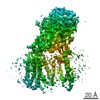 2677M 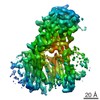 2678M 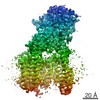 3061MC M: map data used to model this data C: citing same article ( |
|---|---|
| Similar structure data | |
| EM raw data | EMPIAR-10194 (Title: An atomic structure of human gamma-secretase / Data size: 11.7 TB Data #1: Unaligned multi-frame micrographs of human gamma-secretase [micrographs - multiframe]) |


-Links
 PDBj
PDBj
- Assembly
| Deposited unit | 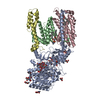
|
|---|---|
| 1 |
|
-Components
-Protein , 2 types, 2 molecules AB
| #1: Protein | Mass: 78483.570 Da / Num. of mol.: 1 Source method: isolated from a genetically manipulated source Source: (gene. exp.) Homo sapiens (human) / Cell line: HEK 293F / Gene: NCSTN, KIAA0253, UNQ1874/PRO4317 / Cell line (production host): HEK 293F / Production host: HOMO SAPIENS (human) / References: UniProt: Q92542 |
|---|---|
| #2: Protein | Mass: 52713.535 Da / Num. of mol.: 1 Source method: isolated from a genetically manipulated source Source: (gene. exp.) Homo sapiens (human) / Cell line: HEK 293F / Gene: PSEN1, AD3, PS1, PSNL1 / Cell line (production host): HEK 293F / Production host: HOMO SAPIENS (human)References: UniProt: P49768, Hydrolases; Acting on peptide bonds (peptidases); Aspartic endopeptidases |
-Gamma-secretase subunit ... , 2 types, 2 molecules CD
| #3: Protein | Mass: 29017.943 Da / Num. of mol.: 1 Source method: isolated from a genetically manipulated source Source: (gene. exp.) Homo sapiens (human) / Cell line: HEK 293F / Gene: APH1A, PSF, CGI-78, UNQ579/PRO1141 / Cell line (production host): HEK 293F / Production host: HOMO SAPIENS (human) / References: UniProt: Q96BI3 |
|---|---|
| #4: Protein | Mass: 12038.029 Da / Num. of mol.: 1 Source method: isolated from a genetically manipulated source Source: (gene. exp.) Homo sapiens (human) / Cell line: HEK 293F / Gene: PSENEN, PEN2, MDS033 / Cell line (production host): HEK 293F / Production host: HOMO SAPIENS (human) / References: UniProt: Q9NZ42 |
-Sugars , 3 types, 11 molecules 
| #5: Polysaccharide | 2-acetamido-2-deoxy-beta-D-glucopyranose-(1-4)-2-acetamido-2-deoxy-beta-D-glucopyranose Source method: isolated from a genetically manipulated source #6: Polysaccharide | beta-D-mannopyranose-(1-3)-[beta-D-mannopyranose-(1-6)]beta-D-mannopyranose-(1-4)-2-acetamido-2- ...beta-D-mannopyranose-(1-3)-[beta-D-mannopyranose-(1-6)]beta-D-mannopyranose-(1-4)-2-acetamido-2-deoxy-beta-D-glucopyranose-(1-4)-2-acetamido-2-deoxy-beta-D-glucopyranose | Source method: isolated from a genetically manipulated source #7: Sugar | ChemComp-NAG / 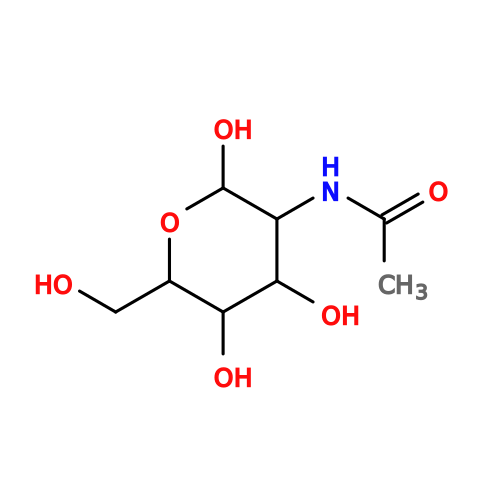 Type: D-saccharide, beta linking / Mass: 221.208 Da / Num. of mol.: 5 Type: D-saccharide, beta linking / Mass: 221.208 Da / Num. of mol.: 5Source method: isolated from a genetically manipulated source Formula: C8H15NO6 |
|---|
-Non-polymers , 1 types, 2 molecules 
| #8: Chemical | 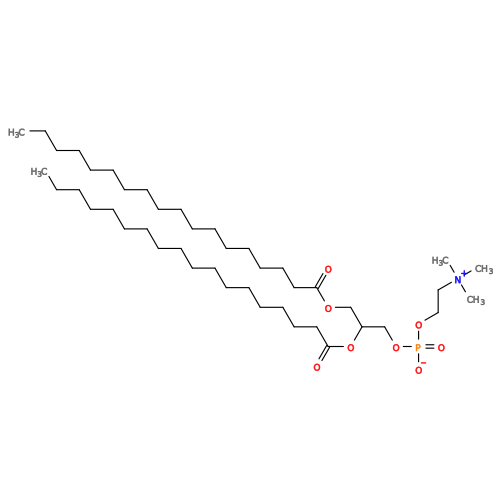 Mass: 790.145 Da / Num. of mol.: 2 / Source method: obtained synthetically / Formula: C44H88NO8P / Comment: phospholipid*YM Mass: 790.145 Da / Num. of mol.: 2 / Source method: obtained synthetically / Formula: C44H88NO8P / Comment: phospholipid*YM |
|---|
-Details
| Has protein modification | Y |
|---|
-Experimental details
-Experiment
| Experiment | Method: ELECTRON MICROSCOPY |
|---|---|
| EM experiment | Aggregation state: PARTICLE / 3D reconstruction method: single particle reconstruction |
- Sample preparation
| Component | Name: HUMAN GAMMA-SECRETASE / Type: COMPLEX |
|---|---|
| Buffer solution | Name: 25 MM HEPES, PH 7.4, 150 MM NACL AND AMPHIPOL A8-35 / pH: 7.4 Details: 25 MM HEPES, PH 7.4, 150 MM NACL AND AMPHIPOL A8-35 |
| Specimen | Conc.: 6 mg/ml / Embedding applied: NO / Shadowing applied: NO / Staining applied: NO / Vitrification applied: YES |
| Specimen support | Details: HOLEY CARBON |
| Vitrification | Instrument: FEI VITROBOT MARK IV / Cryogen name: ETHANE Details: VITRIFICATION 1 -- CRYOGEN- ETHANE, HUMIDITY- 100, TEMPERATURE- 85, INSTRUMENT- FEI VITROBOT MARK IV, METHOD- BLOT FOR 4 SECONDS BEFORE PLUNGING, |
- Electron microscopy imaging
| Experimental equipment | 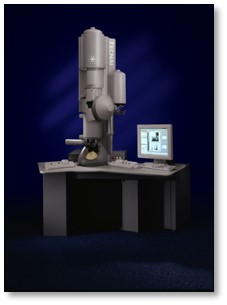 Model: Tecnai F30 / Image courtesy: FEI Company |
|---|---|
| Microscopy | Model: FEI TECNAI F30 / Date: Oct 2, 2014 |
| Electron gun | Electron source:  FIELD EMISSION GUN / Accelerating voltage: 300 kV / Illumination mode: FLOOD BEAM FIELD EMISSION GUN / Accelerating voltage: 300 kV / Illumination mode: FLOOD BEAM |
| Electron lens | Mode: BRIGHT FIELD / Nominal magnification: 81000 X / Calibrated magnification: 35714 X / Nominal defocus max: 3200 nm / Nominal defocus min: 700 nm / Cs: 2.7 mm |
| Specimen holder | Temperature: 85 K |
| Image recording | Electron dose: 38 e/Å2 / Film or detector model: GATAN K2 (4k x 4k) |
| Radiation wavelength | Relative weight: 1 |
- Processing
| EM software |
| ||||||||||||
|---|---|---|---|---|---|---|---|---|---|---|---|---|---|
| CTF correction | Details: EACH PARTICLE | ||||||||||||
| Symmetry | Point symmetry: C1 (asymmetric) | ||||||||||||
| 3D reconstruction | Resolution: 3.4 Å / Num. of particles: 159549 Magnification calibration: CROSS- -CORRELATION DENSITIES WITHIN SPHERICAL SHELL Details: SUBMISSION BASED ON EXPERIMENTAL DATA FROM EMDB EMD-3061. (DEPOSITION ID: 13527). Symmetry type: POINT | ||||||||||||
| Refinement | Highest resolution: 3.4 Å | ||||||||||||
| Refinement step | Cycle: LAST / Highest resolution: 3.4 Å
|
