bBAF complex / npBAF complex / nBAF complex / brahma complex / Formation of the canonical BAF (cBAF) complex / Formation of the polybromo-BAF (pBAF) complex / Formation of neuronal progenitor and neuronal BAF (npBAF and nBAF) / GBAF complex / Formation of the non-canonical BAF (ncBAF) complex / regulation of G0 to G1 transition ...bBAF complex / npBAF complex / nBAF complex / brahma complex / Formation of the canonical BAF (cBAF) complex / Formation of the polybromo-BAF (pBAF) complex / Formation of neuronal progenitor and neuronal BAF (npBAF and nBAF) / GBAF complex / Formation of the non-canonical BAF (ncBAF) complex / regulation of G0 to G1 transition / RSC-type complex / spermatid development / positive regulation of T cell differentiation / regulation of mitotic metaphase/anaphase transition / SWI/SNF complex / regulation of nucleotide-excision repair / positive regulation of stem cell population maintenance / positive regulation of double-strand break repair / Regulation of MITF-M-dependent genes involved in pigmentation / negative regulation of cell differentiation / RUNX1 interacts with co-factors whose precise effect on RUNX1 targets is not known / positive regulation of myoblast differentiation / ATP-dependent activity, acting on DNA / regulation of G1/S transition of mitotic cell cycle / helicase activity / positive regulation of cell differentiation / Regulation of endogenous retroelements by Piwi-interacting RNAs (piRNAs) / negative regulation of cell growth / Hydrolases; Acting on acid anhydrides; Acting on acid anhydrides to facilitate cellular and subcellular movement / RMTs methylate histone arginines / histone binding / transcription coactivator activity / transcription cis-regulatory region binding / chromatin remodeling / negative regulation of cell population proliferation / negative regulation of DNA-templated transcription / chromatin binding / regulation of transcription by RNA polymerase II / positive regulation of cell population proliferation / regulation of DNA-templated transcription / positive regulation of DNA-templated transcription / chromatin / negative regulation of transcription by RNA polymerase II / positive regulation of transcription by RNA polymerase II / ATP hydrolysis activity / nucleoplasm / ATP binding / nucleus Similarity search - Function
SWI/SNF-related matrix-associated actin-dependent regulator of chromatin subfamily A member 2 / cDNA FLJ36757 fis, clone UTERU2018522, highly similar to Human transcriptional activator hSNF2a Similarity search - Component
In the structure databanks used in Yorodumi, some data are registered as the other names, "COVID-19 virus" and "2019-nCoV". Here are the details of the virus and the list of structure data.
Jan 31, 2019. EMDB accession codes are about to change! (news from PDBe EMDB page)
EMDB accession codes are about to change! (news from PDBe EMDB page)
The allocation of 4 digits for EMDB accession codes will soon come to an end. Whilst these codes will remain in use, new EMDB accession codes will include an additional digit and will expand incrementally as the available range of codes is exhausted. The current 4-digit format prefixed with “EMD-” (i.e. EMD-XXXX) will advance to a 5-digit format (i.e. EMD-XXXXX), and so on. It is currently estimated that the 4-digit codes will be depleted around Spring 2019, at which point the 5-digit format will come into force.
The EM Navigator/Yorodumi systems omit the EMD- prefix.
Related info.:Q: What is EMD? / ID/Accession-code notation in Yorodumi/EM Navigator
Yorodumi is a browser for structure data from EMDB, PDB, SASBDB, etc.
This page is also the successor to EM Navigator detail page, and also detail information page/front-end page for Omokage search.
The word "yorodu" (or yorozu) is an old Japanese word meaning "ten thousand". "mi" (miru) is to see.
Related info.:EMDB / PDB / SASBDB / Comparison of 3 databanks / Yorodumi Search / Aug 31, 2016. New EM Navigator & Yorodumi / Yorodumi Papers / Jmol/JSmol / Function and homology information / Changes in new EM Navigator and Yorodumi
 Movie
Movie Controller


 Open data
 Basic information
 Components
 Keywords
 Function and homology information
 Homo sapiens (human)
 X-RAY DIFFRACTION /
  Authors
 Citation
 Structure visualization
 Downloads & links
 Other downloads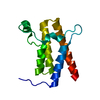
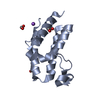
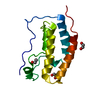
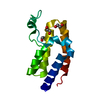
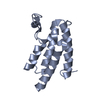
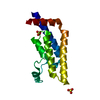
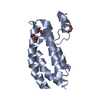
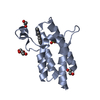

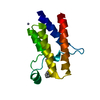
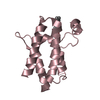
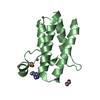
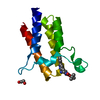
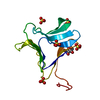
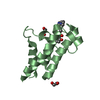
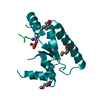
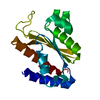
 PDBj
PDBj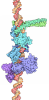
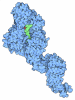
 Assembly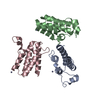
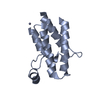
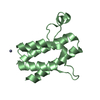
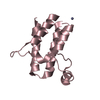

 Escherichia coli (E. coli) / Strain (production host): BL21(DE3)-R3 / References: UniProt: Q8N9Q1, UniProt: P51531*PLUS
 Mass: 65.409 Da / Num. of mol.: 3 / Source method: obtained synthetically / Formula: Zn
 Mass: 18.015 Da / Num. of mol.: 98 / Source method: isolated from a natural source / Formula: H2O
 Sample preparation
 / Beamline: I03 / Wavelength: 0.9763 Å
 Processing