- PDB-4eo2: Structure of the bacteriophage C1 tail knob protein, gp12 -
+
Open data
ID or keywords:
Loading...
-
Basic information
Entry
Database: PDB / ID: 4eo2
Title
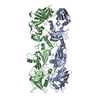
Structure of the bacteriophage C1 tail knob protein, gp12
Components
Major tail protein
Keywords
STRUCTURAL PROTEIN / VIRAL PROTEIN
Function / homology
Distal tube protein, N-terminal / : / Caudoviral major tail protein N-terminus / Bacillus phage phi29, Tail knob protein gp9, C-terminal domain / identical protein binding / Major tail protein
Function and homology information
Biological species
Streptococcus phage C1 (virus)
Method
X-RAY DIFFRACTION / SYNCHROTRON / MAD / Resolution: 3.007 Å
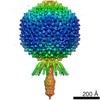
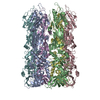
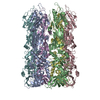
Journal: Proc Natl Acad Sci U S A / Year: 2012 Title: Structural investigations of a Podoviridae streptococcus phage C1, implications for the mechanism of viral entry. Authors: Anastasia A Aksyuk / Valorie D Bowman / Bärbel Kaufmann / Christopher Fields / Thomas Klose / Heather A Holdaway / Vincent A Fischetti / Michael G Rossmann / Abstract: The Podoviridae phage C1 was one of the earliest isolated bacteriophages and the first virus documented to be active against streptococci. The icosahedral and asymmetric reconstructions of the virus ...The Podoviridae phage C1 was one of the earliest isolated bacteriophages and the first virus documented to be active against streptococci. The icosahedral and asymmetric reconstructions of the virus were calculated using cryo-electron microscopy. The capsid protein has an HK97 fold arranged into a T = 4 icosahedral lattice. The C1 tail is terminated with a ϕ29-like knob, surrounded by a skirt of twelve long appendages with novel morphology. Several C1 structural proteins have been identified, including a candidate for an appendage. The crystal structure of the knob has an N-terminal domain with a fold observed previously in tube forming proteins of Siphoviridae and Myoviridae phages. The structure of C1 suggests the mechanisms by which the virus digests the cell wall and ejects its genome. Although there is little sequence similarity to other phages, conservation of the structural proteins demonstrates a common origin of the head and tail, but more recent evolution of the appendages.
 Movie
Movie Controller


 Open data
 Basic information
 Components
 Keywords
 Function and homology information
 Streptococcus phage C1 (virus)
 X-RAY DIFFRACTION /
  Authors
 Citation
 Structure visualization
 Downloads & links
 Other downloads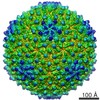



 PDBj
PDBj Assembly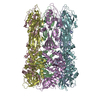

 Escherichia coli (E. coli) / References: UniProt: Q7Y3F0
 Sample preparation
 Processing