phosphatase inhibitor activity / postsynaptic endosome membrane / histone chaperone activity / Swr1 complex / negative regulation of tumor necrosis factor-mediated signaling pathway / RNA polymerase II core promoter sequence-specific DNA binding / protein localization to CENP-A containing chromatin / Replacement of protamines by nucleosomes in the male pronucleus / heterochromatin / CENP-A containing nucleosome ...phosphatase inhibitor activity / postsynaptic endosome membrane / histone chaperone activity / Swr1 complex / negative regulation of tumor necrosis factor-mediated signaling pathway / RNA polymerase II core promoter sequence-specific DNA binding / protein localization to CENP-A containing chromatin / Replacement of protamines by nucleosomes in the male pronucleus / heterochromatin / CENP-A containing nucleosome / protein folding chaperone / Packaging Of Telomere Ends / Recognition and association of DNA glycosylase with site containing an affected purine / Cleavage of the damaged purine / ChAHP complex assembly / Deposition of new CENPA-containing nucleosomes at the centromere / Recognition and association of DNA glycosylase with site containing an affected pyrimidine / Cleavage of the damaged pyrimidine / RNA Polymerase I Promoter Opening / Inhibition of DNA recombination at telomere / Assembly of the ORC complex at the origin of replication / FXIIa activates plasma kallikrein-kinin system / Regulation of endogenous retroelements by the Human Silencing Hub (HUSH) complex / Meiotic synapsis / DNA methylation / Condensation of Prophase Chromosomes / cellular response to estradiol stimulus / Chromatin modifications during the maternal to zygotic transition (MZT) / HCMV Late Events / SIRT1 negatively regulates rRNA expression / ERCC6 (CSB) and EHMT2 (G9a) positively regulate rRNA expression / PRC2 methylates histones and DNA / NuRD complex assembly / Regulation of endogenous retroelements by KRAB-ZFP proteins / Interaction of NuRD complexes with transcription factors / Defective pyroptosis / HDACs deacetylate histones / CHD1 and CHD2 subfamily / Transcriptional regulation by small RNAs / lipopolysaccharide binding / Regulation of endogenous retroelements by Piwi-interacting RNAs (piRNAs) / RNA Polymerase I Promoter Escape / Nonhomologous End-Joining (NHEJ) / euchromatin / CHD6, CHD7, CHD8, CHD9 subfamily / Activated PKN1 stimulates transcription of AR (androgen receptor) regulated genes KLK2 and KLK3 / RUNX1 regulates genes involved in megakaryocyte differentiation and platelet function / chromatin DNA binding / Negative Regulation of CDH1 Gene Transcription / NoRC negatively regulates rRNA expression / G2/M DNA damage checkpoint / Formation of the beta-catenin:TCF transactivating complex / postsynaptic density membrane / B-WICH complex positively regulates rRNA expression / DNA Damage/Telomere Stress Induced Senescence / Meiotic recombination / Pre-NOTCH Transcription and Translation / Activation of anterior HOX genes in hindbrain development during early embryogenesis / Transcriptional regulation of granulopoiesis / HCMV Early Events / nucleosomal DNA binding / innate immune response in mucosa / synaptic vesicle membrane / histone binding / structural constituent of chromatin / nucleosome assembly / Regulation of PD-L1(CD274) transcription / nucleosome / HATs acetylate histones / E3 ubiquitin ligases ubiquitinate target proteins / killing of cells of another organism / Recruitment and ATM-mediated phosphorylation of repair and signaling proteins at DNA double strand breaks / MLL4 and MLL3 complexes regulate expression of PPARG target genes in adipogenesis and hepatic steatosis / RUNX1 regulates transcription of genes involved in differentiation of HSCs / chromatin organization / Processing of DNA double-strand break ends / Dengue Virus-Host Interactions / antimicrobial humoral immune response mediated by antimicrobial peptide / Senescence-Associated Secretory Phenotype (SASP) / cytoplasmic vesicle / heterochromatin formation / defense response to Gram-negative bacterium / Oxidative Stress Induced Senescence / antibacterial humoral response / Estrogen-dependent gene expression / regulation of apoptotic process / defense response to Gram-positive bacterium / Ub-specific processing proteases / RNA polymerase II cis-regulatory region sequence-specific DNA binding / Amyloid fiber formation / protein heterodimerization activity / glutamatergic synapse / positive regulation of transcription by RNA polymerase II / DNA binding / extracellular exosome / nucleoplasm / extracellular region / nucleus Similarity search - Function
Mass: 18.015 Da / Num. of mol.: 212 / Source method: isolated from a natural source / Formula: H2O
Sequence details
THE METHIONINE AT THE START OF THE MACROMOLECULAR SEQUENCE (CHAIN A) IS AN EXPRESSION ARTEFACT THE ...THE METHIONINE AT THE START OF THE MACROMOLECULAR SEQUENCE (CHAIN A) IS AN EXPRESSION ARTEFACT THE METHIONINE AT THE START OF THE MACROMOLECULAR SEQUENCE (CHAIN B) IS AN EXPRESSION ARTEFACT THE GLY-SER AND HIS-MET RESIDUES AT THE BEGINNING OF THE MACROMOLECULAR SEQUENCE (CHAIN C) ARE ARTEFACTS FROM THE THROMBIN CLEAVAGE SITE AND THE CLONING SITE, RESPECTIVELY
-
Experimental details
-
Experiment
Experiment
Method: X-RAY DIFFRACTION / Number of used crystals: 1
-
Sample preparation
Crystal
Density Matthews: 1.84 Å3/Da / Density % sol: 33 % / Description: NONE
Crystal grow
Details: 0.1 M NA CACODYLATE, PH 7.0, 0.2 M NA FORMATE, 24% TO 30% PEG 3350
In the structure databanks used in Yorodumi, some data are registered as the other names, "COVID-19 virus" and "2019-nCoV". Here are the details of the virus and the list of structure data.
Jan 31, 2019. EMDB accession codes are about to change! (news from PDBe EMDB page)
EMDB accession codes are about to change! (news from PDBe EMDB page)
The allocation of 4 digits for EMDB accession codes will soon come to an end. Whilst these codes will remain in use, new EMDB accession codes will include an additional digit and will expand incrementally as the available range of codes is exhausted. The current 4-digit format prefixed with “EMD-” (i.e. EMD-XXXX) will advance to a 5-digit format (i.e. EMD-XXXXX), and so on. It is currently estimated that the 4-digit codes will be depleted around Spring 2019, at which point the 5-digit format will come into force.
The EM Navigator/Yorodumi systems omit the EMD- prefix.
Related info.:Q: What is EMD? / ID/Accession-code notation in Yorodumi/EM Navigator
Yorodumi is a browser for structure data from EMDB, PDB, SASBDB, etc.
This page is also the successor to EM Navigator detail page, and also detail information page/front-end page for Omokage search.
The word "yorodu" (or yorozu) is an old Japanese word meaning "ten thousand". "mi" (miru) is to see.
Related info.:EMDB / PDB / SASBDB / Comparison of 3 databanks / Yorodumi Search / Aug 31, 2016. New EM Navigator & Yorodumi / Yorodumi Papers / Jmol/JSmol / Function and homology information / Changes in new EM Navigator and Yorodumi
 Movie
Movie Controller


 Open data
 Basic information
 Components
 Keywords
 Function and homology information
 HOMO SAPIENS (human)
 X-RAY DIFFRACTION /
  Authors
 Citation
 Structure visualization
 Downloads & links
 Other downloads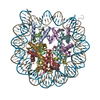
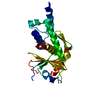
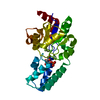
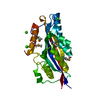
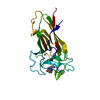
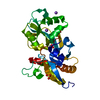
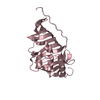
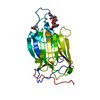
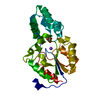
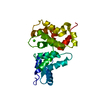
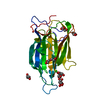
 PDBj
PDBj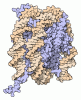
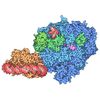
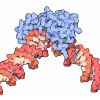
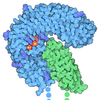
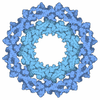
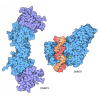
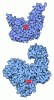
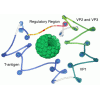
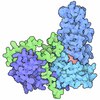
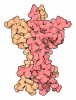
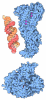
 Assembly

 ESCHERICHIA COLI (E. coli) / Strain (production host): BL21(DE3) / References: UniProt: P0C0S5
 Mass: 18.015 Da / Num. of mol.: 212 / Source method: isolated from a natural source / Formula: H2O
 Sample preparation
 / Beamline: PROXIMA 1 / Wavelength: 0.9801
  Processing