positive regulation of gamma-delta T cell differentiation / kidney morphogenesis / ascending aorta morphogenesis / glial cell development / noradrenergic neuron differentiation / cardiac right ventricle morphogenesis / pro-B cell differentiation / neuroepithelial cell differentiation / hematopoietic stem cell homeostasis / Deactivation of the beta-catenin transactivating complex ...positive regulation of gamma-delta T cell differentiation / kidney morphogenesis / ascending aorta morphogenesis / glial cell development / noradrenergic neuron differentiation / cardiac right ventricle morphogenesis / pro-B cell differentiation / neuroepithelial cell differentiation / hematopoietic stem cell homeostasis / Deactivation of the beta-catenin transactivating complex / mesenchyme development / atrial septum primum morphogenesis / mitral valve morphogenesis / regulation of DNA damage response, signal transduction by p53 class mediator / glial cell proliferation / endocrine pancreas development / camera-type eye morphogenesis / negative regulation of myoblast differentiation / sympathetic nervous system development / somatic stem cell population maintenance / miRNA binding / spinal cord development / ventricular septum morphogenesis / T cell differentiation / positive regulation of myoblast differentiation / gene expression / brain development / cellular response to glucose stimulus / positive regulation of insulin secretion / heart development / sequence-specific double-stranded DNA binding / positive regulation of canonical Wnt signaling pathway / nervous system development / glucose homeostasis / neuron differentiation / transcription regulator complex / DNA-binding transcription activator activity, RNA polymerase II-specific / response to hypoxia / DNA-binding transcription factor activity, RNA polymerase II-specific / transcription cis-regulatory region binding / protein stabilization / RNA polymerase II cis-regulatory region sequence-specific DNA binding / positive regulation of apoptotic process / DNA-binding transcription factor activity / positive regulation of cell population proliferation / regulation of DNA-templated transcription / positive regulation of DNA-templated transcription / negative regulation of transcription by RNA polymerase II / positive regulation of transcription by RNA polymerase II / mitochondrion / DNA binding / nucleoplasm / nucleus / cytoplasm Similarity search - Function
Transcription factor SOX-12/11/4 / : / High mobility group box domain / DNA Binding (I), subunit A / HMG (high mobility group) box / HMG boxes A and B DNA-binding domains profile. / high mobility group / High mobility group box domain / High mobility group box domain superfamily / Orthogonal Bundle / Mainly Alpha Similarity search - Domain/homology
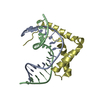
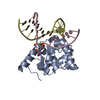
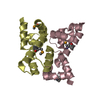
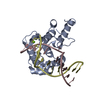
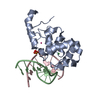
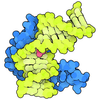
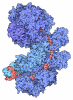
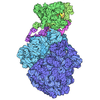
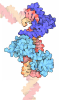
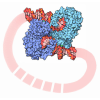
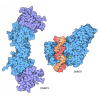
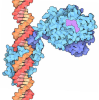
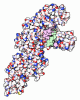
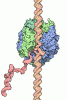
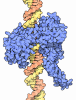
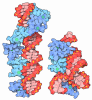
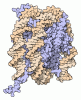
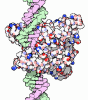
A: DNA (5'-D(*GP*TP*CP*TP*CP*TP*AP*TP*TP*GP*TP*CP*CP*TP*GP*G)-3') B: DNA (5'-D(*CP*CP*AP*GP*GP*AP*CP*AP*AP*TP*AP*GP*AP*GP*AP*C)-3') C: Transcription factor SOX-4
In the structure databanks used in Yorodumi, some data are registered as the other names, "COVID-19 virus" and "2019-nCoV". Here are the details of the virus and the list of structure data.
Jan 31, 2019. EMDB accession codes are about to change! (news from PDBe EMDB page)
EMDB accession codes are about to change! (news from PDBe EMDB page)
The allocation of 4 digits for EMDB accession codes will soon come to an end. Whilst these codes will remain in use, new EMDB accession codes will include an additional digit and will expand incrementally as the available range of codes is exhausted. The current 4-digit format prefixed with “EMD-” (i.e. EMD-XXXX) will advance to a 5-digit format (i.e. EMD-XXXXX), and so on. It is currently estimated that the 4-digit codes will be depleted around Spring 2019, at which point the 5-digit format will come into force.
The EM Navigator/Yorodumi systems omit the EMD- prefix.
Related info.:Q: What is EMD? / ID/Accession-code notation in Yorodumi/EM Navigator
Yorodumi is a browser for structure data from EMDB, PDB, SASBDB, etc.
This page is also the successor to EM Navigator detail page, and also detail information page/front-end page for Omokage search.
The word "yorodu" (or yorozu) is an old Japanese word meaning "ten thousand". "mi" (miru) is to see.
Related info.:EMDB / PDB / SASBDB / Comparison of 3 databanks / Yorodumi Search / Aug 31, 2016. New EM Navigator & Yorodumi / Yorodumi Papers / Jmol/JSmol / Function and homology information / Changes in new EM Navigator and Yorodumi
 Movie
Movie Controller


 Open data
 Basic information
 Components
 Keywords
 Function and homology information
 Mus musculus (house mouse)
 X-RAY DIFFRACTION /
  Authors
 Citation
 Structure visualization
 Downloads & links
 Other downloads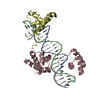




 PDBj
PDBj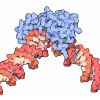
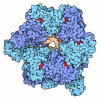
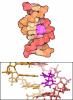
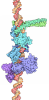
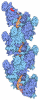
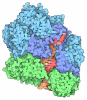
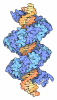
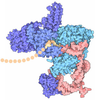
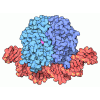

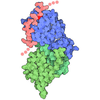
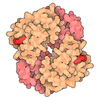
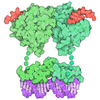
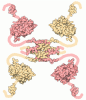
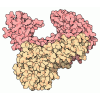
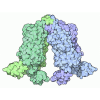
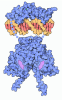
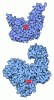
 Assembly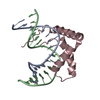

 Escherichia coli (E. coli) / References: UniProt: Q06831
 Mass: 18.015 Da / Num. of mol.: 8 / Source method: isolated from a natural source / Formula: H2O
 Sample preparation
 / Beamline: X29A / Wavelength: 1.075 Å
 Processing