- PDB-3ii6: Structure of human Xrcc4 in complex with the tandem BRCT domains ... -
+
Open data
ID or keywords:
Loading...
-
Basic information
Entry
Database: PDB / ID: 3ii6
Title
Structure of human Xrcc4 in complex with the tandem BRCT domains of DNA LigaseIV.
Components
DNA ligase 4
DNA repair protein XRCC4
Keywords
LIGASE/DNA BINDING PROTEIN / XRCC4 / DNA LIGASE IV / NHEJ / DNA REPAIR / BRCT / Alternative splicing / Coiled coil / DNA damage / DNA recombination / Isopeptide bond / Nucleus / Phosphoprotein / Polymorphism / Ubl conjugation / ATP-binding / Cell cycle / Cell division / Disease mutation / DNA replication / Ligase / Magnesium / Metal-binding / Nucleotide-binding / SCID / LIGASE-DNA BINDING PROTEIN COMPLEX
Function / homology
Function and homology information
T cell receptor V(D)J recombination / FHA domain binding / positive regulation of chromosome organization / pro-B cell differentiation / DNA ligase IV complex / positive regulation of ligase activity / DNA ligase activity / DNA double-strand break attachment to nuclear envelope / DNA ligase (ATP) / DNA ligase (ATP) activity ...T cell receptor V(D)J recombination / FHA domain binding / positive regulation of chromosome organization / pro-B cell differentiation / DNA ligase IV complex / positive regulation of ligase activity / DNA ligase activity / DNA double-strand break attachment to nuclear envelope / DNA ligase (ATP) / DNA ligase (ATP) activity / DNA-dependent protein kinase-DNA ligase 4 complex / immunoglobulin V(D)J recombination / nonhomologous end joining complex / nucleotide-excision repair, DNA gap filling / isotype switching / V(D)J recombination / somatic stem cell population maintenance / double-strand break repair via classical nonhomologous end joining / protein localization to site of double-strand break / single strand break repair / positive regulation of neurogenesis / chromosome organization / response to X-ray / DNA biosynthetic process / 2-LTR circle formation / ligase activity / T cell differentiation in thymus / neuron apoptotic process / SUMOylation of DNA damage response and repair proteins / condensed chromosome / response to gamma radiation / in utero embryonic development / positive regulation of fibroblast proliferation / cellular response to ionizing radiation / central nervous system development / Nonhomologous End-Joining (NHEJ) / base-excision repair / establishment of integrated proviral latency / double-strand break repair via nonhomologous end joining / cell population proliferation / double-strand break repair / site of double-strand break / negative regulation of neuron apoptotic process / protein-macromolecule adaptor activity / chromosome, telomeric region / cell division / magnesium ion binding / enzyme binding / DNA binding / nucleoplasm / ATP binding / identical protein binding / nucleus / cytosol Similarity search - Function
Single alpha-helices involved in coiled-coils or other helix-helix interfaces - #520 / Single alpha-helices involved in coiled-coils or other helix-helix interfaces - #370 / DNA double-strand break repair and VJ recombination XRCC4, N-terminal / Dna Repair Protein Xrcc4; Chain: A, domain 1 / DNA ligase IV domain / DNA ligase IV / DNA ligase 4 / DNA Ligase 4, adenylation domain / XRCC4, N-terminal domain superfamily / DNA repair protein XRCC4 ...Single alpha-helices involved in coiled-coils or other helix-helix interfaces - #520 / Single alpha-helices involved in coiled-coils or other helix-helix interfaces - #370 / DNA double-strand break repair and VJ recombination XRCC4, N-terminal / Dna Repair Protein Xrcc4; Chain: A, domain 1 / DNA ligase IV domain / DNA ligase IV / DNA ligase 4 / DNA Ligase 4, adenylation domain / XRCC4, N-terminal domain superfamily / DNA repair protein XRCC4 / : / : / : / XRCC4 N-terminal domain / XRCC4 coiled-coil / XRCC4 C-terminal region / XRCC4-like, N-terminal domain superfamily / BRCT domain / DNA ligase, ATP-dependent / DNA ligase, ATP-dependent, N-terminal / DNA ligase, ATP-dependent, N-terminal domain superfamily / DNA ligase N terminus / ATP-dependent DNA ligase AMP-binding site. / ATP-dependent DNA ligase signature 2. / DNA ligase, ATP-dependent, C-terminal / ATP dependent DNA ligase C terminal region / DNA ligase, ATP-dependent, conserved site / ATP-dependent DNA ligase family profile. / DNA ligase, ATP-dependent, central / ATP dependent DNA ligase domain / DNA repair protein XRCC4-like, C-terminal / BRCA1 C Terminus (BRCT) domain / Single alpha-helices involved in coiled-coils or other helix-helix interfaces / breast cancer carboxy-terminal domain / BRCT domain profile. / BRCT domain / BRCT domain superfamily / Single alpha-helices involved in coiled-coils or other helix-helix interfaces / Helix non-globular / Beta Complex / Special / Nucleic acid-binding, OB-fold / Up-down Bundle / Rossmann fold / 3-Layer(aba) Sandwich / Mainly Beta / Mainly Alpha / Alpha Beta Similarity search - Domain/homology
A: DNA repair protein XRCC4 B: DNA repair protein XRCC4 C: DNA repair protein XRCC4 D: DNA repair protein XRCC4 X: DNA ligase 4 Y: DNA ligase 4 hetero molecules
In the structure databanks used in Yorodumi, some data are registered as the other names, "COVID-19 virus" and "2019-nCoV". Here are the details of the virus and the list of structure data.
Jan 31, 2019. EMDB accession codes are about to change! (news from PDBe EMDB page)
EMDB accession codes are about to change! (news from PDBe EMDB page)
The allocation of 4 digits for EMDB accession codes will soon come to an end. Whilst these codes will remain in use, new EMDB accession codes will include an additional digit and will expand incrementally as the available range of codes is exhausted. The current 4-digit format prefixed with “EMD-” (i.e. EMD-XXXX) will advance to a 5-digit format (i.e. EMD-XXXXX), and so on. It is currently estimated that the 4-digit codes will be depleted around Spring 2019, at which point the 5-digit format will come into force.
The EM Navigator/Yorodumi systems omit the EMD- prefix.
Related info.:Q: What is EMD? / ID/Accession-code notation in Yorodumi/EM Navigator
Yorodumi is a browser for structure data from EMDB, PDB, SASBDB, etc.
This page is also the successor to EM Navigator detail page, and also detail information page/front-end page for Omokage search.
The word "yorodu" (or yorozu) is an old Japanese word meaning "ten thousand". "mi" (miru) is to see.
Related info.:EMDB / PDB / SASBDB / Comparison of 3 databanks / Yorodumi Search / Aug 31, 2016. New EM Navigator & Yorodumi / Yorodumi Papers / Jmol/JSmol / Function and homology information / Changes in new EM Navigator and Yorodumi
 Movie
Movie Controller

 Yorodumi
 Open data
 Basic information
 Components
 Keywords
 Function and homology information
 Homo sapiens (human)
 X-RAY DIFFRACTION /
  Authors
 Citation
 Structure visualization
 Downloads & links
 Other downloads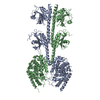



 PDBj
PDBj
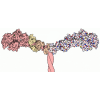
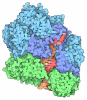
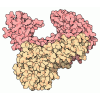
 Assembly


 Escherichia coli (E. coli) / Strain (production host): BL21(DE3) / References: UniProt: Q13426
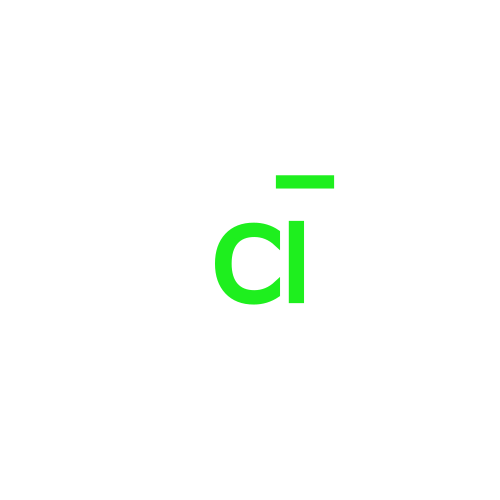 Mass: 35.453 Da / Num. of mol.: 2 / Source method: obtained synthetically / Formula: Cl
 Mass: 18.015 Da / Num. of mol.: 281 / Source method: isolated from a natural source / Formula: H2O
 Sample preparation
 / Beamline: X8C
 Processing