protein phosphorylated amino acid binding / positive regulation of circadian rhythm / regulation of cell cycle process / ubiquitin ligase activator activity / regulation of canonical Wnt signaling pathway / protein dephosphorylation / non-canonical NF-kappaB signal transduction / SCF ubiquitin ligase complex / ligase activity / SCF-dependent proteasomal ubiquitin-dependent protein catabolic process ...protein phosphorylated amino acid binding / positive regulation of circadian rhythm / regulation of cell cycle process / ubiquitin ligase activator activity / regulation of canonical Wnt signaling pathway / protein dephosphorylation / non-canonical NF-kappaB signal transduction / SCF ubiquitin ligase complex / ligase activity / SCF-dependent proteasomal ubiquitin-dependent protein catabolic process / Prolactin receptor signaling / positive regulation of proteolysis / negative regulation of T cell receptor signaling pathway / ubiquitin-like ligase-substrate adaptor activity / protein K48-linked ubiquitination / negative regulation of smoothened signaling pathway / Wnt signaling pathway / MAP3K8 (TPL2)-dependent MAPK1/3 activation / rhythmic process / SCF-beta-TrCP mediated degradation of Emi1 / NIK-->noncanonical NF-kB signaling / Vpu mediated degradation of CD4 / protein destabilization / Dectin-1 mediated noncanonical NF-kB signaling / Degradation of CRY and PER proteins / Activation of NF-kappaB in B cells / Deactivation of the beta-catenin transactivating complex / Degradation of GLI1 by the proteasome / GSK3B and BTRC:CUL1-mediated-degradation of NFE2L2 / beta-catenin binding / Degradation of GLI2 by the proteasome / GLI3 is processed to GLI3R by the proteasome / GSK3B-mediated proteasomal degradation of PD-L1(CD274) / regulation of circadian rhythm / Degradation of beta-catenin by the destruction complex / CLEC7A (Dectin-1) signaling / FCERI mediated NF-kB activation / protein polyubiquitination / Ubiquitin-Mediated Degradation of Phosphorylated Cdc25A / Interleukin-1 signaling / Regulation of PLK1 Activity at G2/M Transition / ubiquitin protein ligase activity / Downstream TCR signaling / Antigen processing: Ubiquitination & Proteasome degradation / Neddylation / ubiquitin-dependent protein catabolic process / proteasome-mediated ubiquitin-dependent protein catabolic process / protein dimerization activity / protein ubiquitination / positive regulation of DNA-templated transcription / negative regulation of transcription by RNA polymerase II / signal transduction / nucleoplasm / cytosol / cytoplasm Similarity search - Function
Single alpha-helices involved in coiled-coils or other helix-helix interfaces - #1840 / D domain of beta-TrCP / D domain of beta-TrCP / D domain of beta-TrCP / : / A Receptor for Ubiquitination Targets / F-box domain profile. / F-box-like / F-box-like domain superfamily / F-box domain ...Single alpha-helices involved in coiled-coils or other helix-helix interfaces - #1840 / D domain of beta-TrCP / D domain of beta-TrCP / D domain of beta-TrCP / : / A Receptor for Ubiquitination Targets / F-box domain profile. / F-box-like / F-box-like domain superfamily / F-box domain / Single alpha-helices involved in coiled-coils or other helix-helix interfaces / Helix non-globular / Special / WD domain, G-beta repeat / G-protein beta WD-40 repeat / WD40 repeat, conserved site / Trp-Asp (WD) repeats signature. / Trp-Asp (WD) repeats profile. / Trp-Asp (WD) repeats circular profile. / WD40 repeats / WD40 repeat / WD40-repeat-containing domain superfamily / WD40/YVTN repeat-like-containing domain superfamily Similarity search - Domain/homology
In the structure databanks used in Yorodumi, some data are registered as the other names, "COVID-19 virus" and "2019-nCoV". Here are the details of the virus and the list of structure data.
Jan 31, 2019. EMDB accession codes are about to change! (news from PDBe EMDB page)
EMDB accession codes are about to change! (news from PDBe EMDB page)
The allocation of 4 digits for EMDB accession codes will soon come to an end. Whilst these codes will remain in use, new EMDB accession codes will include an additional digit and will expand incrementally as the available range of codes is exhausted. The current 4-digit format prefixed with “EMD-” (i.e. EMD-XXXX) will advance to a 5-digit format (i.e. EMD-XXXXX), and so on. It is currently estimated that the 4-digit codes will be depleted around Spring 2019, at which point the 5-digit format will come into force.
The EM Navigator/Yorodumi systems omit the EMD- prefix.
Related info.:Q: What is EMD? / ID/Accession-code notation in Yorodumi/EM Navigator
Yorodumi is a browser for structure data from EMDB, PDB, SASBDB, etc.
This page is also the successor to EM Navigator detail page, and also detail information page/front-end page for Omokage search.
The word "yorodu" (or yorozu) is an old Japanese word meaning "ten thousand". "mi" (miru) is to see.
Related info.:EMDB / PDB / SASBDB / Comparison of 3 databanks / Yorodumi Search / Aug 31, 2016. New EM Navigator & Yorodumi / Yorodumi Papers / Jmol/JSmol / Function and homology information / Changes in new EM Navigator and Yorodumi
 Movie
Movie Controller


 Open data
 Basic information
 Components
 Keywords
 Function and homology information
 Homo sapiens (human)
 X-RAY DIFFRACTION /
  Authors
 Citation
 Structure visualization
 Downloads & links
 Other downloads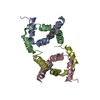
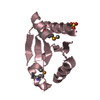
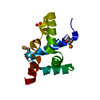

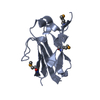

 PDBj
PDBj
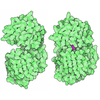
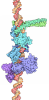
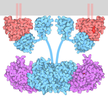
 Assembly

 Escherichia coli BL21 (bacteria) / Strain (production host): BL21 / References: UniProt: Q9Y297
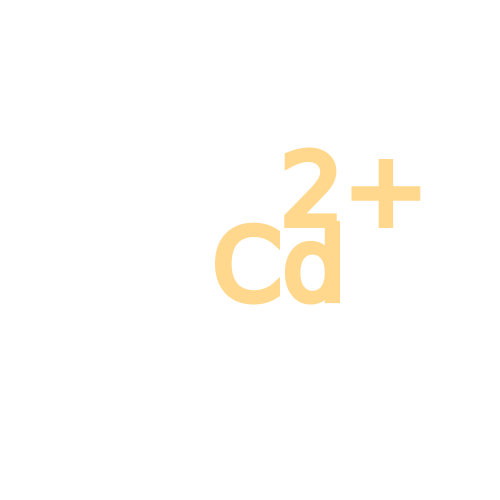 Mass: 112.411 Da / Num. of mol.: 1 / Source method: obtained synthetically / Formula: Cd
 Mass: 18.015 Da / Num. of mol.: 11 / Source method: isolated from a natural source / Formula: H2O
 Sample preparation
 / Beamline: 8-BM / Wavelength: 0.97906 Å
 Processing