- PDB-2f2c: X-ray structure of human CDK6-Vcyclinwith the inhibitor aminopurv... -
+
Open data
ID or keywords:
Loading...
-
Basic information
Entry
Database: PDB / ID: 2f2c
Title
X-ray structure of human CDK6-Vcyclinwith the inhibitor aminopurvalanol
Components
Cell division protein kinase 6
Cyclin homolog
Keywords
CELL CYCLE/TRANSFERASE / Small molecule inhibitor bound between N-terminal and C-terminal domain of kinase / CELL CYCLE-TRANSFERASE COMPLEX
Function / homology
Function and homology information
cyclin D2-CDK6 complex / cell dedifferentiation / Evasion of Oncogene Induced Senescence Due to Defective p16INK4A binding to CDK4 and CDK6 / Evasion of Oxidative Stress Induced Senescence Due to Defective p16INK4A binding to CDK4 and CDK6 / Drug-mediated inhibition of CDK4/CDK6 activity / FBXO family protein binding / negative regulation of monocyte differentiation / lateral ventricle development / symbiont-mediated perturbation of host cell cycle progression / type B pancreatic cell development ...cyclin D2-CDK6 complex / cell dedifferentiation / Evasion of Oncogene Induced Senescence Due to Defective p16INK4A binding to CDK4 and CDK6 / Evasion of Oxidative Stress Induced Senescence Due to Defective p16INK4A binding to CDK4 and CDK6 / Drug-mediated inhibition of CDK4/CDK6 activity / FBXO family protein binding / negative regulation of monocyte differentiation / lateral ventricle development / symbiont-mediated perturbation of host cell cycle progression / type B pancreatic cell development / negative regulation of myeloid cell differentiation / astrocyte development / dentate gyrus development / regulation of cell motility / positive regulation of cell-matrix adhesion / gliogenesis / Regulation of RUNX1 Expression and Activity / negative regulation of cellular senescence / regulation of erythrocyte differentiation / negative regulation of cell cycle / generation of neurons / hemopoiesis / Defective binding of RB1 mutants to E2F1,(E2F2, E2F3) / negative regulation of cell differentiation / cyclin-dependent protein kinase holoenzyme complex / cyclin-dependent kinase / cyclin-dependent protein serine/threonine kinase activity / negative regulation of osteoblast differentiation / ruffle / positive regulation of fibroblast proliferation / cyclin binding / G1/S transition of mitotic cell cycle / G2/M transition of mitotic cell cycle / negative regulation of epithelial cell proliferation / response to virus / Oncogene Induced Senescence / Cyclin D associated events in G1 / regulation of gene expression / Senescence-Associated Secretory Phenotype (SASP) / Oxidative Stress Induced Senescence / regulation of cell cycle / negative regulation of cell population proliferation / protein serine kinase activity / cell division / centrosome / DNA damage response / signal transduction / nucleoplasm / ATP binding / nucleus / cytosol / cytoplasm Similarity search - Function
In the structure databanks used in Yorodumi, some data are registered as the other names, "COVID-19 virus" and "2019-nCoV". Here are the details of the virus and the list of structure data.
Jan 31, 2019. EMDB accession codes are about to change! (news from PDBe EMDB page)
EMDB accession codes are about to change! (news from PDBe EMDB page)
The allocation of 4 digits for EMDB accession codes will soon come to an end. Whilst these codes will remain in use, new EMDB accession codes will include an additional digit and will expand incrementally as the available range of codes is exhausted. The current 4-digit format prefixed with “EMD-” (i.e. EMD-XXXX) will advance to a 5-digit format (i.e. EMD-XXXXX), and so on. It is currently estimated that the 4-digit codes will be depleted around Spring 2019, at which point the 5-digit format will come into force.
The EM Navigator/Yorodumi systems omit the EMD- prefix.
Related info.:Q: What is EMD? / ID/Accession-code notation in Yorodumi/EM Navigator
Yorodumi is a browser for structure data from EMDB, PDB, SASBDB, etc.
This page is also the successor to EM Navigator detail page, and also detail information page/front-end page for Omokage search.
The word "yorodu" (or yorozu) is an old Japanese word meaning "ten thousand". "mi" (miru) is to see.
Related info.:EMDB / PDB / SASBDB / Comparison of 3 databanks / Yorodumi Search / Aug 31, 2016. New EM Navigator & Yorodumi / Yorodumi Papers / Jmol/JSmol / Function and homology information / Changes in new EM Navigator and Yorodumi
 Movie
Movie Controller

 Yorodumi
 Open data
 Basic information
 Components
 Keywords
 Function and homology information
 Homo sapiens (human)
 X-RAY DIFFRACTION /
  Authors
 Citation
 Structure visualization
 Downloads & links
 Other downloads


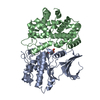

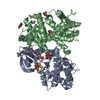
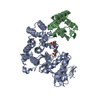
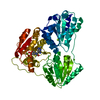

 PDBj
PDBj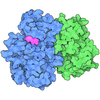


 Assembly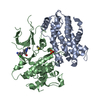
 Herpesvirus saimiri (strain 11) / Genus: Rhadinovirus / Species: Saimiriine herpesvirus 2 / Strain: 11 / Gene: 72, ECLF2 / Production host:
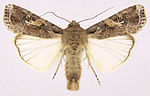 Spodoptera frugiperda (fall armyworm) / References: UniProt: Q01043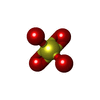
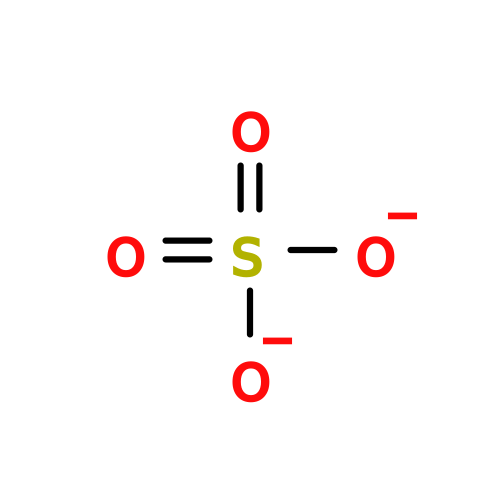 Mass: 96.063 Da / Num. of mol.: 1 / Source method: obtained synthetically / Formula: SO4
 Mass: 403.909 Da / Num. of mol.: 1 / Source method: obtained synthetically / Formula: C19H26ClN7O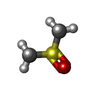
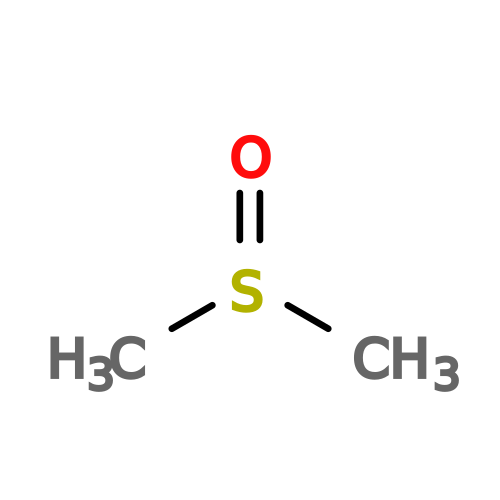 Mass: 78.133 Da / Num. of mol.: 1 / Source method: obtained synthetically / Formula: C2H6OS / Comment: DMSO, precipitant*YM
 Sample preparation
 / Beamline: 5.0.1 / Wavelength: 1 Å
 Processing