- PDB-2e8n: Solution structure of the C-terminal SAM-domain of EphaA2: Ephrin... -
+
Open data
ID or keywords:
Loading...
-
Basic information
Entry
Database: PDB / ID: 2e8n
Title
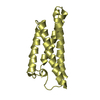
Solution structure of the C-terminal SAM-domain of EphaA2: Ephrin type-A receptor 2 precursor (EC 2.7.10.1)
Components
Ephrin type-A receptor 2
Keywords
TRANSFERASE / SIGNALING PROTEIN / CELL-FREE PROTEIN SYNTHESIS / PROTEIN REGULATION / Structural Genomics / NPPSFA / National Project on Protein Structural and Functional Analyses / RIKEN Structural Genomics/Proteomics Initiative / RSGI
Function / homology
Function and homology information
branching involved in mammary gland duct morphogenesis / lens fiber cell morphogenesis / cAMP metabolic process / regulation of blood vessel endothelial cell migration / leading edge membrane / mammary gland epithelial cell proliferation / ephrin receptor activity / bone remodeling / response to growth factor / positive regulation of bicellular tight junction assembly ...branching involved in mammary gland duct morphogenesis / lens fiber cell morphogenesis / cAMP metabolic process / regulation of blood vessel endothelial cell migration / leading edge membrane / mammary gland epithelial cell proliferation / ephrin receptor activity / bone remodeling / response to growth factor / positive regulation of bicellular tight junction assembly / regulation of lamellipodium assembly / negative regulation of cell adhesion mediated by integrin / EPH-Ephrin signaling / RND1 GTPase cycle / RND2 GTPase cycle / RND3 GTPase cycle / tight junction / RHOV GTPase cycle / EPHA-mediated growth cone collapse / growth factor binding / RHOU GTPase cycle / lamellipodium membrane / keratinocyte differentiation / RHOG GTPase cycle / EPH-ephrin mediated repulsion of cells / regulation of angiogenesis / RAC3 GTPase cycle / RAC2 GTPase cycle / ephrin receptor signaling pathway / regulation of ERK1 and ERK2 cascade / osteoclast differentiation / RAC1 GTPase cycle / transmembrane receptor protein tyrosine kinase activity / cell surface receptor protein tyrosine kinase signaling pathway / protein localization to plasma membrane / cell motility / molecular function activator activity / intrinsic apoptotic signaling pathway in response to DNA damage / cell chemotaxis / positive regulation of protein localization to plasma membrane / receptor protein-tyrosine kinase / cell junction / virus receptor activity / ruffle membrane / osteoblast differentiation / angiogenesis / cell migration / lamellipodium / cell adhesion / signaling receptor complex / positive regulation of cell migration / cadherin binding / focal adhesion / cell surface / ATP binding / plasma membrane Similarity search - Function
Ephrin type-A receptor 2, ligand binding domain / Transcription Factor, Ets-1 / Ephrin cysteine rich domain / Ephrin receptor type-A /type-B / Ephrin receptor ligand binding domain / Tyrosine-protein kinase, receptor class V, conserved site / Ephrin receptor, transmembrane domain / : / Ephrin receptor ligand binding domain / Ephrin type-A receptor 2 transmembrane domain ...Ephrin type-A receptor 2, ligand binding domain / Transcription Factor, Ets-1 / Ephrin cysteine rich domain / Ephrin receptor type-A /type-B / Ephrin receptor ligand binding domain / Tyrosine-protein kinase, receptor class V, conserved site / Ephrin receptor, transmembrane domain / : / Ephrin receptor ligand binding domain / Ephrin type-A receptor 2 transmembrane domain / Receptor tyrosine kinase class V signature 1. / Receptor tyrosine kinase class V signature 2. / Eph receptor ligand-binding domain profile. / Ephrin receptor ligand binding domain / Putative ephrin-receptor like / SAM domain (Sterile alpha motif) / SAM domain profile. / Sterile alpha motif. / Sterile alpha motif domain / Sterile alpha motif/pointed domain superfamily / Fibronectin type III domain / Growth factor receptor cysteine-rich domain superfamily / Fibronectin type 3 domain / Fibronectin type-III domain profile. / Galactose-binding-like domain superfamily / Fibronectin type III / Fibronectin type III superfamily / DNA polymerase; domain 1 / Tyrosine-protein kinase, catalytic domain / Tyrosine kinase, catalytic domain / Tyrosine protein kinases specific active-site signature. / Tyrosine-protein kinase, active site / Protein tyrosine and serine/threonine kinase / Serine-threonine/tyrosine-protein kinase, catalytic domain / Protein kinase, ATP binding site / Protein kinases ATP-binding region signature. / Immunoglobulin-like fold / Protein kinase domain profile. / Protein kinase domain / Protein kinase-like domain superfamily / Orthogonal Bundle / Mainly Alpha Similarity search - Domain/homology
Conformer selection criteria: structures with the least restraint violations Conformers calculated total number: 100 / Conformers submitted total number: 20
+
About Yorodumi
-
News
-
Feb 9, 2022. New format data for meta-information of EMDB entries
New format data for meta-information of EMDB entries
Version 3 of the EMDB header file is now the official format.
The previous official version 1.9 will be removed from the archive.
In the structure databanks used in Yorodumi, some data are registered as the other names, "COVID-19 virus" and "2019-nCoV". Here are the details of the virus and the list of structure data.
Jan 31, 2019. EMDB accession codes are about to change! (news from PDBe EMDB page)
EMDB accession codes are about to change! (news from PDBe EMDB page)
The allocation of 4 digits for EMDB accession codes will soon come to an end. Whilst these codes will remain in use, new EMDB accession codes will include an additional digit and will expand incrementally as the available range of codes is exhausted. The current 4-digit format prefixed with “EMD-” (i.e. EMD-XXXX) will advance to a 5-digit format (i.e. EMD-XXXXX), and so on. It is currently estimated that the 4-digit codes will be depleted around Spring 2019, at which point the 5-digit format will come into force.
The EM Navigator/Yorodumi systems omit the EMD- prefix.
Related info.:Q: What is EMD? / ID/Accession-code notation in Yorodumi/EM Navigator
Yorodumi is a browser for structure data from EMDB, PDB, SASBDB, etc.
This page is also the successor to EM Navigator detail page, and also detail information page/front-end page for Omokage search.
The word "yorodu" (or yorozu) is an old Japanese word meaning "ten thousand". "mi" (miru) is to see.
Related info.:EMDB / PDB / SASBDB / Comparison of 3 databanks / Yorodumi Search / Aug 31, 2016. New EM Navigator & Yorodumi / Yorodumi Papers / Jmol/JSmol / Function and homology information / Changes in new EM Navigator and Yorodumi
 Movie
Movie Controller

 Yorodumi
 Open data
 Basic information
 Components
 Keywords
 Function and homology information
 Homo sapiens (human)
 Authors
 Citation
 Structure visualization
 Downloads & links
 Other downloads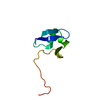



 PDBj
PDBj

 Assembly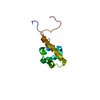
 Sample preparation
 Processing
 CYANA
CYANA