- PDB-22jy: P301L/S320F human tau filaments from mouse brain -
+
Open data
ID or keywords:
Loading...
-
Basic information
Entry
Database: PDB / ID: 22jy
Title
P301L/S320F human tau filaments from mouse brain
Components
Microtubule-associated protein tau
Keywords
PROTEIN FIBRIL / Amyloid Fibril / Alzheimer disease / Pick disease tau / tauopathy
Function / homology
Function and homology information
plus-end-directed organelle transport along microtubule / histone-dependent DNA binding / negative regulation of protein localization to mitochondrion / neurofibrillary tangle / microtubule lateral binding / axonal transport / tubulin complex / positive regulation of protein localization to synapse / phosphatidylinositol bisphosphate binding / generation of neurons ...plus-end-directed organelle transport along microtubule / histone-dependent DNA binding / negative regulation of protein localization to mitochondrion / neurofibrillary tangle / microtubule lateral binding / axonal transport / tubulin complex / positive regulation of protein localization to synapse / phosphatidylinositol bisphosphate binding / generation of neurons / axon development / axonal transport of mitochondrion / rRNA metabolic process / central nervous system neuron development / regulation of microtubule-based movement / regulation of mitochondrial fission / regulation of chromosome organization / intracellular distribution of mitochondria / minor groove of adenine-thymine-rich DNA binding / lipoprotein particle binding / microtubule polymerization / negative regulation of mitochondrial membrane potential / regulation of microtubule polymerization / dynactin binding / apolipoprotein binding / regulation of calcium-mediated signaling / main axon / Caspase-mediated cleavage of cytoskeletal proteins / glial cell projection / regulation of microtubule polymerization or depolymerization / axolemma / positive regulation of axon extension / neurofibrillary tangle assembly / protein polymerization / negative regulation of mitochondrial fission / positive regulation of microtubule polymerization / regulation of cellular response to heat / Activation of AMPK downstream of NMDARs / positive regulation of protein localization / positive regulation of superoxide anion generation / cellular response to brain-derived neurotrophic factor stimulus / cytoplasmic microtubule organization / regulation of long-term synaptic depression / axon cytoplasm / supramolecular fiber organization / synapse assembly / somatodendritic compartment / astrocyte activation / nuclear periphery / phosphatidylinositol binding / protein phosphatase 2A binding / stress granule assembly / enzyme inhibitor activity / cellular response to reactive oxygen species / regulation of microtubule cytoskeleton organization / memory / microglial cell activation / cellular response to nerve growth factor stimulus / regulation of synaptic plasticity / Hsp90 protein binding / SH3 domain binding / synapse organization / regulation of autophagy / protein homooligomerization / microtubule cytoskeleton organization / PKR-mediated signaling / response to lead ion / neuron projection development / cytoplasmic ribonucleoprotein granule / microtubule cytoskeleton / cell-cell signaling / cellular response to heat / single-stranded DNA binding / growth cone / protein-folding chaperone binding / actin binding / cell body / double-stranded DNA binding / sequence-specific DNA binding / microtubule binding / amyloid fibril formation / dendritic spine / microtubule / learning or memory / protein-macromolecule adaptor activity / neuron projection / membrane raft / negative regulation of gene expression / axon / neuronal cell body / DNA damage response / dendrite / protein kinase binding / enzyme binding / mitochondrion / DNA binding / RNA binding / extracellular region / identical protein binding / nucleus Similarity search - Function
Microtubule-associated protein Tau / Microtubule associated protein, tubulin-binding repeat / Tau and MAP protein, tubulin-binding repeat / Tau and MAP proteins tubulin-binding repeat signature. / Tau and MAP proteins tubulin-binding repeat profile. / : Similarity search - Domain/homology
A: Microtubule-associated protein tau B: Microtubule-associated protein tau C: Microtubule-associated protein tau D: Microtubule-associated protein tau E: Microtubule-associated protein tau
Mass: 5465.355 Da / Num. of mol.: 5 / Mutation: P301L, S320F Source method: isolated from a genetically manipulated source Details: P301L/S320F human tau filaments from mouse brain / Source: (gene. exp.) Homo sapiens (human) / Gene: MAPT, MAPTL, MTBT1, TAU / Production host: Mus musculus (house mouse) / References: UniProt: P10636
Has protein modification
N
-
Experimental details
-
Experiment
Experiment
Method: ELECTRON MICROSCOPY
EM experiment
Aggregation state: FILAMENT / 3D reconstruction method: single particle reconstruction
-
Sample preparation
Component
Name: P301L/S320F human tau filaments / Type: COMPLEX / Details: P301L/S320F human tau filaments from mouse brain / Entity ID: all / Source: RECOMBINANT
Molecular weight
Value: 11.25 kDa/nm / Experimental value: NO
Source (natural)
Organism: Homo sapiens (human)
Source (recombinant)
Organism: Mus musculus (house mouse)
Buffer solution
pH: 7.4
Buffer component
ID
Conc.
Name
Buffer-ID
1
50mM
Tris
1
2
1mM
DTT
1
3
0.04 %
sarkosyl
1
Specimen
Embedding applied: NO / Shadowing applied: NO / Staining applied: NO / Vitrification applied: YES Details: P301L/S320F human tau filaments purified from mouse brain
Average exposure time: 2.93 sec. / Electron dose: 50 e/Å2 / Film or detector model: GATAN K3 (6k x 4k) / Num. of grids imaged: 1 / Num. of real images: 25815
Resolution: 2.2 Å / Resolution method: FSC 0.143 CUT-OFF / Num. of particles: 122422 / Algorithm: BACK PROJECTION / Num. of class averages: 1 / Symmetry type: POINT
Atomic model building
Protocol: OTHER / Space: RECIPROCAL
Atomic model building
Details: The initial model was generated using ModelAngelo. / Source name: Other / Type: experimental model
+
About Yorodumi
-
News
-
Feb 9, 2022. New format data for meta-information of EMDB entries
New format data for meta-information of EMDB entries
Version 3 of the EMDB header file is now the official format.
The previous official version 1.9 will be removed from the archive.
In the structure databanks used in Yorodumi, some data are registered as the other names, "COVID-19 virus" and "2019-nCoV". Here are the details of the virus and the list of structure data.
Jan 31, 2019. EMDB accession codes are about to change! (news from PDBe EMDB page)
EMDB accession codes are about to change! (news from PDBe EMDB page)
The allocation of 4 digits for EMDB accession codes will soon come to an end. Whilst these codes will remain in use, new EMDB accession codes will include an additional digit and will expand incrementally as the available range of codes is exhausted. The current 4-digit format prefixed with “EMD-” (i.e. EMD-XXXX) will advance to a 5-digit format (i.e. EMD-XXXXX), and so on. It is currently estimated that the 4-digit codes will be depleted around Spring 2019, at which point the 5-digit format will come into force.
The EM Navigator/Yorodumi systems omit the EMD- prefix.
Related info.:Q: What is EMD? / ID/Accession-code notation in Yorodumi/EM Navigator
Yorodumi is a browser for structure data from EMDB, PDB, SASBDB, etc.
This page is also the successor to EM Navigator detail page, and also detail information page/front-end page for Omokage search.
The word "yorodu" (or yorozu) is an old Japanese word meaning "ten thousand". "mi" (miru) is to see.
Related info.:EMDB / PDB / SASBDB / Comparison of 3 databanks / Yorodumi Search / Aug 31, 2016. New EM Navigator & Yorodumi / Yorodumi Papers / Jmol/JSmol / Function and homology information / Changes in new EM Navigator and Yorodumi
 Movie
Movie Controller


 Open data
 Basic information
 Components
 Keywords
 Function and homology information
 Homo sapiens (human)
 Authors
 Japan, 7items
  Citation
 Structure visualization
 Downloads & links
 Other downloads
 PDBj
PDBj
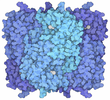
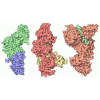
 Assembly

 Mus musculus (house mouse) / References: UniProt: P10636
 Sample preparation
 Electron microscopy imaging
 FIELD EMISSION GUN / Accelerating voltage: 300 kV / Illumination mode: FLOOD BEAM
 Processing