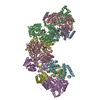
Movie
Movie Controller

[English] 日本語
 Yorodumi
- PDB-13he: CryoEM structure of AdhE Spirosome from Clostridium thermocellum ... -
+ Open data

- Basic information
| Entry | Database: PDB / ID: 13he | ||||||||||||||||||||||||||||||
|---|---|---|---|---|---|---|---|---|---|---|---|---|---|---|---|---|---|---|---|---|---|---|---|---|---|---|---|---|---|---|---|
| Title | CryoEM structure of AdhE Spirosome from Clostridium thermocellum uncovered by visual proteomics. | ||||||||||||||||||||||||||||||
 Components Components | Aldehyde-alcohol dehydrogenase | ||||||||||||||||||||||||||||||
 Keywords Keywords | PROTEIN FIBRIL / Dehydrogenase / Filament / Ethanol Production | ||||||||||||||||||||||||||||||
| Function / homology |  Function and homology information Function and homology informationbutanol dehydrogenase (NAD+) activity / alcohol metabolic process / acetaldehyde dehydrogenase (acetylating) activity / methylglyoxal reductase (NADPH) (acetol producing) activity / carbon utilization / alcohol dehydrogenase (NADP+) activity / aldehyde dehydrogenase (NAD+) activity / metal ion binding / cytosol Similarity search - Function | ||||||||||||||||||||||||||||||
| Biological species |  Acetivibrio thermocellus DSM 1313 (bacteria) Acetivibrio thermocellus DSM 1313 (bacteria) | ||||||||||||||||||||||||||||||
| Method | ELECTRON MICROSCOPY / helical reconstruction / cryo EM / Resolution: 4.07 Å | ||||||||||||||||||||||||||||||
 Authors Authors | Agdanowski, M.P. / Rodriguez, J.A. | ||||||||||||||||||||||||||||||
| Funding support |  United States, 5items United States, 5items
| ||||||||||||||||||||||||||||||
 Citation Citation | Journal: bioRxiv / Year: 2026 Title: Visual exoproteomics of during anaerobic biomass-degradation identifies functional spirosomes. Authors: Matthew P Agdanowski / Matthew J Kensil / Trevor H Moser / Ethan Humm / Yaneli I Guandique / Kayleigh Mason-Chalmers / Tracy Al-Set / Rachel R Ogorzalek Loo / James E Evans / Robert P ...Authors: Matthew P Agdanowski / Matthew J Kensil / Trevor H Moser / Ethan Humm / Yaneli I Guandique / Kayleigh Mason-Chalmers / Tracy Al-Set / Rachel R Ogorzalek Loo / James E Evans / Robert P Gunsalus / Joseph A Loo / Jose A Rodriguez / Abstract: Visual proteomics enables the study of low-abundance proteins and identification of unknown complexes from heterogeneous samples by complementing high-resolution cryogenic electron microscopy (cryoEM) ...Visual proteomics enables the study of low-abundance proteins and identification of unknown complexes from heterogeneous samples by complementing high-resolution cryogenic electron microscopy (cryoEM) with external inputs on protein identity such as mass spectrometry. Using this approach, we interrogated the exoproteome of the anaerobic cellulose-degrading bacterium as it carried out biomass degradation. Mass spectrometry indicated a broad exoproteome composition, including cellulose degrading machinery CelA and CipA. A focus on large exoproteome assemblies revealed abundant protein filaments and pleomorphic vesicular structures. Analysis of the most abundant protein filaments yielded an ~4 resolution native structure that, aided by mass spectrometry, modeling, and structural searching, was found to be the aldehyde-alcohol dehydrogenase (AdhE) spirosome. AdhE contained both NAD and Fe in their expected binding sites and biochemical and structural analyses of enriched spirosome preparations indicated they were functional. Altered NADH solution concentrations triggered conformational changes in the exoproteomic spirosomes, and the constituent AdhE remained capable of ethanol production. Although the basis for functional extracellular spirosome accumulation in live anaerobic cultures remains unclear, their abundance in crude exoproteomes suggests their presence could influence biomass fueled growth. | ||||||||||||||||||||||||||||||
| History |
|
- Structure visualization
| Structure viewer | Molecule: MolmilJmol/JSmol |
|---|
- Downloads & links
-Download
| PDBx/mmCIF format | 13he.cif.gz | 876.5 KB | Display | PDBx/mmCIF format |
|---|---|---|---|---|
| PDB format | pdb13he.ent.gz | 715 KB | Display | PDB format |
| PDBx/mmJSON format | 13he.json.gz | Tree view | PDBx/mmJSON format | |
| Others |  Other downloads Other downloads |
-Validation report
| Arichive directory | https://data.pdbj.org/pub/pdb/validation_reports/3h/13heftp://data.pdbj.org/pub/pdb/validation_reports/3h/13he | HTTPS FTP |
|---|
-Related structure data
| Related structure data |  77065MC M: map data used to model this data C: citing same article ( |
|---|---|
| Similar structure data |
-Links
 PDBj
PDBj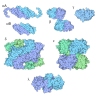
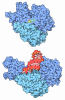
- Assembly
| Deposited unit | 
|
|---|---|
| 1 |
|
-Components
| #1: Protein | Mass: 94788.023 Da / Num. of mol.: 6 / Source method: isolated from a natural source Source: (natural) Acetivibrio thermocellus DSM 1313 (bacteria)References: UniProt: A0A0H3W5U9 #2: Chemical | ChemComp-FE /   Mass: 55.845 Da / Num. of mol.: 6 / Source method: obtained synthetically / Formula: Fe Mass: 55.845 Da / Num. of mol.: 6 / Source method: obtained synthetically / Formula: Fe#3: Chemical | ChemComp-NAD / 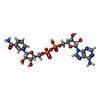 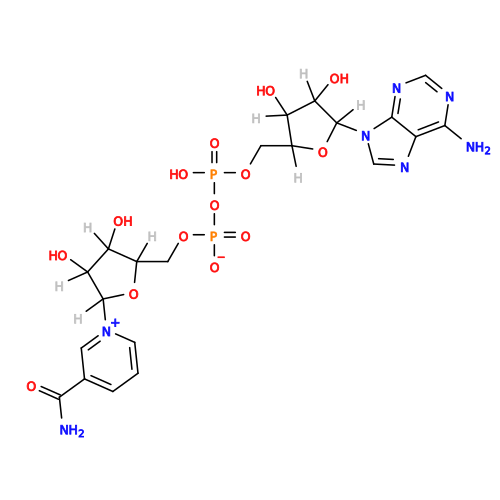 Mass: 663.425 Da / Num. of mol.: 6 / Source method: obtained synthetically / Formula: C21H27N7O14P2 / Comment: NAD*YM Mass: 663.425 Da / Num. of mol.: 6 / Source method: obtained synthetically / Formula: C21H27N7O14P2 / Comment: NAD*YMHas ligand of interest | N | Has protein modification | N | |
|---|
-Experimental details
-Experiment
| Experiment | Method: ELECTRON MICROSCOPY |
|---|---|
| EM experiment | Aggregation state: FILAMENT / 3D reconstruction method: helical reconstruction |
- Sample preparation
| Component | Name: AdhE spirosome / Type: COMPLEX / Entity ID: #1 / Source: NATURAL | ||||||||||||||||||||
|---|---|---|---|---|---|---|---|---|---|---|---|---|---|---|---|---|---|---|---|---|---|
| Molecular weight | Experimental value: NO | ||||||||||||||||||||
| Source (natural) | Organism: Acetivibrio thermocellus DSM 1313 (bacteria) | ||||||||||||||||||||
| Buffer solution | pH: 8 / Details: 20mM Tris pH 8.0, 150mM NaCl, 2mM CaCl2 | ||||||||||||||||||||
| Buffer component |
| ||||||||||||||||||||
| Specimen | Conc.: 3 mg/ml / Embedding applied: NO / Shadowing applied: NO / Staining applied: NO / Vitrification applied: YES Details: Sample was obtained from partially-purified extracellular media and contained an array of unidentified species. | ||||||||||||||||||||
| Specimen support | Details: CFlat 1.2/1.3 300 mesh holey carbon Cu support grids were negatively glow discharged for 20 seconds on the sample side. Grid material: COPPER / Grid mesh size: 300 divisions/in. / Grid type: EMS Formvar Carbon | ||||||||||||||||||||
| Vitrification | Instrument: FEI VITROBOT MARK IV / Cryogen name: ETHANE / Humidity: 100 % / Chamber temperature: 285.15 K Details: Vitification was performed on CFlat 1.2/1.3 300 mesh holey carbon grids with copper support. |
- Electron microscopy imaging
| Experimental equipment |  Model: Titan Krios / Image courtesy: FEI Company |
|---|---|
| Microscopy | Model: TFS KRIOS |
| Electron gun | Electron source:  FIELD EMISSION GUN / Accelerating voltage: 300 kV / Illumination mode: FLOOD BEAM FIELD EMISSION GUN / Accelerating voltage: 300 kV / Illumination mode: FLOOD BEAM |
| Electron lens | Mode: BRIGHT FIELD / Nominal magnification: 130000 X / Nominal defocus max: 2500 nm / Nominal defocus min: 500 nm |
| Image recording | Average exposure time: 1.03 sec. / Electron dose: 48 e/Å2 / Film or detector model: GATAN K3 (6k x 4k) / Num. of grids imaged: 1 / Num. of real images: 4863 Details: Images were recorded as movies consisting of 50 frames over an exposure time of 1.03 seconds, with a total accumulated dose of 48 electrons per Angstrom |
| EM imaging optics | Energyfilter name: GIF Bioquantum / Energyfilter slit width: 20 eV |
| Image scans | Width: 11520 / Height: 8184 |
- Processing
| EM software |
| |||||||||||||||||||||||||||||||||||||||||||||
|---|---|---|---|---|---|---|---|---|---|---|---|---|---|---|---|---|---|---|---|---|---|---|---|---|---|---|---|---|---|---|---|---|---|---|---|---|---|---|---|---|---|---|---|---|---|---|
| CTF correction | Details: Patch CTF was used on micrographs, final volume had global and local CTF estimation jobs performed on it. Type: PHASE FLIPPING AND AMPLITUDE CORRECTION | |||||||||||||||||||||||||||||||||||||||||||||
| Helical symmerty | Angular rotation/subunit: -166.03 ° / Axial rise/subunit: 60.06 Å / Axial symmetry: C1 | |||||||||||||||||||||||||||||||||||||||||||||
| Particle selection | Num. of particles selected: 94278 Details: 94,278 particles were used in final reconstruction. Particles were picked using cryoSPARC's automated filament tracer with particle diameter of 70Ang and spacing of 0.2 | |||||||||||||||||||||||||||||||||||||||||||||
| 3D reconstruction | Resolution: 4.07 Å / Resolution method: FSC 0.143 CUT-OFF / Num. of particles: 95407 / Algorithm: FOURIER SPACE Details: Overall resolution 4.07 angstrom as estimated by the masked gold-standard FSC = 0.143 criterion in cryoSPARC. Unmasked FSC values are lower, consistent with expected effects of masking." in the details field. Num. of class averages: 65 / Symmetry type: HELICAL | |||||||||||||||||||||||||||||||||||||||||||||
| Atomic model building | Protocol: RIGID BODY FIT Details: A existing structure's (PDB:8UHW) coordinates were relaxed using the Rosetta Fast Relax algorithm and refined against the EM density from cryoSPARC using Phenix and Coot. Histidine residues ...Details: A existing structure's (PDB:8UHW) coordinates were relaxed using the Rosetta Fast Relax algorithm and refined against the EM density from cryoSPARC using Phenix and Coot. Histidine residues coordinate the iron ion; short distances flagged as clashes correspond to metal coordination geometry. | |||||||||||||||||||||||||||||||||||||||||||||
| Atomic model building | PDB-ID: 8UHW Pdb chain-ID: A / Accession code: 8UHW / Chain residue range: 11-869 Details: published structure was fast relaxed and then used as an initial model for model building and refinement Pdb chain residue range: 11-869 / Source name: PDB / Type: experimental model | |||||||||||||||||||||||||||||||||||||||||||||
| Refinement | Cross valid method: NONE Stereochemistry target values: GeoStd + Monomer Library + CDL v1.2 | |||||||||||||||||||||||||||||||||||||||||||||
| Displacement parameters | Biso mean: 98.98 Å2 | |||||||||||||||||||||||||||||||||||||||||||||
| Refine LS restraints |
|