 Movie
Movie Controller

[English] 日本語
 Yorodumi
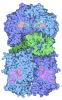
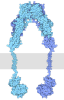
- PDB-12ai: Structure of mammalian Type 2 Inositol 1,4,5-trisphosphate recept... -
+ Open data

- Basic information
| Entry | Database: PDB / ID: 12ai | |||||||||||||||||||||
|---|---|---|---|---|---|---|---|---|---|---|---|---|---|---|---|---|---|---|---|---|---|---|
| Title | Structure of mammalian Type 2 Inositol 1,4,5-trisphosphate receptor (IP3R2) in the presence of IP3/Ca2+/ATP | |||||||||||||||||||||
 Components Components | Inositol 1,4,5-trisphosphate-gated calcium channel ITPR2 | |||||||||||||||||||||
 Keywords Keywords | MEMBRANE PROTEIN / ion channel | |||||||||||||||||||||
| Function / homology |  Function and homology information Function and homology informationEffects of PIP2 hydrolysis / Elevation of cytosolic Ca2+ levels / inositol 1,4,5-trisphosphate-gated calcium channel activity / Antigen activates B Cell Receptor (BCR) leading to generation of second messengers / Glucagon-like Peptide-1 (GLP1) regulates insulin secretion / Ion homeostasis / inositol 1,4,5 trisphosphate binding / cellular response to ethanol / transport vesicle membrane / intracellularly gated calcium channel activity ...Effects of PIP2 hydrolysis / Elevation of cytosolic Ca2+ levels / inositol 1,4,5-trisphosphate-gated calcium channel activity / Antigen activates B Cell Receptor (BCR) leading to generation of second messengers / Glucagon-like Peptide-1 (GLP1) regulates insulin secretion / Ion homeostasis / inositol 1,4,5 trisphosphate binding / cellular response to ethanol / transport vesicle membrane / intracellularly gated calcium channel activity / release of sequestered calcium ion into cytosol / cellular response to cAMP / sarcoplasmic reticulum membrane / phosphatidylinositol binding / secretory granule membrane / sarcoplasmic reticulum / calcium ion transport / scaffold protein binding / cell cortex / response to hypoxia / transmembrane transporter binding / signaling receptor complex / axon / calcium ion binding / endoplasmic reticulum membrane / endoplasmic reticulum / ATP binding / plasma membrane / cytoplasm Similarity search - Function | |||||||||||||||||||||
| Biological species |   Mus musculus (house mouse) Mus musculus (house mouse) | |||||||||||||||||||||
| Method | ELECTRON MICROSCOPY / single particle reconstruction / cryo EM / Resolution: 3.64 Å | |||||||||||||||||||||
 Authors Authors | Serysheva, I.I. / Baker, M.R. / Fan, G. | |||||||||||||||||||||
| Funding support |  United States, 6items United States, 6items
| |||||||||||||||||||||
 Citation Citation | Journal: Nat Commun / Year: 2026 Title: Cryo-EM insights into isoform-specific properties of the IPR2 channel. Authors: Mariah R Baker / Xiaoxuan Lin / Guizhen Fan / Ariel Martinez-Chavez / Larry E Wagner / Sundeep Malik / Tyler Allison / Briar Bell / Alexander B Seryshev / Julio Cordero-Morales / Matthew L ...Authors: Mariah R Baker / Xiaoxuan Lin / Guizhen Fan / Ariel Martinez-Chavez / Larry E Wagner / Sundeep Malik / Tyler Allison / Briar Bell / Alexander B Seryshev / Julio Cordero-Morales / Matthew L Baker / David I Yule / Irina I Serysheva / Abstract: Calcium release through inositol 1,4,5-trisphosphate receptors (IPRs) is a fundamental signaling mechanism that regulates diverse cellular processes. Among the three mammalian IPR isoforms, IPR2 is ...Calcium release through inositol 1,4,5-trisphosphate receptors (IPRs) is a fundamental signaling mechanism that regulates diverse cellular processes. Among the three mammalian IPR isoforms, IPR2 is widely expressed, yet its structural basis for activation and regulation remains unclear. Here, we report cryo-EM structures of mammalian IPR2 in ligand-free (closed) and CaIP/ATP-bound (activated) states at 3.3 Å and 3.6 Å resolution, respectively. These structures define the architecture of IPR2 and reveal conformational transitions associated with channel activation. Although the IP-binding pocket is conserved, subtype-specific differences in IP affinity likely arise from conformational dynamics of the regulatory ARM2 domain. Comparative analyses of IPR isoforms identify subtype-specific allosteric networks and domain motions that underlie differential regulation. We further define the ATP-binding site and, through mutagenesis and electrophysiology, establish the structural basis for ATP modulation of channel activity. Together, these findings reveal mechanisms of IPR2 activation and subtype-specific regulation, providing a framework for understanding isoform-dependent Ca signaling. | |||||||||||||||||||||
| History |
|
- Structure visualization
| Structure viewer | Molecule: MolmilJmol/JSmol |
|---|
- Downloads & links
-Download
| PDBx/mmCIF format | 12ai.cif.gz | 1.8 MB | Display | PDBx/mmCIF format |
|---|---|---|---|---|
| PDB format | pdb12ai.ent.gz | 1.4 MB | Display | PDB format |
| PDBx/mmJSON format | 12ai.json.gz | Tree view | PDBx/mmJSON format | |
| Others |  Other downloads Other downloads |
-Validation report
| Arichive directory | https://data.pdbj.org/pub/pdb/validation_reports/2a/12aiftp://data.pdbj.org/pub/pdb/validation_reports/2a/12ai | HTTPS FTP |
|---|
-Related structure data
| Related structure data |  76264MC  12adC C: citing same article ( M: map data used to model this data |
|---|---|
| Similar structure data |


-Links
 PDBj
PDBj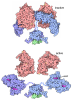
- Assembly
| Deposited unit | 
|
|---|---|
| 1 |
|
-Components
-Protein , 1 types, 4 molecules ABCD
| #1: Protein | Mass: 307854.719 Da / Num. of mol.: 4 Source method: isolated from a genetically manipulated source Source: (gene. exp.) Mus musculus (house mouse) / Gene: Itpr2, Itpr5 / Cell line (production host): HEK293S GNTI- / Production host:  Homo sapiens (human) / References: UniProt: Q9Z329 Homo sapiens (human) / References: UniProt: Q9Z329 |
|---|
-Non-polymers , 5 types, 20 molecules 
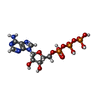
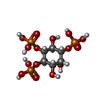

| #2: Chemical | ChemComp-ZN /  Mass: 65.409 Da / Num. of mol.: 4 / Source method: obtained synthetically / Formula: Zn / Feature type: SUBJECT OF INVESTIGATION Mass: 65.409 Da / Num. of mol.: 4 / Source method: obtained synthetically / Formula: Zn / Feature type: SUBJECT OF INVESTIGATION#3: Chemical | ChemComp-ATP / 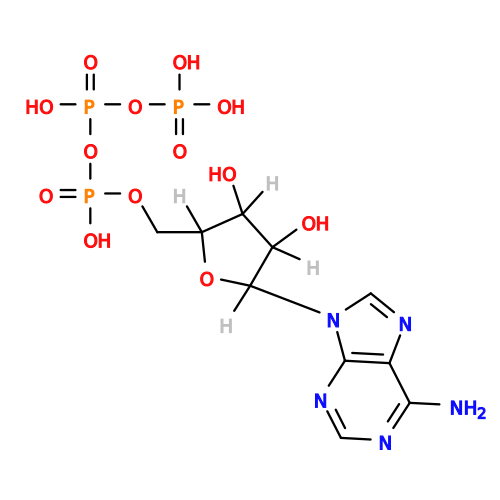 Mass: 507.181 Da / Num. of mol.: 4 / Source method: obtained synthetically / Formula: C10H16N5O13P3 / Feature type: SUBJECT OF INVESTIGATION / Comment: ATP, energy-carrying molecule*YM Mass: 507.181 Da / Num. of mol.: 4 / Source method: obtained synthetically / Formula: C10H16N5O13P3 / Feature type: SUBJECT OF INVESTIGATION / Comment: ATP, energy-carrying molecule*YM#4: Chemical | ChemComp-I3P /  Mass: 420.096 Da / Num. of mol.: 4 / Source method: obtained synthetically / Formula: C6H15O15P3 / Feature type: SUBJECT OF INVESTIGATION Mass: 420.096 Da / Num. of mol.: 4 / Source method: obtained synthetically / Formula: C6H15O15P3 / Feature type: SUBJECT OF INVESTIGATION#5: Chemical | ChemComp-CA /  Mass: 40.078 Da / Num. of mol.: 4 / Source method: obtained synthetically / Formula: Ca / Feature type: SUBJECT OF INVESTIGATION Mass: 40.078 Da / Num. of mol.: 4 / Source method: obtained synthetically / Formula: Ca / Feature type: SUBJECT OF INVESTIGATION#6: Chemical | ChemComp-PLX / ( 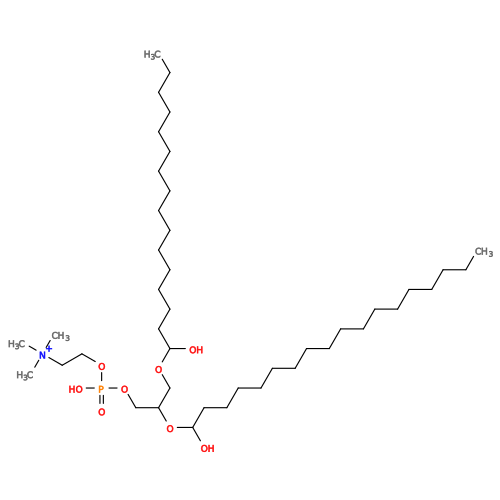 Mass: 767.132 Da / Num. of mol.: 4 / Source method: obtained synthetically / Formula: C42H89NO8P / Comment: phospholipid*YM Mass: 767.132 Da / Num. of mol.: 4 / Source method: obtained synthetically / Formula: C42H89NO8P / Comment: phospholipid*YM |
|---|
-Details
| Has ligand of interest | Y |
|---|---|
| Has protein modification | Y |
-Experimental details
-Experiment
| Experiment | Method: ELECTRON MICROSCOPY |
|---|---|
| EM experiment | Aggregation state: PARTICLE / 3D reconstruction method: single particle reconstruction |
- Sample preparation
| Component | Name: Inositol 1,4,5-trisphosphate receptor type 2 / Type: ORGANELLE OR CELLULAR COMPONENT / Entity ID: #1 / Source: RECOMBINANT |
|---|---|
| Molecular weight | Value: 1.2 MDa / Experimental value: YES |
| Source (natural) | Organism: Mus musculus (house mouse) |
| Source (recombinant) | Organism: Homo sapiens (human) / Cell: HEK293 GNTI- / Plasmid: BacMam |
| Buffer solution | pH: 7.4 / Details: 50mM Tris-HCl, 150 mM NaCl, 1mM DTT, 1mM EDTA |
| Specimen | Conc.: 3 mg/ml / Embedding applied: NO / Shadowing applied: NO / Staining applied: NO / Vitrification applied: YES Details: immuoaffinity purified, LMNG and lipid solubilized tetrameric ion channel protein |
| Specimen support | Grid material: COPPER / Grid type: Quantifoil |
| Vitrification | Instrument: FEI VITROBOT MARK IV / Cryogen name: ETHANE / Humidity: 90 % / Chamber temperature: 277.15 K |
- Electron microscopy imaging
| Experimental equipment |  Model: Titan Krios / Image courtesy: FEI Company | ||||||||||||||||||||
|---|---|---|---|---|---|---|---|---|---|---|---|---|---|---|---|---|---|---|---|---|---|
| Microscopy | Model: TFS KRIOS | ||||||||||||||||||||
| Electron gun | Electron source:  FIELD EMISSION GUN / Accelerating voltage: 300 kV / Illumination mode: FLOOD BEAM FIELD EMISSION GUN / Accelerating voltage: 300 kV / Illumination mode: FLOOD BEAM | ||||||||||||||||||||
| Electron lens | Mode: BRIGHT FIELD / Nominal magnification: 130000 X / Calibrated magnification: 46100 X / Nominal defocus max: 3000 nm / Nominal defocus min: 1000 nm / Cs: 2.7 mm / Alignment procedure: COMA FREE | ||||||||||||||||||||
| Specimen holder | Cryogen: NITROGEN / Specimen holder model: FEI TITAN KRIOS AUTOGRID HOLDER | ||||||||||||||||||||
| Image recording | Imaging-ID: 1 / Film or detector model: GATAN K2 SUMMIT (4k x 4k) / Num. of grids imaged: 2 / Num. of real images: 37329
| ||||||||||||||||||||
| Image scans |
|
- Processing
| EM software |
| ||||||||||||||||||||||||||||||||||||||||||||||||||
|---|---|---|---|---|---|---|---|---|---|---|---|---|---|---|---|---|---|---|---|---|---|---|---|---|---|---|---|---|---|---|---|---|---|---|---|---|---|---|---|---|---|---|---|---|---|---|---|---|---|---|---|
| CTF correction | Type: PHASE FLIPPING AND AMPLITUDE CORRECTION | ||||||||||||||||||||||||||||||||||||||||||||||||||
| Particle selection | Num. of particles selected: 6026377 | ||||||||||||||||||||||||||||||||||||||||||||||||||
| Symmetry | Point symmetry: C4 (4 fold cyclic) | ||||||||||||||||||||||||||||||||||||||||||||||||||
| 3D reconstruction | Resolution: 3.64 Å / Resolution method: FSC 0.143 CUT-OFF / Num. of particles: 151391 / Symmetry type: POINT | ||||||||||||||||||||||||||||||||||||||||||||||||||
| Atomic model building | B value: 135.9 / Protocol: FLEXIBLE FIT / Space: REAL / Target criteria: fit to map | ||||||||||||||||||||||||||||||||||||||||||||||||||
| Atomic model building | Source name: AlphaFold / Type: in silico model |
