 Movie
Movie Controller

[English] 日本語
 Yorodumi
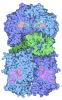
- EMDB-76264: Structure of mammalian Type 2 Inositol 1,4,5-trisphosphate recept... -
+ Open data

- Basic information
| Entry |  | |||||||||||||||||||||
|---|---|---|---|---|---|---|---|---|---|---|---|---|---|---|---|---|---|---|---|---|---|---|
| Title | Structure of mammalian Type 2 Inositol 1,4,5-trisphosphate receptor (IP3R2) in the presence of IP3/Ca2+/ATP | |||||||||||||||||||||
 Map data Map data | IP3R2-CIA consensus | |||||||||||||||||||||
 Sample Sample |
| |||||||||||||||||||||
 Keywords Keywords | ion channel / MEMBRANE PROTEIN | |||||||||||||||||||||
| Function / homology |  Function and homology information Function and homology informationEffects of PIP2 hydrolysis / Elevation of cytosolic Ca2+ levels / inositol 1,4,5-trisphosphate-gated calcium channel activity / Antigen activates B Cell Receptor (BCR) leading to generation of second messengers / Glucagon-like Peptide-1 (GLP1) regulates insulin secretion / Ion homeostasis / inositol 1,4,5 trisphosphate binding / cellular response to ethanol / transport vesicle membrane / intracellularly gated calcium channel activity ...Effects of PIP2 hydrolysis / Elevation of cytosolic Ca2+ levels / inositol 1,4,5-trisphosphate-gated calcium channel activity / Antigen activates B Cell Receptor (BCR) leading to generation of second messengers / Glucagon-like Peptide-1 (GLP1) regulates insulin secretion / Ion homeostasis / inositol 1,4,5 trisphosphate binding / cellular response to ethanol / transport vesicle membrane / intracellularly gated calcium channel activity / release of sequestered calcium ion into cytosol / cellular response to cAMP / sarcoplasmic reticulum membrane / phosphatidylinositol binding / secretory granule membrane / sarcoplasmic reticulum / calcium ion transport / scaffold protein binding / cell cortex / response to hypoxia / transmembrane transporter binding / signaling receptor complex / axon / calcium ion binding / endoplasmic reticulum membrane / endoplasmic reticulum / ATP binding / plasma membrane / cytoplasm Similarity search - Function | |||||||||||||||||||||
| Biological species |   Mus musculus (house mouse) Mus musculus (house mouse) | |||||||||||||||||||||
| Method | single particle reconstruction / cryo EM / Resolution: 3.64 Å | |||||||||||||||||||||
 Authors Authors | Serysheva II / Baker MR / Fan G | |||||||||||||||||||||
| Funding support |  United States, 6 items United States, 6 items
| |||||||||||||||||||||
 Citation Citation | Journal: Nat Commun / Year: 2026 Title: Cryo-EM insights into isoform-specific properties of the IPR2 channel. Authors: Mariah R Baker / Xiaoxuan Lin / Guizhen Fan / Ariel Martinez-Chavez / Larry E Wagner / Sundeep Malik / Tyler Allison / Briar Bell / Alexander B Seryshev / Julio Cordero-Morales / Matthew L ...Authors: Mariah R Baker / Xiaoxuan Lin / Guizhen Fan / Ariel Martinez-Chavez / Larry E Wagner / Sundeep Malik / Tyler Allison / Briar Bell / Alexander B Seryshev / Julio Cordero-Morales / Matthew L Baker / David I Yule / Irina I Serysheva / Abstract: Calcium release through inositol 1,4,5-trisphosphate receptors (IPRs) is a fundamental signaling mechanism that regulates diverse cellular processes. Among the three mammalian IPR isoforms, IPR2 is ...Calcium release through inositol 1,4,5-trisphosphate receptors (IPRs) is a fundamental signaling mechanism that regulates diverse cellular processes. Among the three mammalian IPR isoforms, IPR2 is widely expressed, yet its structural basis for activation and regulation remains unclear. Here, we report cryo-EM structures of mammalian IPR2 in ligand-free (closed) and CaIP/ATP-bound (activated) states at 3.3 Å and 3.6 Å resolution, respectively. These structures define the architecture of IPR2 and reveal conformational transitions associated with channel activation. Although the IP-binding pocket is conserved, subtype-specific differences in IP affinity likely arise from conformational dynamics of the regulatory ARM2 domain. Comparative analyses of IPR isoforms identify subtype-specific allosteric networks and domain motions that underlie differential regulation. We further define the ATP-binding site and, through mutagenesis and electrophysiology, establish the structural basis for ATP modulation of channel activity. Together, these findings reveal mechanisms of IPR2 activation and subtype-specific regulation, providing a framework for understanding isoform-dependent Ca signaling. | |||||||||||||||||||||
| History |
|
- Structure visualization
| Supplemental images |
|---|

- Downloads & links
-EMDB archive
| Map data | emd_76264.map.gz | 302.6 MB | EMDB map data format | |
|---|---|---|---|---|
| Header (meta data) | emd-76264-v30.xmlemd-76264.xml | 31 KB 31 KB | Display Display | EMDB header |
| Images |  emd_76264.png emd_76264.png | 165.4 KB | ||
| Filedesc metadata | emd-76264.cif.gz | 9 KB | ||
| Others | emd_76264_half_map_1.map.gzemd_76264_half_map_2.map.gz | 296.7 MB 296.6 MB | ||
| Archive directory |  https://data.pdbj.org/pub/emdb/structures/EMD-76264ftp://data.pdbj.org/pub/emdb/structures/EMD-76264 https://data.pdbj.org/pub/emdb/structures/EMD-76264ftp://data.pdbj.org/pub/emdb/structures/EMD-76264 | HTTPS FTP |
-Related structure data
| Related structure data |  12aiMC  12adC C: citing same article ( M: atomic model generated by this map |
|---|---|
| Similar structure data |


-Links
| EMDB pages | EMDB (EBI/PDBe) / EMDataResource |
|---|---|
| Related items in Molecule of the Month |
-Map
| File | Download / File: emd_76264.map.gz / Format: CCP4 / Size: 325 MB / Type: IMAGE STORED AS FLOATING POINT NUMBER (4 BYTES) | ||||||||||||||||||||||||||||||||||||
|---|---|---|---|---|---|---|---|---|---|---|---|---|---|---|---|---|---|---|---|---|---|---|---|---|---|---|---|---|---|---|---|---|---|---|---|---|---|
| Annotation | IP3R2-CIA consensus | ||||||||||||||||||||||||||||||||||||
| Projections & slices | Image control
Images are generated by Spider. | ||||||||||||||||||||||||||||||||||||
| Voxel size | X=Y=Z: 1.08 Å | ||||||||||||||||||||||||||||||||||||
| Density |
| ||||||||||||||||||||||||||||||||||||
| Symmetry | Space group: 1 | ||||||||||||||||||||||||||||||||||||
| Details | EMDB XML:
|
 Z (Sec.)
 Y (Row.)
 X (Col.)


-Supplemental data
-Half map: IP3R2-CIA-half map A
| File | emd_76264_half_map_1.map | ||||||||||||
|---|---|---|---|---|---|---|---|---|---|---|---|---|---|
| Annotation | IP3R2-CIA-half_map A | ||||||||||||
| Projections & Slices |
| ||||||||||||
| Density Histograms |


-Half map: IP3R2-CIA-half map B
| File | emd_76264_half_map_2.map | ||||||||||||
|---|---|---|---|---|---|---|---|---|---|---|---|---|---|
| Annotation | IP3R2-CIA-half_map B | ||||||||||||
| Projections & Slices |
| ||||||||||||
| Density Histograms |


- Sample components
-Entire : Inositol 1,4,5-trisphosphate receptor type 2
| Entire | Name: Inositol 1,4,5-trisphosphate receptor type 2 |
|---|---|
| Components |
|
-Supramolecule #1: Inositol 1,4,5-trisphosphate receptor type 2
| Supramolecule | Name: Inositol 1,4,5-trisphosphate receptor type 2 / type: organelle_or_cellular_component / ID: 1 / Parent: 0 / Macromolecule list: #1 |
|---|---|
| Source (natural) | Organism: Mus musculus (house mouse) |
| Molecular weight | Theoretical: 1.2 MDa |
-Macromolecule #1: Inositol 1,4,5-trisphosphate-gated calcium channel ITPR2
| Macromolecule | Name: Inositol 1,4,5-trisphosphate-gated calcium channel ITPR2 type: protein_or_peptide / ID: 1 / Number of copies: 4 / Enantiomer: LEVO |
|---|---|
| Source (natural) | Organism: Mus musculus (house mouse) |
| Molecular weight | Theoretical: 307.854719 KDa |
| Recombinant expression | Organism:  Homo sapiens (human) Homo sapiens (human) |
| Sequence | String: MSDKMSSFLY IGDIVSLYAE GSVNGFISTL GLVDDRCVVH PEAGDLANPP KKFRDCLFKV CPMNRYSAQK QYWKAKQAKQ GNHTEAALL KKLQHAAELE QKQNESENRK LLGEIVKYSN VIQLLHIKSN KYLTVNKRLP ALLEKNAMRV SLDAAGNEGS W FYIHPFWK ...String: MSDKMSSFLY IGDIVSLYAE GSVNGFISTL GLVDDRCVVH PEAGDLANPP KKFRDCLFKV CPMNRYSAQK QYWKAKQAKQ GNHTEAALL KKLQHAAELE QKQNESENRK LLGEIVKYSN VIQLLHIKSN KYLTVNKRLP ALLEKNAMRV SLDAAGNEGS W FYIHPFWK LRSEGDNIVV GDKVVLMPVN AGQPLHASNV ELLDNPGCKE VNAVNCNTSW KITLFMKFSS YREDVLKGGD VV RLFHAEQ EKFLTCDDYE KKQHIFLRTT LRQSATSATS SKALWEIEVV HHDPCRGGAG QWNSLFRFKH LATGNYLAAE LNP DYRDAQ NEGKNVKDGE IPTPKKKRQA GEKIMYTLVS VPHGNDIASL FELDATTLQR ADCLVPRNSY VRLRHLCTNT WVTS TTIPI DTEEERPVML KIGTCQTKED KEAFAIVCVP LSEVRDLDFA NDANKVLATT VKKLENGSIT QNERRFVTKL LEDLI FFVA DVTNNGQDVL DVVITKPNRE RQKLMREQNI LAQVFGILKA PFKEKAGEGS MLRLEDLGDQ RYAPYKYVLR LCYRVL RHS QQDYRKNQEY IAKNFCVMQS QIGYDILAED TITALLHNNR KLLEKHITAK EIETFVSLLR RNREPRFLDY LSDLCVS NS TAIPVTQELI CKFMLSPGNA DILIQTKLVS MQVENPMESS ILPDDIDDEE VWLYWIDSNK EPHGKAIRHL AQEAREGT K ADLEVLTYYR YQLNLFARMC LDRQYLAINQ ISTQLSVDLI LRCVSDESLP FDLRASFCRL MLHMHVDRDP QESVVPVRY ARLWTEIPTK ITIHEYDSIT DSSRNDMKRK FALTMEFVEE YLKEVVNQPF PFGDKEKNKL TFEVVHLARN LIYFGFYSFS ELLRLTRTL LAILDIVQAP MSSYFERLSK FQDGSNNVMR TIHGVGEMMT QMVLSRGSIF PVSVPDAQPI VHPSKQASPG E QEDVTVMD TKLKVIEILQ FILSVRLDYR ISYMLSIYKK EFGDNDDNGD PSASGTPDTL LPSALVPDID EIAAQAETMF AG RKEKTPV QLDDEGGRTF LRVLIHLIMH DYAPLLSGAL QLLFKHFSQR AEVLQAFKQV QLLVSNQDVD NYKQIKADLD QLR LTVEKS ELWVEKSGSY ENGDVGEGQA KGGEEANEES NLLSPVQDGA KTPQIDSNKG NNYRIVKEIL IRLSKLCVQN KKCR NQHQR LLKNMGAHSV VLDLLQIPYE KTDEKMNEVM DLAHTFLQNF CRGNPQNQVL LHKHLNLFLT PGLLEAETMR HIFMN NYHL CNEISERVVQ HFVHCIETHG RHVEYLRFLQ TIVKADGKYV KKCQDMVMTE LINGGEDVLI FYNDRASFPI LLNMMC SER ARGDESGPLA YHITLVELLA ACTEGKNVYT EIKCNSLLPL DDIVRVVTHD DCIPEVKIAY VNFVNHCYVD TEVEMKE IY TSNHIWKLFE NFLVDMARVC NTTTDRKHAD TFLERCVTES VMNIVSGFFN SPFSDNSTSL QTHQPVFIQL LQSAFRIY N CTWPNPAQKA SVESCIRALA EVAKNRGIAI PVDLDSQVNT LFMKNHSSTV QRAAMGWRLS ARSGPRFKEA LGGPAWDYR NIIEKLQDVV ASLEQQFSPM MQAEFSVLVD VLYSPELLFP EGSDARIRCG AFMSKLINHT KKLMEKEEKL CIKILQTLRE MLEKKDSFM EEGSTLRRIL LNRYFKGDHS ISVNGPLSGA YAKTAQVGGS FSGQDSDKKG ISMSDIQCLL DKEGASELVI D VIVNTKND RIFSEGILLG IALLEGGNTQ TQYSFYQQLH EQKKSEKFFK VLYDRMKAAQ KEIRSTVTVN TIDLGSKKRE ED SDVMALG PRMRVRDSSL HLREGMKGQL TEASSATSKA YCVYRREMDP EIDTMCPGQE AGSAEEKSAE EVTMSPAITI MRP ILRFLQ LLCENHNREL QNFLRNQNNK TNYNLVCETL QFLDCICGST TGGLGLLGLY INERNVALVN QTLESLTEYC QGPC HENQT CIATHESNGI DIIIALILND INPLGKYRMD LVLQLKNNAS KLLLAIMESR HDSENAERIL FNMRPRELVD VMKNA YNQG LECDHGDEEG GDDGVSPKDV GHNIYILAHQ LARHNKLLQQ MLKPGSDPEE GDEALKYYAN HTAQIEIVRH DRTMEQ IVF PVPNICEFLT RESKYRVFNT TERDEQGSKV NDFFQQTEDL YNEMKWQKKI RNNPALFWFS RHISLWGSIS FNLAVFI NL AVALFYPFGD DGDEGTLSPM FSVLLWVAVA ICTSMLFFFS KPVGIRPFLV SVMLRSIYTI GLGPTLILLG AANLCNKI V FLVSFVGNRG TFTRGYRAVI LDMAFLYHVA YVLVCMLGLF VHEFFYSFLL FDLVYREETL LNVIKSVTRN GRSIILTAV LALILVYLFS IIGFLFLKDD FTMEVDRLKN RTPVTGNHGV PTMTLSSMME TCQKENCSPT IPSSNTAGEE GEDGIERTCD TLLMCIVTV LNQGLRNGGG VGDVLRRPSK DEPLFAARVV YDLLFFFIVI IIVLNLIFGV IIDTFADLRS EKQKKEEILK T TCFICGLE RDKFDNKTVS FEEHIKSEHN MWHYLYFIVL VKVKDPTEYT GPESYVAQMI TEKNLDWFPR MRAMSLVSNE GD SEQNEIR NLQEKLESTM SLVKQLSGQL AELKEQMTEQ RKNKQRLGFL GSNTPHVNHH MPPH UniProtKB: Inositol 1,4,5-trisphosphate-gated calcium channel ITPR2 |
-Macromolecule #2: ZINC ION
| Macromolecule | Name: ZINC ION / type: ligand / ID: 2 / Number of copies: 4 / Formula: ZN |
|---|---|
| Molecular weight | Theoretical: 65.409 Da |
-Macromolecule #3: ADENOSINE-5'-TRIPHOSPHATE
| Macromolecule | Name: ADENOSINE-5'-TRIPHOSPHATE / type: ligand / ID: 3 / Number of copies: 4 / Formula: ATP |
|---|---|
| Molecular weight | Theoretical: 507.181 Da |
| Chemical component information | 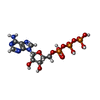 ChemComp-ATP: |
-Macromolecule #4: D-MYO-INOSITOL-1,4,5-TRIPHOSPHATE
| Macromolecule | Name: D-MYO-INOSITOL-1,4,5-TRIPHOSPHATE / type: ligand / ID: 4 / Number of copies: 4 / Formula: I3P |
|---|---|
| Molecular weight | Theoretical: 420.096 Da |
| Chemical component information | 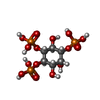 ChemComp-I3P: |
-Macromolecule #5: CALCIUM ION
| Macromolecule | Name: CALCIUM ION / type: ligand / ID: 5 / Number of copies: 4 / Formula: CA |
|---|---|
| Molecular weight | Theoretical: 40.078 Da |
-Macromolecule #6: (9R,11S)-9-({[(1S)-1-HYDROXYHEXADECYL]OXY}METHYL)-2,2-DIMETHYL-5,...
| Macromolecule | Name: (9R,11S)-9-({[(1S)-1-HYDROXYHEXADECYL]OXY}METHYL)-2,2-DIMETHYL-5,7,10-TRIOXA-2LAMBDA~5~-AZA-6LAMBDA~5~-PHOSPHAOCTACOSANE-6,6,11-TRIOL type: ligand / ID: 6 / Number of copies: 4 / Formula: PLX |
|---|---|
| Molecular weight | Theoretical: 767.132 Da |
| Chemical component information | 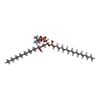 ChemComp-PLX: |
-Experimental details
-Structure determination
| Method | cryo EM |
|---|---|
 Processing Processing | single particle reconstruction |
| Aggregation state | particle |
-Sample preparation
| Concentration | 3 mg/mL |
|---|---|
| Buffer | pH: 7.4 / Details: 50mM Tris-HCl, 150 mM NaCl, 1mM DTT, 1mM EDTA |
| Grid | Model: Quantifoil / Material: COPPER / Support film - Material: CARBON / Support film - topology: CONTINUOUS / Pretreatment - Type: GLOW DISCHARGE / Pretreatment - Time: 10 sec. |
| Vitrification | Cryogen name: ETHANE / Chamber humidity: 90 % / Chamber temperature: 277.15 K / Instrument: FEI VITROBOT MARK IV |
| Details | immuoaffinity purified, LMNG and lipid solubilized tetrameric ion channel protein |
- Electron microscopy
| Microscope | TFS KRIOS |
|---|---|
| Image recording | #0 - Image recording ID: 1 / #0 - Film or detector model: GATAN K2 SUMMIT (4k x 4k) / #0 - Detector mode: SUPER-RESOLUTION / #0 - Digitization - Frames/image: 1-35 / #0 - Number grids imaged: 2 / #0 - Number real images: 37329 / #0 - Average exposure time: 8.0 sec. / #0 - Average electron dose: 1.43 e/Å2 / #1 - Image recording ID: 2 / #1 - Film or detector model: GATAN K2 SUMMIT (4k x 4k) / #1 - Detector mode: SUPER-RESOLUTION / #1 - Digitization - Frames/image: 1-30 / #1 - Number grids imaged: 2 / #1 - Number real images: 37329 / #1 - Average exposure time: 7.0 sec. / #1 - Average electron dose: 1.66 e/Å2 / #2 - Image recording ID: 3 / #2 - Film or detector model: GATAN K2 SUMMIT (4k x 4k) / #2 - Digitization - Frames/image: 1-35 / #2 - Number grids imaged: 2 / #2 - Number real images: 37329 / #2 - Average exposure time: 8.0 sec. / #2 - Average electron dose: 1.43 e/Å2 |
| Electron beam | Acceleration voltage: 300 kV / Electron source:  FIELD EMISSION GUN FIELD EMISSION GUN |
| Electron optics | Calibrated magnification: 46100 / Illumination mode: FLOOD BEAM / Imaging mode: BRIGHT FIELD / Cs: 2.7 mm / Nominal defocus max: 3.0 µm / Nominal defocus min: 1.0 µm / Nominal magnification: 130000 |
| Sample stage | Specimen holder model: FEI TITAN KRIOS AUTOGRID HOLDER / Cooling holder cryogen: NITROGEN |
| Experimental equipment |  Model: Titan Krios / Image courtesy: FEI Company |
+Image processing
-Atomic model buiding 1
| Initial model | Chain - Source name: AlphaFold / Chain - Initial model type: in silico model |
|---|---|
| Refinement | Space: REAL / Protocol: FLEXIBLE FIT / Overall B value: 135.9 / Target criteria: fit to map |
| Output model | PDB-12ai: |
