[English] 日本語
Yorodumi
- EMDB-81713: Cryo-EM structure of hydrogenase-2 in complex with L1 (right) -

+
Open data


ID or keywords:

Loading...

-
Basic information

Entry
Database: EMDB / ID: EMD-81713
TitleCryo-EM structure of hydrogenase-2 in complex with L1 (right)
Map data
Sample
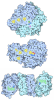
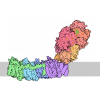
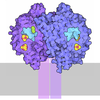
  • Complex: The complex of hydrogenase-2 with binder L1 (right)
    • Protein or peptide: binder L1
    • Protein or peptide: Hydrogenase-2 small chain
    • Protein or peptide: Hydrogenase-2 large chain
  • Ligand: IRON/SULFUR CLUSTER
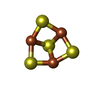
  • Ligand: FE3-S4 CLUSTER
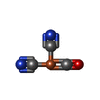
  • Ligand: CARBONMONOXIDE-(DICYANO) IRON
  • Ligand: NICKEL (II) ION
KeywordsComplex / Binder / OXIDOREDUCTASE
Function / homology
Function and homology information


hydrogenase (acceptor) / ferredoxin hydrogenase complex / [Ni-Fe] hydrogenase complex / hydrogenase (acceptor) activity / ferredoxin hydrogenase activity / anaerobic respiration / nickel cation binding / iron-sulfur cluster binding / electron transfer activity / periplasmic space ...hydrogenase (acceptor) / ferredoxin hydrogenase complex / [Ni-Fe] hydrogenase complex / hydrogenase (acceptor) activity / ferredoxin hydrogenase activity / anaerobic respiration / nickel cation binding / iron-sulfur cluster binding / electron transfer activity / periplasmic space / membrane / plasma membrane
Similarity search - Function
: / [NiFe]-hydrogenase, small subunit / Cytochrome-c3 hydrogenase, C-terminal / [NiFe]-hydrogenase, small subunit, C-terminal domain superfamily / NiFe/NiFeSe hydrogenase small subunit C-terminal / HoxL-like / Nickel-dependent hydrogenases large subunit signature 2. / Nickel-dependent hydrogenases large subunit signature 1. / [NiFe]-hydrogenase, small subunit, N-terminal domain superfamily / Nickel-dependent hydrogenase, large subunit, nickel binding site ...: / [NiFe]-hydrogenase, small subunit / Cytochrome-c3 hydrogenase, C-terminal / [NiFe]-hydrogenase, small subunit, C-terminal domain superfamily / NiFe/NiFeSe hydrogenase small subunit C-terminal / HoxL-like / Nickel-dependent hydrogenases large subunit signature 2. / Nickel-dependent hydrogenases large subunit signature 1. / [NiFe]-hydrogenase, small subunit, N-terminal domain superfamily / Nickel-dependent hydrogenase, large subunit, nickel binding site / Nickel-dependent hydrogenase, large subunit / Nickel-dependent hydrogenase / Twin-arginine translocation pathway, signal sequence, bacterial/archaeal / NADH:ubiquinone oxidoreductase-like, 20kDa subunit / NADH ubiquinone oxidoreductase, 20 Kd subunit / [NiFe]-hydrogenase, large subunit / Twin arginine translocation (Tat) signal profile. / Twin-arginine translocation pathway, signal sequence
Similarity search - Domain/homology
Hydrogenase-2 large chain / Hydrogenase-2 small chain
Similarity search - Component
Biological speciesEscherichia coli (strain K12) (bacteria) / synthetic construct (others)
Methodsingle particle reconstruction / cryo EM / Resolution: 2.48 Å
AuthorsZhang N / Huang Y / Zhang L
Funding support China, 1 items
OrganizationGrant numberCountry
Ministry of Science and Technology (MoST, China)2020YFA0907300 China
CitationJournal: Angew Chem Int Ed Engl / Year: 2026
Title: De Novo Design of a Protein Binder to Probe Gas Channel and Enhance the Oxygen Tolerance of [NiFe]-Hydrogenase.
Authors: Xuan Sun / Qi Xiao / Nan Zhang / Wenjin Li / Hang Luo / Yanxin Gao / Leyan Zhang / Yilin Fan / Peiyu Jiang / Yucen Huang / Geng Wu / Liyun Zhang /
Abstract: [NiFe]-Hydrogenases display remarkable catalytic efficiency for H production and oxidation but are sensitive to O, which severely restricts their biotechnological applications. The identities and ...[NiFe]-Hydrogenases display remarkable catalytic efficiency for H production and oxidation but are sensitive to O, which severely restricts their biotechnological applications. The identities and functional relevance of gas channels leading to the buried [NiFe] active site remain elusive, hindering rational enzyme engineering. Here, we introduce an artificial intelligence-guided de novo protein binder design strategy to map hydrophobic O diffusion pathways in Escherichia coli hydrogenase-2 (Hyd-2). By integrating RFdiffusion, ProteinMPNN, and AlphaFold, ∼100,000 candidate binders were computationally screened, yielding two high-affinity binders, L1 and L2. Biophysical and electrochemical analyses show that L1 selectively occludes the primary O ingress channel, enhancing the enzyme's oxygen tolerance by more than threefold, whereas L2, which targets another putative channel, has a negligible effect, indicating that this pathway contributes minimally to O ingress under the tested conditions. Furthermore, we determined the L1-Hyd-2 complex structure by cryo-electron microscopy and revealed the key interaction residues and interface conformation. Integrated structural and computational analyses provide mechanistic insights into the system's oxygen tolerance and high-affinity L1-Hyd-2 interaction. All findings provide the first direct experimental evidence for hierarchical O diffusion channels in [NiFe]-hydrogenases and establish binder-mediated channel occlusion as a generalizable, mutation-free strategy for elucidating and modulating gas transport in metalloenzymes.
History
DepositionJun 24, 2026-
Header (metadata) releaseOct 14, 2026-
Map releaseOct 14, 2026-
UpdateOct 14, 2026-
Current statusOct 14, 2026Processing site: PDBc / Status: Released

-
Structure visualization

Supplemental images

Downloads & links

-
Map

FileDownload / File: emd_81713.map.gz / Format: CCP4 / Size: 30.5 MB / Type: IMAGE STORED AS FLOATING POINT NUMBER (4 BYTES)
Projections & slices

Image control

Size
Brightness
Contrast
Others
AxesZ (Sec.)Y (Row.)X (Col.)
0.93 Å/pix.
x 200 pix.
= 186. Å
0.93 Å/pix.
x 200 pix.
= 186. Å
0.93 Å/pix.
x 200 pix.
= 186. Å

Surface

Projections

Slices (1/3)

Slices (1/2)

Slices (2/3)

Images are generated by Spider.

Voxel sizeX=Y=Z: 0.93 Å
Density
Contour LevelBy AUTHOR: 0.119
Minimum - Maximum-0.36047345 - 0.68993694
Average (Standard dev.)0.0018037019 (±0.023633964)
SymmetrySpace group: 1
Details

EMDB XML:

Map geometry
Axis orderXYZ
Origin000
Dimensions200200200
Spacing200200200
CellA=B=C: 186.0 Å
α=β=γ: 90.0 °

-
Supplemental data

-
Half map: #1

Fileemd_81713_half_map_1.map
Projections & Slices
AxesZYX

Projections

Slices (1/2)
Density Histograms

-
Half map: #2

Fileemd_81713_half_map_2.map
Projections & Slices
AxesZYX

Projections

Slices (1/2)
Density Histograms

-
Sample components

-
Entire : The complex of hydrogenase-2 with binder L1 (right)

EntireName: The complex of hydrogenase-2 with binder L1 (right)
Components
  • Complex: The complex of hydrogenase-2 with binder L1 (right)
    • Protein or peptide: binder L1
    • Protein or peptide: Hydrogenase-2 small chain
    • Protein or peptide: Hydrogenase-2 large chain
  • Ligand: IRON/SULFUR CLUSTER
  • Ligand: FE3-S4 CLUSTER
  • Ligand: CARBONMONOXIDE-(DICYANO) IRON
  • Ligand: NICKEL (II) ION

-
Supramolecule #1: The complex of hydrogenase-2 with binder L1 (right)

SupramoleculeName: The complex of hydrogenase-2 with binder L1 (right) / type: complex / ID: 1 / Parent: 0 / Macromolecule list: #1-#3
Source (natural)Organism: Escherichia coli (strain K12) (bacteria)

-
Macromolecule #1: binder L1

MacromoleculeName: binder L1 / type: protein_or_peptide / ID: 1 / Number of copies: 1 / Enantiomer: LEVO
Source (natural)Organism: synthetic construct (others)
Molecular weightTheoretical: 8.356343 KDa
Recombinant expressionOrganism: Escherichia coli (E. coli)
SequenceString:
MHHHHHHSPY RDAAVQAALD AAAAAPSTAD IINAAAEAIR KGEVGLALLR LGVAAARDPA NAATINAAAD TVYALSQKEK AA

-
Macromolecule #2: Hydrogenase-2 small chain

MacromoleculeName: Hydrogenase-2 small chain / type: protein_or_peptide / ID: 2 / Number of copies: 2 / Enantiomer: LEVO / EC number: hydrogenase (acceptor)
Source (natural)Organism: Escherichia coli (strain K12) (bacteria) / Strain: K12
Molecular weightTheoretical: 32.371498 KDa
Recombinant expressionOrganism: Escherichia coli (E. coli)
SequenceString: MAESVTNPQR PPVIWIGAQE CTGCTESLLR ATHPTVENLV LETISLEYHE VLSAAFGHQV EENKHNALEK YKGQYVLVVD GSIPLKDNG IYCMVAGEPI VDHIRKAAEG AAAIIAIGSC SAWGGVAAAG VNPTGAVSLQ EVLPGKTVIN IPGCPPNPHN F LATVAHII ...String:
MAESVTNPQR PPVIWIGAQE CTGCTESLLR ATHPTVENLV LETISLEYHE VLSAAFGHQV EENKHNALEK YKGQYVLVVD GSIPLKDNG IYCMVAGEPI VDHIRKAAEG AAAIIAIGSC SAWGGVAAAG VNPTGAVSLQ EVLPGKTVIN IPGCPPNPHN F LATVAHII TYGKPPKLDD KNRPTFAYGR LIHEHCERRP HFDAGRFAKE FGDEGHREGW CLYHLGCKGP ETYGNCSTLQ FC DVGGVWP VAIGHPCYGC NEEGIGFHKG IHQLANVENQ TPRSQKPDVN AKEGGHHHHH H

UniProtKB: Hydrogenase-2 small chain

-
Macromolecule #3: Hydrogenase-2 large chain

MacromoleculeName: Hydrogenase-2 large chain / type: protein_or_peptide / ID: 3 / Number of copies: 2 / Enantiomer: LEVO / EC number: hydrogenase (acceptor)
Source (natural)Organism: Escherichia coli (strain K12) (bacteria) / Strain: K12
Molecular weightTheoretical: 62.557906 KDa
Recombinant expressionOrganism: Escherichia coli (E. coli)
SequenceString: MSQRITIDPV TRIEGHLRID CEIENGVVSK AWASGTMWRG MEEIVKNRDP RDAWMIVQRI CGVCTTTHAL SSVRAAESAL NIDVPVNAQ YIRNIILAAH TTHDHIVHFY QLSALDWVDI TSALQADPTK ASEMLKGVST WHLNSPEEFT KVQNKIKDLV A SGQLGIFA ...String:
MSQRITIDPV TRIEGHLRID CEIENGVVSK AWASGTMWRG MEEIVKNRDP RDAWMIVQRI CGVCTTTHAL SSVRAAESAL NIDVPVNAQ YIRNIILAAH TTHDHIVHFY QLSALDWVDI TSALQADPTK ASEMLKGVST WHLNSPEEFT KVQNKIKDLV A SGQLGIFA NGYWGHPAMK LPPEVNLIAV AHYLQALECQ RDANRVVALL GGKTPHIQNL AVGGVANPIN LDGLGVLNLE RL MYIKSFI DKLSDFVEQV YKVDTAVIAA FYPEWLTRGK GAVNYLSVPE FPTDSKNGSF LFPGGYIENA DLSSYRPITS HSD EYLIKG IQESAKHSWY KDEAPQAPWE GTTIPAYDGW SDDGKYSWVK SPTFYGKTVE VGPLANMLVK LAAGRESTQN KLNE IVAIY QKLTGNTLEV AQLHSTLGRI IGRTVHCCEL QDILQNQYSA LITNIGKGDH TTFVKPNIPA TGEFKGVGFL EAPRG MLSH WMVIKDGIIS NYQAVVPSTW NSGPRNFNDD VGPYEQSLVG TPVADPNKPL EVVRTIHSFD PCMACAVHVV DADGNE VVS VKVL

UniProtKB: Hydrogenase-2 large chain

-
Macromolecule #4: IRON/SULFUR CLUSTER

MacromoleculeName: IRON/SULFUR CLUSTER / type: ligand / ID: 4 / Number of copies: 4 / Formula: SF4
Molecular weightTheoretical: 351.64 Da
Chemical component information

ChemComp-FS1:
IRON/SULFUR CLUSTER

-
Macromolecule #5: FE3-S4 CLUSTER

MacromoleculeName: FE3-S4 CLUSTER / type: ligand / ID: 5 / Number of copies: 2 / Formula: F3S
Molecular weightTheoretical: 295.795 Da
Chemical component information

ChemComp-F3S:
FE3-S4 CLUSTER

-
Macromolecule #6: CARBONMONOXIDE-(DICYANO) IRON

MacromoleculeName: CARBONMONOXIDE-(DICYANO) IRON / type: ligand / ID: 6 / Number of copies: 2 / Formula: FCO
Molecular weightTheoretical: 135.89 Da
Chemical component information

ChemComp-FCO:
CARBONMONOXIDE-(DICYANO) IRON

-
Macromolecule #7: NICKEL (II) ION

MacromoleculeName: NICKEL (II) ION / type: ligand / ID: 7 / Number of copies: 2 / Formula: NI
Molecular weightTheoretical: 58.693 Da
Chemical component information

ChemComp-NI:
NICKEL (II) ION

-
Experimental details

-
Structure determination

Methodcryo EM
Processingsingle particle reconstruction
Aggregation stateparticle

-
Sample preparation

BufferpH: 7.2
VitrificationCryogen name: ETHANE

-
Electron microscopy

MicroscopeTFS TITAN THEMIS
Image recordingFilm or detector model: FEI FALCON IV (4k x 4k) / Average electron dose: 50.0 e/Å2
Electron beamAcceleration voltage: 300 kV / Electron source: FIELD EMISSION GUN
Electron opticsIllumination mode: FLOOD BEAM / Imaging mode: BRIGHT FIELD / Nominal defocus max: 2.0 µm / Nominal defocus min: 0.8 µm

+
Image processing

CTF correctionType: NONE
Startup modelType of model: NONE
Final reconstructionResolution.type: BY AUTHOR / Resolution: 2.48 Å / Resolution method: FSC 0.143 CUT-OFF / Software - Name: cryoSPARC / Number images used: 241696
Initial angle assignmentType: MAXIMUM LIKELIHOOD
Final angle assignmentType: MAXIMUM LIKELIHOOD

+
About Yorodumi

-
News

-
Feb 9, 2022. New format data for meta-information of EMDB entries

New format data for meta-information of EMDB entries

  • Version 3 of the EMDB header file is now the official format.
  • The previous official version 1.9 will be removed from the archive.

Related info.:EMDB header

External links:wwPDB to switch to version 3 of the EMDB data model

-
Aug 12, 2020. Covid-19 info

Covid-19 info

URL: https://pdbj.org/emnavi/covid19.php

New page: Covid-19 featured information page in EM Navigator.

Related info.:Covid-19 info / Mar 5, 2020. Novel coronavirus structure data

+
Mar 5, 2020. Novel coronavirus structure data

Novel coronavirus structure data

Related info.:Yorodumi Speices / Aug 12, 2020. Covid-19 info

External links:COVID-19 featured content - PDBj / Molecule of the Month (242):Coronavirus Proteases

+
Jan 31, 2019. EMDB accession codes are about to change! (news from PDBe EMDB page)

EMDB accession codes are about to change! (news from PDBe EMDB page)

  • The allocation of 4 digits for EMDB accession codes will soon come to an end. Whilst these codes will remain in use, new EMDB accession codes will include an additional digit and will expand incrementally as the available range of codes is exhausted. The current 4-digit format prefixed with “EMD-” (i.e. EMD-XXXX) will advance to a 5-digit format (i.e. EMD-XXXXX), and so on. It is currently estimated that the 4-digit codes will be depleted around Spring 2019, at which point the 5-digit format will come into force.
  • The EM Navigator/Yorodumi systems omit the EMD- prefix.

Related info.:Q: What is EMD? / ID/Accession-code notation in Yorodumi/EM Navigator

External links:EMDB Accession Codes are Changing Soon! / Contact to PDBj

+
Jul 12, 2017. Major update of PDB

Major update of PDB

  • wwPDB released updated PDB data conforming to the new PDBx/mmCIF dictionary.
  • This is a major update changing the version number from 4 to 5, and with Remediation, in which all the entries are updated.
  • In this update, many items about electron microscopy experimental information are reorganized (e.g. em_software).
  • Now, EM Navigator and Yorodumi are based on the updated data.

External links:wwPDB Remediation / Enriched Model Files Conforming to OneDep Data Standards Now Available in the PDB FTP Archive

-
Yorodumi

Thousand views of thousand structures

  • Yorodumi is a browser for structure data from EMDB, PDB, SASBDB, etc.
  • This page is also the successor to EM Navigator detail page, and also detail information page/front-end page for Omokage search.
  • The word "yorodu" (or yorozu) is an old Japanese word meaning "ten thousand". "mi" (miru) is to see.

Related info.:EMDB / PDB / SASBDB / Comparison of 3 databanks / Yorodumi Search / Aug 31, 2016. New EM Navigator & Yorodumi / Yorodumi Papers / Jmol/JSmol / Function and homology information / Changes in new EM Navigator and Yorodumi

Read more