Journal: Angew Chem Int Ed Engl / Year: 2026 Title: De Novo Design of a Protein Binder to Probe Gas Channel and Enhance the Oxygen Tolerance of [NiFe]-Hydrogenase. Authors: Xuan Sun / Qi Xiao / Nan Zhang / Wenjin Li / Hang Luo / Yanxin Gao / Leyan Zhang / Yilin Fan / Peiyu Jiang / Yucen Huang / Geng Wu / Liyun Zhang / Abstract: [NiFe]-Hydrogenases display remarkable catalytic efficiency for H production and oxidation but are sensitive to O, which severely restricts their biotechnological applications. The identities and ...[NiFe]-Hydrogenases display remarkable catalytic efficiency for H production and oxidation but are sensitive to O, which severely restricts their biotechnological applications. The identities and functional relevance of gas channels leading to the buried [NiFe] active site remain elusive, hindering rational enzyme engineering. Here, we introduce an artificial intelligence-guided de novo protein binder design strategy to map hydrophobic O diffusion pathways in Escherichia coli hydrogenase-2 (Hyd-2). By integrating RFdiffusion, ProteinMPNN, and AlphaFold, ∼100,000 candidate binders were computationally screened, yielding two high-affinity binders, L1 and L2. Biophysical and electrochemical analyses show that L1 selectively occludes the primary O ingress channel, enhancing the enzyme's oxygen tolerance by more than threefold, whereas L2, which targets another putative channel, has a negligible effect, indicating that this pathway contributes minimally to O ingress under the tested conditions. Furthermore, we determined the L1-Hyd-2 complex structure by cryo-electron microscopy and revealed the key interaction residues and interface conformation. Integrated structural and computational analyses provide mechanistic insights into the system's oxygen tolerance and high-affinity L1-Hyd-2 interaction. All findings provide the first direct experimental evidence for hierarchical O diffusion channels in [NiFe]-hydrogenases and establish binder-mediated channel occlusion as a generalizable, mutation-free strategy for elucidating and modulating gas transport in metalloenzymes.
In the structure databanks used in Yorodumi, some data are registered as the other names, "COVID-19 virus" and "2019-nCoV". Here are the details of the virus and the list of structure data.
Jan 31, 2019. EMDB accession codes are about to change! (news from PDBe EMDB page)
EMDB accession codes are about to change! (news from PDBe EMDB page)
The allocation of 4 digits for EMDB accession codes will soon come to an end. Whilst these codes will remain in use, new EMDB accession codes will include an additional digit and will expand incrementally as the available range of codes is exhausted. The current 4-digit format prefixed with “EMD-” (i.e. EMD-XXXX) will advance to a 5-digit format (i.e. EMD-XXXXX), and so on. It is currently estimated that the 4-digit codes will be depleted around Spring 2019, at which point the 5-digit format will come into force.
The EM Navigator/Yorodumi systems omit the EMD- prefix.
Related info.:Q: What is EMD? / ID/Accession-code notation in Yorodumi/EM Navigator
Yorodumi is a browser for structure data from EMDB, PDB, SASBDB, etc.
This page is also the successor to EM Navigator detail page, and also detail information page/front-end page for Omokage search.
The word "yorodu" (or yorozu) is an old Japanese word meaning "ten thousand". "mi" (miru) is to see.
Related info.:EMDB / PDB / SASBDB / Comparison of 3 databanks / Yorodumi Search / Aug 31, 2016. New EM Navigator & Yorodumi / Yorodumi Papers / Jmol/JSmol / Function and homology information / Changes in new EM Navigator and Yorodumi
 Movie
Movie Controller


 Open data
 Basic information
 Map data
 Sample
 Keywords
 Function and homology information
 Escherichia coli (E. coli) / synthetic construct (others) /
  Authors
 China, 1 items
  Citation
 Structure visualization
 Downloads & links
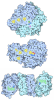
 emd_81712.png
 https://data.pdbj.org/pub/emdb/structures/EMD-81712


 Z (Sec.)
 Y (Row.)
 X (Col.)


 Sample components

 Processing
 Electron microscopy
 FIELD EMISSION GUN