[English] 日本語
Yorodumi
- EMDB-80088: receptor-arrestin -

+
Open data


ID or keywords:

Loading...

-
Basic information

Entry
Database: EMDB / ID: EMD-80088
Titlereceptor-arrestin
Map data
Sample
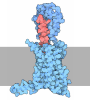
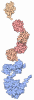
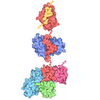
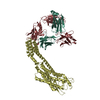
  • Complex: FZD6 beta-arrestin 1 complex
    • Protein or peptide: Isoform 1B of Beta-arrestin-1
    • Protein or peptide: heavy chain of scFv30
    • Protein or peptide: light chain of scFv30
    • Protein or peptide: Frizzled-6
KeywordsReceptor / Complex / MEMBRANE PROTEIN
Function / homology
Function and homology information


midbrain morphogenesis / Signaling by RNF43 mutants / angiotensin receptor binding / negative regulation of protein localization to ciliary membrane / Wnt receptor activity / non-canonical Wnt signaling pathway / TGFBR3 regulates TGF-beta signaling / Activation of SMO / Wnt-protein binding / protein localization to non-motile cilium ...midbrain morphogenesis / Signaling by RNF43 mutants / angiotensin receptor binding / negative regulation of protein localization to ciliary membrane / Wnt receptor activity / non-canonical Wnt signaling pathway / TGFBR3 regulates TGF-beta signaling / Activation of SMO / Wnt-protein binding / protein localization to non-motile cilium / apicolateral plasma membrane / intraciliary retrograde transport / negative regulation of interleukin-8 production / desensitization of G protein-coupled receptor signaling pathway / PCP/CE pathway / Class B/2 (Secretin family receptors) / arrestin family protein binding / G protein-coupled receptor internalization / stress fiber assembly / Wnt signaling pathway, planar cell polarity pathway / mitogen-activated protein kinase kinase binding / negative regulation of Notch signaling pathway / sensory perception / Lysosome Vesicle Biogenesis / negative regulation of interleukin-6 production / Golgi Associated Vesicle Biogenesis / positive regulation of Rho protein signal transduction / canonical Wnt signaling pathway / pseudopodium / positive regulation of smoothened signaling pathway / positive regulation of receptor internalization / cysteine-type endopeptidase inhibitor activity / insulin-like growth factor receptor binding / clathrin-coated pit / negative regulation of protein ubiquitination / GTPase activator activity / intracellular glucose homeostasis / Regulation of FZD by ubiquitination / enzyme inhibitor activity / negative regulation of canonical NF-kappaB signal transduction / Activated NOTCH1 Transmits Signal to the Nucleus / positive regulation of insulin secretion involved in cellular response to glucose stimulus / negative regulation of canonical Wnt signaling pathway / Signaling by high-kinase activity BRAF mutants / MAP2K and MAPK activation / cytoplasmic vesicle membrane / positive regulation of protein phosphorylation / G protein-coupled receptor binding / Signaling by RAF1 mutants / Signaling by moderate kinase activity BRAF mutants / Paradoxical activation of RAF signaling by kinase inactive BRAF / Signaling downstream of RAS mutants / endocytic vesicle membrane / Signaling by BRAF and RAF1 fusions / cilium / Cargo recognition for clathrin-mediated endocytosis / Clathrin-mediated endocytosis / Thrombin signalling through proteinase activated receptors (PARs) / cytoplasmic vesicle / ubiquitin-dependent protein catabolic process / Ca2+ pathway / G alpha (s) signalling events / proteasome-mediated ubiquitin-dependent protein catabolic process / molecular adaptor activity / regulation of apoptotic process / positive regulation of ERK1 and ERK2 cascade / cell surface receptor signaling pathway / transcription coactivator activity / protein-macromolecule adaptor activity / apical plasma membrane / protein ubiquitination / Ub-specific processing proteases / Golgi membrane / lysosomal membrane / ubiquitin protein ligase binding / regulation of transcription by RNA polymerase II / endoplasmic reticulum membrane / chromatin / negative regulation of transcription by RNA polymerase II / cell surface / positive regulation of transcription by RNA polymerase II / nucleoplasm / membrane / nucleus / plasma membrane / cytosol / cytoplasm
Similarity search - Function
Frizzled-6 / Frizzled 6, cysteine-rich domain / Frizzled/Smoothened, transmembrane domain / Frizzled/Smoothened family membrane region / Frizzled/Smoothened family membrane region / Frizzled/secreted frizzled-related protein / Frizzled / Frizzled domain / Frizzled cysteine-rich domain superfamily / Fz domain ...Frizzled-6 / Frizzled 6, cysteine-rich domain / Frizzled/Smoothened, transmembrane domain / Frizzled/Smoothened family membrane region / Frizzled/Smoothened family membrane region / Frizzled/secreted frizzled-related protein / Frizzled / Frizzled domain / Frizzled cysteine-rich domain superfamily / Fz domain / Frizzled (fz) domain profile. / Arrestin, conserved site / Arrestins signature. / Arrestin / Arrestin, N-terminal / Arrestin-like, N-terminal / Arrestin C-terminal-like domain / Arrestin (or S-antigen), N-terminal domain / Arrestin (or S-antigen), C-terminal domain / Arrestin (or S-antigen), C-terminal domain / Arrestin-like, C-terminal / GPCR, family 2-like / G-protein coupled receptors family 2 profile 2. / Immunoglobulin E-set
Similarity search - Domain/homology
Frizzled-6 / Beta-arrestin-1
Similarity search - Component
Biological speciesHomo sapiens (human)
Methodsingle particle reconstruction / cryo EM / Resolution: 3.2 Å
AuthorsFei X / Zhibin Z
Funding support1 items
OrganizationGrant numberCountry
Not funded
CitationJournal: Acta Pharmacol Sin / Year: 2026
Title: Direct β-arrestin engagement by the non-canonical WNT receptor FZD6 via a shallow binding pocket.
Authors: Zhi-Bin Zhang / Xi Lin / Meng-Rao Li / Yu-Rui Pan / Qing Kang / Fei Xu / Xiang-Jia Zhu /
Abstract: As primary WNT receptors, Frizzled (FZD) receptors behave as nonclassical GPCRs; however, their engagement with downstream transducers is largely unknown. Previous studies have suggested that β- ...As primary WNT receptors, Frizzled (FZD) receptors behave as nonclassical GPCRs; however, their engagement with downstream transducers is largely unknown. Previous studies have suggested that β-arrestin recruitment to FZD receptors depends on its interaction with Dishevelled (DVL) and that this process regulates both canonical and non-canonical pathways. Here, we reveal that FZD6, which mainly mediates non-canonical WNT signalling, directly binds to β-arrestin 1 (βarr1) and report the cryo-EM structure of the FZD6-βarr1 complex, which revealed a unique shallow pocket in FZD6 for βarr1 engagement and identified arrestin-specific motifs that are distinct from those observed in previously reported FZD receptor-transducer complexes. Collectively, our findings establish a direct arrestin recruitment mechanism in FZD receptors that shares key features with arrestin engagement in classical GPCRs, suggesting that the engagement of core GPCR transducers may modulate WNT signalling specificity. These insights position FZD receptors as druggable targets akin to classical GPCRs, opening new avenues for targeting FZD receptors for a wide range of diseases, including cancer.
History
DepositionApr 2, 2026-
Header (metadata) releaseAug 26, 2026-
Map releaseAug 26, 2026-
UpdateSep 2, 2026-
Current statusSep 2, 2026Processing site: PDBc / Status: Released

-
Structure visualization

Supplemental images

Downloads & links

-
Map

FileDownload / File: emd_80088.map.gz / Format: CCP4 / Size: 125 MB / Type: IMAGE STORED AS FLOATING POINT NUMBER (4 BYTES)
Projections & slices

Image control

Size
Brightness
Contrast
Others
AxesZ (Sec.)Y (Row.)X (Col.)
0.54 Å/pix.
x 320 pix.
= 171.36 Å
0.54 Å/pix.
x 320 pix.
= 171.36 Å
0.54 Å/pix.
x 320 pix.
= 171.36 Å

Surface

Projections

Slices (1/3)

Slices (1/2)

Slices (2/3)

Images are generated by Spider.

Voxel sizeX=Y=Z: 0.5355 Å
Density
Contour LevelBy AUTHOR: 0.0254
Minimum - Maximum-0.094165765 - 0.17547545
Average (Standard dev.)-0.00008271779 (±0.0072698737)
SymmetrySpace group: 1
Details

EMDB XML:

Map geometry
Axis orderXYZ
Origin189191167
Dimensions320320320
Spacing320320320
CellA=B=C: 171.36 Å
α=β=γ: 90.0 °

-
Supplemental data

-
Half map: #2

Fileemd_80088_half_map_1.map
Projections & Slices
AxesZYX

Projections

Slices (1/2)
Density Histograms

-
Half map: #1

Fileemd_80088_half_map_2.map
Projections & Slices
AxesZYX

Projections

Slices (1/2)
Density Histograms

-
Sample components

-
Entire : FZD6 beta-arrestin 1 complex

EntireName: FZD6 beta-arrestin 1 complex
Components
  • Complex: FZD6 beta-arrestin 1 complex
    • Protein or peptide: Isoform 1B of Beta-arrestin-1
    • Protein or peptide: heavy chain of scFv30
    • Protein or peptide: light chain of scFv30
    • Protein or peptide: Frizzled-6

-
Supramolecule #1: FZD6 beta-arrestin 1 complex

SupramoleculeName: FZD6 beta-arrestin 1 complex / type: complex / ID: 1 / Parent: 0 / Macromolecule list: all
Source (natural)Organism: Homo sapiens (human)

-
Macromolecule #1: Isoform 1B of Beta-arrestin-1

MacromoleculeName: Isoform 1B of Beta-arrestin-1 / type: protein_or_peptide / ID: 1 / Number of copies: 1 / Enantiomer: LEVO
Source (natural)Organism: Homo sapiens (human)
Molecular weightTheoretical: 46.398629 KDa
Recombinant expressionOrganism: Trichoplusia ni (cabbage looper)
SequenceString: MGDKGTRVFK KASPNGKLTV YLGKRDFVDH IDLVDPVDGV VLVDPEYLKE RRVYVTLTVA FRYGREDLDV LGLTFRKDLF VANVQSFPP APEDKKPLTR LQERLIKKLG EHAYPFTFEI PPNLPSSVTL QPGPEDTGKA LGVDYEVKAF VAENLEEKIH K RNSVRLVI ...String:
MGDKGTRVFK KASPNGKLTV YLGKRDFVDH IDLVDPVDGV VLVDPEYLKE RRVYVTLTVA FRYGREDLDV LGLTFRKDLF VANVQSFPP APEDKKPLTR LQERLIKKLG EHAYPFTFEI PPNLPSSVTL QPGPEDTGKA LGVDYEVKAF VAENLEEKIH K RNSVRLVI RKVQYAPERP GPQPTAETTR QFLMSDKPLH LEASLDKEIY YHGEPISVNV HVTNNTNKTV KKIKISVRQY AD IVLFNTA QYKVPVAMEE ADDTVAPSST FSKVYTLTPF LANNREKRGL ALDGKLKHED TNLASSTLLR EGANREILGI IVS YKVKVK LVVSRSSDVA VELPFTLMHP KPKEEPPHRE VPENETPVDT NLIELDTNDD DIVFEDFARQ RLKGMKDDKE EEED GTGSP QLNNR

UniProtKB: Beta-arrestin-1

-
Macromolecule #2: heavy chain of scFv30

MacromoleculeName: heavy chain of scFv30 / type: protein_or_peptide / ID: 2 / Number of copies: 1 / Enantiomer: LEVO
Source (natural)Organism: Homo sapiens (human)
Molecular weightTheoretical: 13.294725 KDa
Recombinant expressionOrganism: Trichoplusia ni (cabbage looper)
SequenceString:
MQVQLVESGG GLVQPGGSLR LSCAASGFNV YSSSIHWVRQ APGKGLEWVA SISSYYGYTY YADSVKGRFT ISADTSKNTA YLQMNSLRA EDTAVYYCAR SRQFWYSGLD YWGQGTLVTV SS

-
Macromolecule #3: light chain of scFv30

MacromoleculeName: light chain of scFv30 / type: protein_or_peptide / ID: 3 / Number of copies: 1 / Enantiomer: LEVO
Source (natural)Organism: Homo sapiens (human)
Molecular weightTheoretical: 11.717078 KDa
Recombinant expressionOrganism: Trichoplusia ni (cabbage looper)
SequenceString:
SDIQMTQSPS SLSASVGDRV TITCRASQSV SSAVAWYQQK PGKAPKLLIY SASSLYSGVP SRFSGSRSGT DFTLTISSLQ PEDFATYYC QQYKYVPVTF GQGTKVEIK

-
Macromolecule #4: Frizzled-6

MacromoleculeName: Frizzled-6 / type: protein_or_peptide / ID: 4 / Number of copies: 1 / Enantiomer: LEVO
Source (natural)Organism: Homo sapiens (human)
Molecular weightTheoretical: 60.422824 KDa
Recombinant expressionOrganism: Trichoplusia ni (cabbage looper)
SequenceString: HSLFTCEPIT VPRCMKMAYN MTFFPNLMGH YDQSIAAVEM EHFLPLANLE CSPNIETFLC KAFVPTCIEQ IHVVPPCRKL CEKVYSDCK KLIDTFGIRW PEELECDRLQ YCDETVPVTF DPHTEFLGPQ KKTEQVQRDI GFWCPRHLKT SGGQGYKFLG I DQCAPPCP ...String:
HSLFTCEPIT VPRCMKMAYN MTFFPNLMGH YDQSIAAVEM EHFLPLANLE CSPNIETFLC KAFVPTCIEQ IHVVPPCRKL CEKVYSDCK KLIDTFGIRW PEELECDRLQ YCDETVPVTF DPHTEFLGPQ KKTEQVQRDI GFWCPRHLKT SGGQGYKFLG I DQCAPPCP NMYFKSDELE FAKSFIGTVS IFCLCATLFT FLTFLIDVRR FRYPERPIIY YSVCYSIVSL MYFIGFLLGD ST ACNKADE KLELGDTVVL GSQNKACTVL FMLLYFFTMA GTVWWVILTI TWFLAAGRKW SCEAIEQKAV WFHAVAWGTP GFL TVMLLA MNKVEGDNIS GVCFVGLYDL DASRYFVLLP LCLCVFVGLS LLLAGIISLN HVRQVIQHDG RNQEKLKKFM IRIG VFSGL YLVPLVTLLG CYVYEQVNRI TWEITWVSDH CRQYHIPCPY QAKAKARPEL ALFMIKYLMT LIVGISAVFW VGSKK TCTE WAGFFKRNRK RDPISESRRV LQEDE(SEP)C(TPO)(TPO)A (SEP)(SEP)(SEP)LAKDTSS

UniProtKB: Frizzled-6

-
Experimental details

-
Structure determination

Methodcryo EM
Processingsingle particle reconstruction
Aggregation stateparticle

-
Sample preparation

Concentration7.5 mg/mL
BufferpH: 7.5
VitrificationCryogen name: ETHANE

-
Electron microscopy

MicroscopeTFS KRIOS
Image recordingFilm or detector model: GATAN K3 (6k x 4k) / Average electron dose: 60.0 e/Å2
Electron beamAcceleration voltage: 300 kV / Electron source: OTHER
Electron opticsIllumination mode: OTHER / Imaging mode: OTHER / Nominal defocus max: 2.0 µm / Nominal defocus min: 1.0 µm
Experimental equipment
Model: Titan Krios / Image courtesy: FEI Company

+
Image processing

CTF correctionType: PHASE FLIPPING AND AMPLITUDE CORRECTION
Startup modelType of model: PDB ENTRY
PDB model - PDB ID:
Final reconstructionResolution.type: BY AUTHOR / Resolution: 3.2 Å / Resolution method: FSC 0.143 CUT-OFF / Software - Name: cryoSPARC / Number images used: 71056
Initial angle assignmentType: COMMON LINE
Final angle assignmentType: MAXIMUM LIKELIHOOD
FSC plot (resolution estimation)

+
About Yorodumi

-
News

-
Feb 9, 2022. New format data for meta-information of EMDB entries

New format data for meta-information of EMDB entries

  • Version 3 of the EMDB header file is now the official format.
  • The previous official version 1.9 will be removed from the archive.

Related info.:EMDB header

External links:wwPDB to switch to version 3 of the EMDB data model

-
Aug 12, 2020. Covid-19 info

Covid-19 info

URL: https://pdbj.org/emnavi/covid19.php

New page: Covid-19 featured information page in EM Navigator.

Related info.:Covid-19 info / Mar 5, 2020. Novel coronavirus structure data

+
Mar 5, 2020. Novel coronavirus structure data

Novel coronavirus structure data

Related info.:Yorodumi Speices / Aug 12, 2020. Covid-19 info

External links:COVID-19 featured content - PDBj / Molecule of the Month (242):Coronavirus Proteases

+
Jan 31, 2019. EMDB accession codes are about to change! (news from PDBe EMDB page)

EMDB accession codes are about to change! (news from PDBe EMDB page)

  • The allocation of 4 digits for EMDB accession codes will soon come to an end. Whilst these codes will remain in use, new EMDB accession codes will include an additional digit and will expand incrementally as the available range of codes is exhausted. The current 4-digit format prefixed with “EMD-” (i.e. EMD-XXXX) will advance to a 5-digit format (i.e. EMD-XXXXX), and so on. It is currently estimated that the 4-digit codes will be depleted around Spring 2019, at which point the 5-digit format will come into force.
  • The EM Navigator/Yorodumi systems omit the EMD- prefix.

Related info.:Q: What is EMD? / ID/Accession-code notation in Yorodumi/EM Navigator

External links:EMDB Accession Codes are Changing Soon! / Contact to PDBj

+
Jul 12, 2017. Major update of PDB

Major update of PDB

  • wwPDB released updated PDB data conforming to the new PDBx/mmCIF dictionary.
  • This is a major update changing the version number from 4 to 5, and with Remediation, in which all the entries are updated.
  • In this update, many items about electron microscopy experimental information are reorganized (e.g. em_software).
  • Now, EM Navigator and Yorodumi are based on the updated data.

External links:wwPDB Remediation / Enriched Model Files Conforming to OneDep Data Standards Now Available in the PDB FTP Archive

-
Yorodumi

Thousand views of thousand structures

  • Yorodumi is a browser for structure data from EMDB, PDB, SASBDB, etc.
  • This page is also the successor to EM Navigator detail page, and also detail information page/front-end page for Omokage search.
  • The word "yorodu" (or yorozu) is an old Japanese word meaning "ten thousand". "mi" (miru) is to see.

Related info.:EMDB / PDB / SASBDB / Comparison of 3 databanks / Yorodumi Search / Aug 31, 2016. New EM Navigator & Yorodumi / Yorodumi Papers / Jmol/JSmol / Function and homology information / Changes in new EM Navigator and Yorodumi

Read more