 Movie
Movie Controller


+ Open data

- Basic information
| Entry | Database: PDB / ID: 25gn | |||||||||
|---|---|---|---|---|---|---|---|---|---|---|
| Title | receptor-arrestin | |||||||||
 Components Components |
| |||||||||
 Keywords Keywords | MEMBRANE PROTEIN / Receptor / Complex | |||||||||
| Function / homology |  Function and homology information Function and homology informationmidbrain morphogenesis / Signaling by RNF43 mutants / angiotensin receptor binding / negative regulation of protein localization to ciliary membrane / Wnt receptor activity / non-canonical Wnt signaling pathway / TGFBR3 regulates TGF-beta signaling / Activation of SMO / Wnt-protein binding / protein localization to non-motile cilium ...midbrain morphogenesis / Signaling by RNF43 mutants / angiotensin receptor binding / negative regulation of protein localization to ciliary membrane / Wnt receptor activity / non-canonical Wnt signaling pathway / TGFBR3 regulates TGF-beta signaling / Activation of SMO / Wnt-protein binding / protein localization to non-motile cilium / apicolateral plasma membrane / intraciliary retrograde transport / negative regulation of interleukin-8 production / desensitization of G protein-coupled receptor signaling pathway / PCP/CE pathway / Class B/2 (Secretin family receptors) / arrestin family protein binding / G protein-coupled receptor internalization / stress fiber assembly / Wnt signaling pathway, planar cell polarity pathway / mitogen-activated protein kinase kinase binding / negative regulation of Notch signaling pathway / sensory perception / Lysosome Vesicle Biogenesis / negative regulation of interleukin-6 production / Golgi Associated Vesicle Biogenesis / positive regulation of Rho protein signal transduction / canonical Wnt signaling pathway / pseudopodium / positive regulation of smoothened signaling pathway / positive regulation of receptor internalization / cysteine-type endopeptidase inhibitor activity / insulin-like growth factor receptor binding / clathrin-coated pit / negative regulation of protein ubiquitination / GTPase activator activity / intracellular glucose homeostasis / Regulation of FZD by ubiquitination / enzyme inhibitor activity / negative regulation of canonical NF-kappaB signal transduction / Activated NOTCH1 Transmits Signal to the Nucleus / positive regulation of insulin secretion involved in cellular response to glucose stimulus / negative regulation of canonical Wnt signaling pathway / Signaling by high-kinase activity BRAF mutants / MAP2K and MAPK activation / cytoplasmic vesicle membrane / positive regulation of protein phosphorylation / G protein-coupled receptor binding / Signaling by RAF1 mutants / Signaling by moderate kinase activity BRAF mutants / Paradoxical activation of RAF signaling by kinase inactive BRAF / Signaling downstream of RAS mutants / endocytic vesicle membrane / Signaling by BRAF and RAF1 fusions / cilium / Cargo recognition for clathrin-mediated endocytosis / Clathrin-mediated endocytosis / Thrombin signalling through proteinase activated receptors (PARs) / cytoplasmic vesicle / ubiquitin-dependent protein catabolic process / Ca2+ pathway / G alpha (s) signalling events / proteasome-mediated ubiquitin-dependent protein catabolic process / molecular adaptor activity / regulation of apoptotic process / positive regulation of ERK1 and ERK2 cascade / cell surface receptor signaling pathway / transcription coactivator activity / protein-macromolecule adaptor activity / apical plasma membrane / protein ubiquitination / Ub-specific processing proteases / Golgi membrane / lysosomal membrane / ubiquitin protein ligase binding / regulation of transcription by RNA polymerase II / endoplasmic reticulum membrane / chromatin / negative regulation of transcription by RNA polymerase II / cell surface / positive regulation of transcription by RNA polymerase II / nucleoplasm / membrane / nucleus / plasma membrane / cytosol / cytoplasm Similarity search - Function | |||||||||
| Biological species |  Homo sapiens (human) Homo sapiens (human) | |||||||||
| Method | ELECTRON MICROSCOPY / single particle reconstruction / cryo EM / Resolution: 3.2 Å | |||||||||
 Authors Authors | Fei, X. / Zhibin, Z. | |||||||||
| Funding support | 1items
| |||||||||
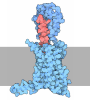
 Citation Citation | Journal: Acta Pharmacol Sin / Year: 2026 Title: Direct β-arrestin engagement by the non-canonical WNT receptor FZD6 via a shallow binding pocket. Authors: Zhi-Bin Zhang / Xi Lin / Meng-Rao Li / Yu-Rui Pan / Qing Kang / Fei Xu / Xiang-Jia Zhu /  Abstract: As primary WNT receptors, Frizzled (FZD) receptors behave as nonclassical GPCRs; however, their engagement with downstream transducers is largely unknown. Previous studies have suggested that β- ...As primary WNT receptors, Frizzled (FZD) receptors behave as nonclassical GPCRs; however, their engagement with downstream transducers is largely unknown. Previous studies have suggested that β-arrestin recruitment to FZD receptors depends on its interaction with Dishevelled (DVL) and that this process regulates both canonical and non-canonical pathways. Here, we reveal that FZD6, which mainly mediates non-canonical WNT signalling, directly binds to β-arrestin 1 (βarr1) and report the cryo-EM structure of the FZD6-βarr1 complex, which revealed a unique shallow pocket in FZD6 for βarr1 engagement and identified arrestin-specific motifs that are distinct from those observed in previously reported FZD receptor-transducer complexes. Collectively, our findings establish a direct arrestin recruitment mechanism in FZD receptors that shares key features with arrestin engagement in classical GPCRs, suggesting that the engagement of core GPCR transducers may modulate WNT signalling specificity. These insights position FZD receptors as druggable targets akin to classical GPCRs, opening new avenues for targeting FZD receptors for a wide range of diseases, including cancer. | |||||||||
| History |
|
- Structure visualization
| Structure viewer | Molecule: MolmilJmol/JSmol |
|---|
- Downloads & links
-Download
| PDBx/mmCIF format | 25gn.cif.gz | 184.7 KB | Display | PDBx/mmCIF format |
|---|---|---|---|---|
| PDB format | pdb25gn.ent.gz | 138.3 KB | Display | PDB format |
| PDBx/mmJSON format | 25gn.json.gz | Tree view | PDBx/mmJSON format | |
| Others |  Other downloads Other downloads |
-Validation report
| Arichive directory | https://data.pdbj.org/pub/pdb/validation_reports/5g/25gnftp://data.pdbj.org/pub/pdb/validation_reports/5g/25gn | HTTPS FTP |
|---|
-Related structure data
| Related structure data |  80088MC M: map data used to model this data C: citing same article ( |
|---|---|
| Similar structure data |
-Links
 PDBj
PDBj
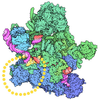
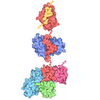
- Assembly
| Deposited unit | 
|
|---|---|
| 1 |
|
-Components
| #1: Protein | Mass: 46398.629 Da / Num. of mol.: 1 Source method: isolated from a genetically manipulated source Source: (gene. exp.) Homo sapiens (human) / Gene: ARRB1, ARR1 / Production host:  Trichoplusia ni (cabbage looper) / References: UniProt: P49407 Trichoplusia ni (cabbage looper) / References: UniProt: P49407 |
|---|---|
| #2: Antibody | Mass: 13294.725 Da / Num. of mol.: 1 Source method: isolated from a genetically manipulated source Source: (gene. exp.) Homo sapiens (human) / Production host: Trichoplusia ni (cabbage looper) |
| #3: Antibody | Mass: 11717.078 Da / Num. of mol.: 1 Source method: isolated from a genetically manipulated source Source: (gene. exp.) Homo sapiens (human) / Production host: Trichoplusia ni (cabbage looper) |
| #4: Protein | Mass: 60422.824 Da / Num. of mol.: 1 Source method: isolated from a genetically manipulated source Source: (gene. exp.) Homo sapiens (human) / Gene: FZD6 / Production host: Trichoplusia ni (cabbage looper) / References: UniProt: O60353 |
| Has ligand of interest | Y |
| Has protein modification | Y |
-Experimental details
-Experiment
| Experiment | Method: ELECTRON MICROSCOPY |
|---|---|
| EM experiment | Aggregation state: PARTICLE / 3D reconstruction method: single particle reconstruction |
- Sample preparation
| Component | Name: FZD6 beta-arrestin 1 complex / Type: COMPLEX / Entity ID: all / Source: RECOMBINANT |
|---|---|
| Source (natural) | Organism: Homo sapiens (human) |
| Source (recombinant) | Organism: Trichoplusia ni (cabbage looper) |
| Buffer solution | pH: 7.5 |
| Specimen | Conc.: 7.5 mg/ml / Embedding applied: NO / Shadowing applied: NO / Staining applied: NO / Vitrification applied: YES |
| Vitrification | Cryogen name: ETHANE |
- Electron microscopy imaging
| Experimental equipment |  Model: Titan Krios / Image courtesy: FEI Company |
|---|---|
| Microscopy | Model: TFS KRIOS |
| Electron gun | Electron source: OTHER / Accelerating voltage: 300 kV / Illumination mode: OTHER |
| Electron lens | Mode: OTHER / Nominal defocus max: 2000 nm / Nominal defocus min: 1000 nm |
| Image recording | Electron dose: 60 e/Å2 / Film or detector model: GATAN K3 (6k x 4k) |
- Processing
| EM software |
| ||||||||||||||||||||||||
|---|---|---|---|---|---|---|---|---|---|---|---|---|---|---|---|---|---|---|---|---|---|---|---|---|---|
| CTF correction | Type: PHASE FLIPPING AND AMPLITUDE CORRECTION | ||||||||||||||||||||||||
| 3D reconstruction | Resolution: 3.2 Å / Resolution method: FSC 0.143 CUT-OFF / Num. of particles: 71056 / Symmetry type: POINT | ||||||||||||||||||||||||
| Refinement | Highest resolution: 3.2 Å Stereochemistry target values: REAL-SPACE (WEIGHTED MAP SUM AT ATOM CENTERS) | ||||||||||||||||||||||||
| Refine LS restraints |
|
