Defective F8 accelerates dissociation of the A2 domain / Defective F8 binding to the cell membrane / Defective F8 secretion / Defective F8 sulfation at Y1699 / Gamma carboxylation, hypusinylation, hydroxylation, and arylsulfatase activation / Defective F8 binding to von Willebrand factor / blood coagulation, intrinsic pathway / Amplification and propagation of coagulation cascade / Cargo concentration in the ER / Initiation of coagulation cascade ...Defective F8 accelerates dissociation of the A2 domain / Defective F8 binding to the cell membrane / Defective F8 secretion / Defective F8 sulfation at Y1699 / Gamma carboxylation, hypusinylation, hydroxylation, and arylsulfatase activation / Defective F8 binding to von Willebrand factor / blood coagulation, intrinsic pathway / Amplification and propagation of coagulation cascade / Cargo concentration in the ER / Initiation of coagulation cascade / COPII-coated ER to Golgi transport vesicle / Defective factor IX causes thrombophilia / Defective cofactor function of FVIIIa variant / Defective F9 variant does not activate FX / COPII-mediated vesicle transport / Regulation of clotting cascade / Defective F8 cleavage by thrombin / endoplasmic reticulum-Golgi intermediate compartment membrane / platelet alpha granule lumen / Golgi lumen / blood coagulation / Platelet degranulation / oxidoreductase activity / endoplasmic reticulum lumen / copper ion binding / extracellular region / plasma membrane Similarity search - Function
Coagulation factor 5/8-like / : / Multicopper oxidases, conserved site / Multicopper oxidases signature 1. / Coagulation factors 5/8 type C domain (FA58C) signature 2. / Coagulation factors 5/8 type C domain (FA58C) signature 1. / Coagulation factor 5/8 C-terminal domain, discoidin domain / Multicopper oxidase, C-terminal / Multicopper oxidase / Coagulation factors 5/8 type C domain (FA58C) profile. ...Coagulation factor 5/8-like / : / Multicopper oxidases, conserved site / Multicopper oxidases signature 1. / Coagulation factors 5/8 type C domain (FA58C) signature 2. / Coagulation factors 5/8 type C domain (FA58C) signature 1. / Coagulation factor 5/8 C-terminal domain, discoidin domain / Multicopper oxidase, C-terminal / Multicopper oxidase / Coagulation factors 5/8 type C domain (FA58C) profile. / F5/8 type C domain / Coagulation factor 5/8 C-terminal domain / Multicopper oxidase, N-terminal / Multicopper oxidase / Cupredoxin / Galactose-binding-like domain superfamily Similarity search - Domain/homology
Doisy Fund of the Edward A. Doisy Department of Biochemistry and Molecular Biology
United States
Childrens Discovery Institute of Washington University and St. Louis Childrens Hospital
CDI-CORE-2015-505 and CDI-CORE-2019-813
United States
The Foundation for Barnes-Jewish Hospital
3770
United States
National Institutes of Health/National Institute of Diabetes and Digestive and Kidney Disease (NIH/NIDDK)
DK020579
United States
National Institutes of Health/National Cancer Institute (NIH/NCI)
CA091842
United States
Citation
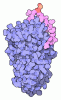
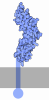
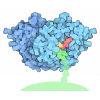
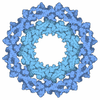
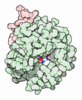
Journal: J Thromb Haemost / Year: 2026 Title: Structural determination of lipid-bound factor VIII. Authors: Bassem M Mohammed / Abstract: BACKGROUND: Coagulation factor (F)VIII is the inactive precursor of FVIIIa, an essential component of the intrinsic tenase complex. Despite numerous structures of recombinant FVIII in solution, the ...BACKGROUND: Coagulation factor (F)VIII is the inactive precursor of FVIIIa, an essential component of the intrinsic tenase complex. Despite numerous structures of recombinant FVIII in solution, the structural basis of the procofactor-membrane interface remains poorly defined. Traditional liposome platforms require special grids and often suffer from heterogeneous particle distribution and overcrowding, precluding high-resolution single-particle analysis, while membrane mimetics-nanodiscs-are too planar, posing significant biophysical challenges. OBJECTIVES: This study established a reproducible methodology for structural determination of membrane-bound coagulation factors and resolve the procofactor FVIII-lipid interface. METHODS: We used methylated branched lipids to compensate for membrane planarity and used cryoelectron microscopy to solve the structure of FVIII bound to lipids. RESULTS: We resolved the cryoelectron microscopy structure of procofactor FVIII on nanodiscs and liposomes lipid membranes at 3.46 and 3.56 Å, respectively. Structural analysis reveals a definitive ...RESULTS: We resolved the cryoelectron microscopy structure of procofactor FVIII on nanodiscs and liposomes lipid membranes at 3.46 and 3.56 Å, respectively. Structural analysis reveals a definitive tilted docking orientation where both C domains mediate shallow interfacial insertion, with the C2 domain acting as the primary anchor and the C1 domain serving as a secondary tether. This spatial arrangement structurally explains the high clinical severity of C2 interface mutations compared with more moderate C1 surface mutations. CONCLUSION: Methylated branched lipids enable rapid, high-resolution characterization of membrane-associated clotting factors. This structure provides the first definitive template for the FVIII- ...CONCLUSION: Methylated branched lipids enable rapid, high-resolution characterization of membrane-associated clotting factors. This structure provides the first definitive template for the FVIII-lipid interface, serving as a benchmark for future studies on tenase complex assembly.
Model: Quantifoil R1.2/1.3 / Material: COPPER / Mesh: 300 / Support film - Material: CARBON / Support film - topology: HOLEY / Pretreatment - Type: GLOW DISCHARGE / Pretreatment - Time: 20 sec. / Pretreatment - Atmosphere: AIR
Vitrification
Cryogen name: ETHANE / Chamber humidity: 95 % / Instrument: FEI VITROBOT MARK IV
-
Electron microscopy
Microscope
TFS GLACIOS
Image recording
Film or detector model: FEI FALCON IV (4k x 4k) / Number grids imaged: 1 / Number real images: 4185 / Average electron dose: 55.0 e/Å2 / Details: Cu R1.2/1.3
Electron beam
Acceleration voltage: 200 kV / Electron source: FIELD EMISSION GUN
In the structure databanks used in Yorodumi, some data are registered as the other names, "COVID-19 virus" and "2019-nCoV". Here are the details of the virus and the list of structure data.
Jan 31, 2019. EMDB accession codes are about to change! (news from PDBe EMDB page)
EMDB accession codes are about to change! (news from PDBe EMDB page)
The allocation of 4 digits for EMDB accession codes will soon come to an end. Whilst these codes will remain in use, new EMDB accession codes will include an additional digit and will expand incrementally as the available range of codes is exhausted. The current 4-digit format prefixed with “EMD-” (i.e. EMD-XXXX) will advance to a 5-digit format (i.e. EMD-XXXXX), and so on. It is currently estimated that the 4-digit codes will be depleted around Spring 2019, at which point the 5-digit format will come into force.
The EM Navigator/Yorodumi systems omit the EMD- prefix.
Related info.:Q: What is EMD? / ID/Accession-code notation in Yorodumi/EM Navigator
Yorodumi is a browser for structure data from EMDB, PDB, SASBDB, etc.
This page is also the successor to EM Navigator detail page, and also detail information page/front-end page for Omokage search.
The word "yorodu" (or yorozu) is an old Japanese word meaning "ten thousand". "mi" (miru) is to see.
Related info.:EMDB / PDB / SASBDB / Comparison of 3 databanks / Yorodumi Search / Aug 31, 2016. New EM Navigator & Yorodumi / Yorodumi Papers / Jmol/JSmol / Function and homology information / Changes in new EM Navigator and Yorodumi
 Movie
Movie Controller


 Open data
 Basic information
 Map data
 Sample
 Keywords
 Function and homology information
 Homo sapiens (human)
 Authors
 United States, 5 items
  Citation
 Structure visualization
 Downloads & links
 emd_76497.png
 https://data.pdbj.org/pub/emdb/structures/EMD-76497


 Z (Sec.)
 Y (Row.)
 X (Col.)


 Sample components
 Mesocricetus auratus (golden hamster)
 Processing
 Electron microscopy
 FIELD EMISSION GUN

