National Institutes of Health/National Institute of General Medical Sciences (NIH/NIGMS)
GM038660
United States
National Institutes of Health/National Institute of General Medical Sciences (NIH/NIGMS)
GM118130
United States
Citation
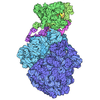
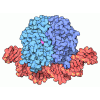
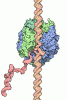
Journal: bioRxiv / Year: 2026 Title: ppGpp regulates transcription elongation via direct and indirect inputs to RNA polymerase pausing and nucleotide addition. Authors: Andreas U Mueller / Rachel A Mooney / Michael D Engstrom / Yu Bao / Michael B Wolfe / Balendra Sah / Jonathan Buscher / Jason Saba / James Liu / Seth A Darst / Robert Landick / Abstract: The signaling molecules guanosine 5'-tri/diphosphate 3'-diphosphate, (p)ppGpp, control bacterial protein synthesis rates and cell growth by targeting transcription, translation, NTP synthesis, and ...The signaling molecules guanosine 5'-tri/diphosphate 3'-diphosphate, (p)ppGpp, control bacterial protein synthesis rates and cell growth by targeting transcription, translation, NTP synthesis, and other functions. In lineages like , (p)ppGpp produced in response to charged-tRNA deficiency directly targets transcribing RNAP polymerase (RNAP) to match its pace to the pioneering ribosome on the nascent RNA (transcription-translation coupling). However, the mechanism by which (p)ppGpp slows RNAP is poorly defined. (p)ppGpp may allosterically stimulate RNAP pausing, inhibit catalysis, promote backtracking, compete for substrate GTP, inhibit GTP synthesis, or uncouple transcription-translation by inhibiting translation. Using a combination of cryo-EM, biochemical assays, and quantitative nascent elongating transcript sequencing (qNET-seq), we establish that (p)ppGpp allosterically regulates pausing and nucleotide addition via distinct motions of the RNAP swivel module and both competes with and lowers GTP in vivo. (p)ppGpp stimulates swiveling at pause sites to delay escape but may also inhibit counter-swiveling required in every round of nucleotide addition.
In the structure databanks used in Yorodumi, some data are registered as the other names, "COVID-19 virus" and "2019-nCoV". Here are the details of the virus and the list of structure data.
Jan 31, 2019. EMDB accession codes are about to change! (news from PDBe EMDB page)
EMDB accession codes are about to change! (news from PDBe EMDB page)
The allocation of 4 digits for EMDB accession codes will soon come to an end. Whilst these codes will remain in use, new EMDB accession codes will include an additional digit and will expand incrementally as the available range of codes is exhausted. The current 4-digit format prefixed with “EMD-” (i.e. EMD-XXXX) will advance to a 5-digit format (i.e. EMD-XXXXX), and so on. It is currently estimated that the 4-digit codes will be depleted around Spring 2019, at which point the 5-digit format will come into force.
The EM Navigator/Yorodumi systems omit the EMD- prefix.
Related info.:Q: What is EMD? / ID/Accession-code notation in Yorodumi/EM Navigator
Yorodumi is a browser for structure data from EMDB, PDB, SASBDB, etc.
This page is also the successor to EM Navigator detail page, and also detail information page/front-end page for Omokage search.
The word "yorodu" (or yorozu) is an old Japanese word meaning "ten thousand". "mi" (miru) is to see.
Related info.:EMDB / PDB / SASBDB / Comparison of 3 databanks / Yorodumi Search / Aug 31, 2016. New EM Navigator & Yorodumi / Yorodumi Papers / Jmol/JSmol / Function and homology information / Changes in new EM Navigator and Yorodumi
 Movie
Movie Controller

 Yorodumi
 Open data
 Basic information
 Map data
 Sample
 Keywords
 Function and homology information
 Escherichia coli (E. coli)
 Authors
 United States, 2 items
  Citation
 Structure visualization
 Downloads & links
 emd_76372.png
 https://data.pdbj.org/pub/emdb/structures/EMD-76372


 Z (Sec.)
 Y (Row.)
 X (Col.)


 Sample components
 Processing
 Electron microscopy
 FIELD EMISSION GUN

