[English] 日本語
Yorodumi
- EMDB-74711: Nucleosome with an SSB at SHL +5.3 in complex with human PARP2, H... -

+
Open data


ID or keywords:

Loading...

-
Basic information

Entry
Database: EMDB / ID: EMD-74711
TitleNucleosome with an SSB at SHL +5.3 in complex with human PARP2, HPF1, and Talazoparib, Class 3
Map data
Sample
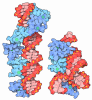
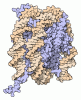
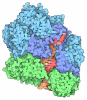
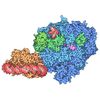
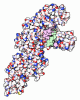
  • Complex: Nucleosome with an SSB at SHL +5.3 in complex with human PARP2, HPF1, and Talazoparib, Class 3
    • Protein or peptide: Histone H2A
    • Protein or peptide: Histone H2B
    • Protein or peptide: Histone H3
    • Protein or peptide: Histone H4
    • Protein or peptide: PL2-6 scFv
    • DNA: DNA 130-mer
    • DNA: DNA 23-mer
    • DNA: DNA 153-mer
    • Protein or peptide: Poly [ADP-ribose] polymerase 2
KeywordsDNA damage binding protein / DNA BINDING PROTEIN / DNA BINDING PROTEIN-DNA complex
Function / homology
Function and homology information


HDMs demethylate histones / PKMTs methylate histone lysines / Interleukin-7 signaling / Chromatin modifying enzymes / SUMOylation of chromatin organization proteins / Recruitment and ATM-mediated phosphorylation of repair and signaling proteins at DNA double strand breaks / RMTs methylate histone arginines / E3 ubiquitin ligases ubiquitinate target proteins / RCAF complex / Factors involved in megakaryocyte development and platelet production ...HDMs demethylate histones / PKMTs methylate histone lysines / Interleukin-7 signaling / Chromatin modifying enzymes / SUMOylation of chromatin organization proteins / Recruitment and ATM-mediated phosphorylation of repair and signaling proteins at DNA double strand breaks / RMTs methylate histone arginines / E3 ubiquitin ligases ubiquitinate target proteins / RCAF complex / Factors involved in megakaryocyte development and platelet production / SIRT1 negatively regulates rRNA expression / NoRC negatively regulates rRNA expression / Activated PKN1 stimulates transcription of AR (androgen receptor) regulated genes KLK2 and KLK3 / CHD6, CHD7, CHD8, CHD9 subfamily / polytene chromosome band / PRC2 methylates histones and DNA / Ub-specific processing proteases / Negative Regulation of CDH1 Gene Transcription / Interaction of NuRD complexes with transcription factors / MLL4 and MLL3 complexes regulate expression of PPARG target genes in adipogenesis and hepatic steatosis / Regulation of PD-L1(CD274) transcription / larval somatic muscle development / RNA Polymerase I Promoter Escape / RUNX1 regulates genes involved in megakaryocyte differentiation and platelet function / Senescence-Associated Secretory Phenotype (SASP) / CHD1 and CHD2 subfamily / Regulation of endogenous retroelements by KRAB-ZFP proteins / Transcriptional regulation by small RNAs / Estrogen-dependent gene expression / Assembly of the ORC complex at the origin of replication / Oxidative Stress Induced Senescence / HATs acetylate histones / poly-ADP-D-ribose binding / polytene chromosome / NAD+-protein-serine ADP-ribosyltransferase activity / NAD DNA ADP-ribosyltransferase activity / DNA ADP-ribosylation / poly-ADP-D-ribose modification-dependent protein binding / HDR through MMEJ (alt-NHEJ) / NAD+ ADP-ribosyltransferase / protein auto-ADP-ribosylation / NAD+-protein-aspartate ADP-ribosyltransferase activity / protein poly-ADP-ribosylation / NAD+-protein-glutamate ADP-ribosyltransferase activity / decidualization / NAD+-protein mono-ADP-ribosyltransferase activity / nuclear chromosome / Transferases; Glycosyltransferases; Pentosyltransferases / POLB-Dependent Long Patch Base Excision Repair / NAD+ poly-ADP-ribosyltransferase activity / DNA repair-dependent chromatin remodeling / nucleosome binding / site of DNA damage / DNA Damage Recognition in GG-NER / Dual Incision in GG-NER / nucleosomal DNA binding / Formation of Incision Complex in GG-NER / structural constituent of chromatin / nucleosome assembly / nucleosome / chromatin organization / heterochromatin formation / damaged DNA binding / DNA repair / protein heterodimerization activity / chromosome / chromatin binding / DNA damage response / nucleolus / protein-containing complex binding / chromatin / DNA binding / nucleoplasm / nucleus
Similarity search - Function
: / Poly(ADP-ribose) polymerase, regulatory domain / WGR domain / WGR domain superfamily / WGR domain / WGR domain profile. / Proposed nucleic acid binding domain / Poly(ADP-ribose) polymerase, regulatory domain superfamily / Poly(ADP-ribose) polymerase, regulatory domain / PARP alpha-helical domain profile. ...: / Poly(ADP-ribose) polymerase, regulatory domain / WGR domain / WGR domain superfamily / WGR domain / WGR domain profile. / Proposed nucleic acid binding domain / Poly(ADP-ribose) polymerase, regulatory domain superfamily / Poly(ADP-ribose) polymerase, regulatory domain / PARP alpha-helical domain profile. / Poly(ADP-ribose) polymerase catalytic domain / Poly(ADP-ribose) polymerase, catalytic domain / PARP catalytic domain profile. / : / : / Histone H2A conserved site / Histone H2A signature. / Histone H2B signature. / Histone H2B / Histone H2B / Histone H2A, C-terminal domain / C-terminus of histone H2A / Histone 2A / Histone H2A / TATA box binding protein associated factor / TATA box binding protein associated factor (TAF), histone-like fold domain / Histone H4, conserved site / Histone H4 signature. / Histone H4 / Histone H4 / CENP-T/Histone H4, histone fold / Centromere kinetochore component CENP-T histone fold / Histone H3 signature 1. / Histone H3 signature 2. / Histone H3 / Histone H3/CENP-A / Histone H2A/H2B/H3 / Core histone H2A/H2B/H3/H4 domain / Histone-fold
Similarity search - Domain/homology
Histone H2B / Histone H3 / Histone H4 / Histone H2A / Poly [ADP-ribose] polymerase 2
Similarity search - Component
Biological speciesDrosophila melanogaster (fruit fly) / Mus musculus (house mouse) / Homo sapiens (human) / synthetic construct (others)
Methodsingle particle reconstruction / cryo EM / Resolution: 2.6 Å
AuthorsGregory-Lott E / Kim TH / Jayathilake C / Virk RK
Funding support United States, 3 items
OrganizationGrant numberCountry
National Institutes of Health/National Institute of General Medical Sciences (NIH/NIGMS)R35GM154859 United States
American Cancer SocietyIRG-16-186-21 United States
The G. Harold and Leila Y. Mathers Foundation2310-04968 United States
CitationJournal: Nucleic Acids Res / Year: 2026
Title: Structural basis of PARP2 recognition of nucleosomal DNA breaks and inhibitor trapping.
Authors: Chathuni Jayathilake / Emily R Gregory-Lott / Rajbinder K Virk / Grace K Koh / Eun Cho / Tae Hun Kim /
Abstract: Single-strand DNA breaks are among the most frequent forms of DNA damage, yet how PARP2 recognizes these lesions within the constrained geometry of chromatin remains unclear. Here we use cryogenic ...Single-strand DNA breaks are among the most frequent forms of DNA damage, yet how PARP2 recognizes these lesions within the constrained geometry of chromatin remains unclear. Here we use cryogenic electron microscopy (cryo-EM) to determine structures of PARP2 and HPF1 bound to nucleosomes containing a site-specific single-strand break (SSB) at superhelical location + 5.3. The structures reveal a multivalent binding mode in which the Trp-Gly-Arg (WGR) domain engages the break while the helical domain and HPF1 contact the opposing DNA gyre, spanning both DNA gyres of the nucleosome. This configuration explains the higher affinity of PARP2 for nucleosomal SSBs relative to free DNA. 3D classification resolves multiple PARP2-bound states with distinct WGR orientations and DNA backbone distortions, revealing structural plasticity during damage recognition. Comparative analysis shows that HPF1 constrains the conformational ensemble of PARP2 and promotes a defined catalytic domain architecture compatible with histone PARylation. PARP inhibitors (olaparib, talazoparib, EB-47) stabilize WGR-helical domain interfaces and make the ADP-ribosyltransferase-HPF1 catalytic module dynamic, consistent with reverse allosteric retention on damaged chromatin, while also promoting asymmetric nucleosomal DNA unwrapping. Together, these structures provide a chromatin-context framework for understanding PARP2 recognition of nucleosomal DNA breaks and how PARPis reshape these interactions to promote PARP retention and local chromatin remodeling.
History
DepositionDec 22, 2025-
Header (metadata) releaseOct 14, 2026-
Map releaseOct 14, 2026-
UpdateOct 14, 2026-
Current statusOct 14, 2026Processing site: RCSB / Status: Released

-
Structure visualization

Supplemental images

Downloads & links

-
Map

FileDownload / File: emd_74711.map.gz / Format: CCP4 / Size: 244.1 MB / Type: IMAGE STORED AS FLOATING POINT NUMBER (4 BYTES)
Projections & slices

Image control

Size
Brightness
Contrast
Others
AxesZ (Sec.)Y (Row.)X (Col.)
0.83 Å/pix.
x 400 pix.
= 331.2 Å
0.83 Å/pix.
x 400 pix.
= 331.2 Å
0.83 Å/pix.
x 400 pix.
= 331.2 Å

Surface

Projections

Slices (1/3)

Slices (1/2)

Slices (2/3)

Images are generated by Spider.

Voxel sizeX=Y=Z: 0.828 Å
Density
Contour LevelBy AUTHOR: 0.0313
Minimum - Maximum-0.072647855 - 0.60445535
Average (Standard dev.)0.0023909975 (±0.013157686)
SymmetrySpace group: 1
Details

EMDB XML:

Map geometry
Axis orderXYZ
Origin000
Dimensions400400400
Spacing400400400
CellA=B=C: 331.2 Å
α=β=γ: 90.0 °

-
Supplemental data

-
Sample components

+
Entire : Nucleosome with an SSB at SHL +5.3 in complex with human PARP2, H...

EntireName: Nucleosome with an SSB at SHL +5.3 in complex with human PARP2, HPF1, and Talazoparib, Class 3
Components
  • Complex: Nucleosome with an SSB at SHL +5.3 in complex with human PARP2, HPF1, and Talazoparib, Class 3
    • Protein or peptide: Histone H2A
    • Protein or peptide: Histone H2B
    • Protein or peptide: Histone H3
    • Protein or peptide: Histone H4
    • Protein or peptide: PL2-6 scFv
    • DNA: DNA 130-mer
    • DNA: DNA 23-mer
    • DNA: DNA 153-mer
    • Protein or peptide: Poly [ADP-ribose] polymerase 2

+
Supramolecule #1: Nucleosome with an SSB at SHL +5.3 in complex with human PARP2, H...

SupramoleculeName: Nucleosome with an SSB at SHL +5.3 in complex with human PARP2, HPF1, and Talazoparib, Class 3
type: complex / ID: 1 / Parent: 0 / Macromolecule list: #1-#9

+
Macromolecule #1: Histone H2A

MacromoleculeName: Histone H2A / type: protein_or_peptide / ID: 1 / Number of copies: 2 / Enantiomer: LEVO
Source (natural)Organism: Drosophila melanogaster (fruit fly)
Molecular weightTheoretical: 13.388727 KDa
Recombinant expressionOrganism: Escherichia coli (E. coli)
SequenceString:
MSGRGKGGKV KGKAKSRSNR AGLQFPVGRI HRLLRKGNYA ERVGAGAPVY LAAVMEYLAA EVLELAGNAA RDNKKTRIIP RHLQLAIRN DEELNKLLSG VTIAQGGVLP NIQAVLLPKK TEKKA

UniProtKB: Histone H2A

+
Macromolecule #2: Histone H2B

MacromoleculeName: Histone H2B / type: protein_or_peptide / ID: 2 / Number of copies: 2 / Enantiomer: LEVO
Source (natural)Organism: Drosophila melanogaster (fruit fly)
Molecular weightTheoretical: 13.897275 KDa
Recombinant expressionOrganism: Escherichia coli (E. coli)
SequenceString:
GMIPPKTSGK AAKKAGKAQK NITKTDKKKK RKRKESYAIY IYKVLKQVHP DTGISSKAMS IMNSFVNDIF ERIAAEASRL AHYNKRSTI TSREIQTAVR LLLPGELAKH AVSEGTKAVT KYTSSK

UniProtKB: Histone H2B

+
Macromolecule #3: Histone H3

MacromoleculeName: Histone H3 / type: protein_or_peptide / ID: 3 / Number of copies: 2 / Enantiomer: LEVO
Source (natural)Organism: Drosophila melanogaster (fruit fly)
Molecular weightTheoretical: 15.405036 KDa
Recombinant expressionOrganism: Escherichia coli (E. coli)
SequenceString:
MARTKQTARK STGGKAPRKQ LATKAARKSA PATGGVKKPH RYRPGTVALR EIRRYQKSTE LLIRKLPFQR LVREIAQDFK TDLRFQSSA VMALQEASEA YLVGLFEDTN LSAIHAKRVT IMPKDIQLAR RIRGERA

UniProtKB: Histone H3

+
Macromolecule #4: Histone H4

MacromoleculeName: Histone H4 / type: protein_or_peptide / ID: 4 / Number of copies: 2 / Enantiomer: LEVO
Source (natural)Organism: Drosophila melanogaster (fruit fly)
Molecular weightTheoretical: 11.521611 KDa
Recombinant expressionOrganism: Escherichia coli (E. coli)
SequenceString:
MITGRGKGGK GLGKGGAKRH RKVLRDNIQG ITKPAIRRLA RRGGVKRISG LIYEETRGVL KVFLENVIRD AVTYTEHAKR KTVTAMDVV YALKRQGRTL YGFGG

UniProtKB: Histone H4

+
Macromolecule #5: PL2-6 scFv

MacromoleculeName: PL2-6 scFv / type: protein_or_peptide / ID: 5 / Number of copies: 2 / Enantiomer: LEVO
Source (natural)Organism: Mus musculus (house mouse)
Molecular weightTheoretical: 29.631662 KDa
Recombinant expressionOrganism: Escherichia coli (E. coli)
SequenceString: MGSSHHHHHH SSGRENLYFQ GNAMDIKMTQ SPSSMHASLG ERVTITCKAS QDIRSYLSWY QQKPWKSPKT LIYYATSLAD GVPSRFSGS GSGQDFSLTI NNLESDDTAT YYCLQHGESP YTFGSGTKLE IKRAGGGGSG GGGSGGGGSG GGGSMEVQLQ Q SGPELVEP ...String:
MGSSHHHHHH SSGRENLYFQ GNAMDIKMTQ SPSSMHASLG ERVTITCKAS QDIRSYLSWY QQKPWKSPKT LIYYATSLAD GVPSRFSGS GSGQDFSLTI NNLESDDTAT YYCLQHGESP YTFGSGTKLE IKRAGGGGSG GGGSGGGGSG GGGSMEVQLQ Q SGPELVEP GTSVKMPCKA SGYTFTSYTI QWVKQTPRQG LEWIGYIYPY NAGTKYNEKF KGKATLTSDK SSSTVYMELS SL TSEDSAV YYCARKSSRL RSTLDYWGQG TSVTVSS

+
Macromolecule #9: Poly [ADP-ribose] polymerase 2

MacromoleculeName: Poly [ADP-ribose] polymerase 2 / type: protein_or_peptide / ID: 9
Details: Sequence begins at G90; structure sequence begins at K91.
Number of copies: 1 / Enantiomer: LEVO / EC number: NAD+ ADP-ribosyltransferase
Source (natural)Organism: Homo sapiens (human)
Molecular weightTheoretical: 56.503555 KDa
Recombinant expressionOrganism: Escherichia coli (E. coli)
SequenceString: GKAPVDPECT AKVGKAHVYC EGNDVYDVML NQTNLQFNNN KYYLIQLLED DAQRNFSVWM RWGRVGKMGQ HSLVACSGNL NKAKEIFQK KFLDKTKNNW EDREKFEKVP GKYDMLQMDY ATNTQDEEET KKEESLKSPL KPESQLDLRV QELIKLICNV Q AMEEMMME ...String:
GKAPVDPECT AKVGKAHVYC EGNDVYDVML NQTNLQFNNN KYYLIQLLED DAQRNFSVWM RWGRVGKMGQ HSLVACSGNL NKAKEIFQK KFLDKTKNNW EDREKFEKVP GKYDMLQMDY ATNTQDEEET KKEESLKSPL KPESQLDLRV QELIKLICNV Q AMEEMMME MKYNTKKAPL GKLTVAQIKA GYQSLKKIED CIRAGQHGRA LMEACNEFYT RIPHDFGLRT PPLIRTQKEL SE KIQLLEA LGDIEIAIKL VKTELQSPEH PLDQHYRNLH CALRPLDHES YEFKVISQYL QSTHAPTHSD YTMTLLDLFE VEK DGEKEA FREDLHNRML LWHGSRMSNW VGILSHGLRI APPEAPITGY MFGKGIYFAD MSSKSANYCF ASRLKNTGLL LLSE VALGQ CNELLEANPK AEGLLQGKHS TKGLGKMAPS SAHFVTLNGS TVPLGPASDT GILNPDGYTL NYNEYIVYNP NQVRM RYLL KVQFNFLQLW

UniProtKB: Poly [ADP-ribose] polymerase 2

+
Macromolecule #6: DNA 130-mer

MacromoleculeName: DNA 130-mer / type: dna / ID: 6 / Number of copies: 1 / Classification: DNA
Source (natural)Organism: synthetic construct (others)
Molecular weightTheoretical: 39.859379 KDa
SequenceString: (DA)(DT)(DC)(DC)(DT)(DG)(DG)(DA)(DG)(DA) (DA)(DT)(DC)(DC)(DC)(DG)(DG)(DT)(DG)(DC) (DC)(DG)(DA)(DG)(DG)(DC)(DC)(DG)(DC) (DT)(DC)(DA)(DA)(DT)(DT)(DG)(DG)(DT)(DC) (DG) (DT)(DA)(DG)(DA)(DC)(DA) ...String:
(DA)(DT)(DC)(DC)(DT)(DG)(DG)(DA)(DG)(DA) (DA)(DT)(DC)(DC)(DC)(DG)(DG)(DT)(DG)(DC) (DC)(DG)(DA)(DG)(DG)(DC)(DC)(DG)(DC) (DT)(DC)(DA)(DA)(DT)(DT)(DG)(DG)(DT)(DC) (DG) (DT)(DA)(DG)(DA)(DC)(DA)(DG)(DC) (DT)(DC)(DT)(DA)(DG)(DC)(DA)(DC)(DC)(DG) (DC)(DT) (DT)(DA)(DA)(DA)(DC)(DG)(DC) (DA)(DC)(DG)(DT)(DA)(DC)(DG)(DC)(DG)(DC) (DT)(DG)(DT) (DC)(DC)(DC)(DC)(DC)(DG) (DC)(DG)(DT)(DT)(DT)(DT)(DA)(DA)(DC)(DC) (DG)(DC)(DC)(DA) (DA)(DG)(DG)(DG)(DG) (DA)(DT)(DT)(DA)(DC)(DT)(DC)(DC)(DC)(DT) (DA)(DC)(DT)(DG)(DA) (DC)(DC)(DA)(DG) (DG)(DT)(DC)(DT)(DC)(DC)

+
Macromolecule #7: DNA 23-mer

MacromoleculeName: DNA 23-mer / type: dna / ID: 7 / Number of copies: 1 / Classification: DNA
Source (natural)Organism: synthetic construct (others)
Molecular weightTheoretical: 7.054583 KDa
SequenceString:
(DG)(DT)(DC)(DA)(DG)(DA)(DT)(DA)(DT)(DA) (DT)(DA)(DC)(DA)(DT)(DC)(DC)(DT)(DG)(DT) (DG)(DA)(DT)

+
Macromolecule #8: DNA 153-mer

MacromoleculeName: DNA 153-mer / type: dna / ID: 8 / Number of copies: 1 / Classification: DNA
Source (natural)Organism: synthetic construct (others)
Molecular weightTheoretical: 47.497258 KDa
SequenceString: (DA)(DT)(DC)(DA)(DC)(DA)(DG)(DG)(DA)(DT) (DG)(DT)(DA)(DT)(DA)(DT)(DA)(DT)(DC)(DT) (DG)(DA)(DC)(DG)(DG)(DA)(DG)(DA)(DC) (DC)(DT)(DG)(DG)(DT)(DC)(DA)(DG)(DT)(DA) (DG) (DG)(DG)(DA)(DG)(DT)(DA) ...String:
(DA)(DT)(DC)(DA)(DC)(DA)(DG)(DG)(DA)(DT) (DG)(DT)(DA)(DT)(DA)(DT)(DA)(DT)(DC)(DT) (DG)(DA)(DC)(DG)(DG)(DA)(DG)(DA)(DC) (DC)(DT)(DG)(DG)(DT)(DC)(DA)(DG)(DT)(DA) (DG) (DG)(DG)(DA)(DG)(DT)(DA)(DA)(DT) (DC)(DC)(DC)(DC)(DT)(DT)(DG)(DG)(DC)(DG) (DG)(DT) (DT)(DA)(DA)(DA)(DA)(DC)(DG) (DC)(DG)(DG)(DG)(DG)(DG)(DA)(DC)(DA)(DG) (DC)(DG)(DC) (DG)(DT)(DA)(DC)(DG)(DT) (DG)(DC)(DG)(DT)(DT)(DT)(DA)(DA)(DG)(DC) (DG)(DG)(DT)(DG) (DC)(DT)(DA)(DG)(DA) (DG)(DC)(DT)(DG)(DT)(DC)(DT)(DA)(DC)(DG) (DA)(DC)(DC)(DA)(DA) (DT)(DT)(DG)(DA) (DG)(DC)(DG)(DG)(DC)(DC)(DT)(DC)(DG)(DG) (DC)(DA)(DC)(DC)(DG)(DG) (DG)(DA)(DT) (DT)(DC)(DT)(DC)(DC)(DA)(DG)(DG)(DA)(DT)

-
Experimental details

-
Structure determination

Methodcryo EM
Processingsingle particle reconstruction
Aggregation stateparticle

-
Sample preparation

BufferpH: 7.4
VitrificationCryogen name: ETHANE

-
Electron microscopy

MicroscopeTFS KRIOS
Image recordingFilm or detector model: GATAN K3 BIOQUANTUM (6k x 4k) / Average electron dose: 49.0 e/Å2
Electron beamAcceleration voltage: 300 kV / Electron source: FIELD EMISSION GUN
Electron opticsIllumination mode: FLOOD BEAM / Imaging mode: BRIGHT FIELD / Nominal defocus max: 1.8 µm / Nominal defocus min: 0.8 µm
Experimental equipment
Model: Titan Krios / Image courtesy: FEI Company

+
Image processing

CTF correctionType: PHASE FLIPPING AND AMPLITUDE CORRECTION
Startup modelType of model: INSILICO MODEL / In silico model: Alphafold model
Final reconstructionResolution.type: BY AUTHOR / Resolution: 2.6 Å / Resolution method: FSC 0.143 CUT-OFF / Software - Name: cryoSPARC (ver. 4.7.0) / Number images used: 30675
Initial angle assignmentType: MAXIMUM LIKELIHOOD
Final angle assignmentType: MAXIMUM LIKELIHOOD

+
About Yorodumi

-
News

-
Feb 9, 2022. New format data for meta-information of EMDB entries

New format data for meta-information of EMDB entries

  • Version 3 of the EMDB header file is now the official format.
  • The previous official version 1.9 will be removed from the archive.

Related info.:EMDB header

External links:wwPDB to switch to version 3 of the EMDB data model

-
Aug 12, 2020. Covid-19 info

Covid-19 info

URL: https://pdbj.org/emnavi/covid19.php

New page: Covid-19 featured information page in EM Navigator.

Related info.:Covid-19 info / Mar 5, 2020. Novel coronavirus structure data

+
Mar 5, 2020. Novel coronavirus structure data

Novel coronavirus structure data

Related info.:Yorodumi Speices / Aug 12, 2020. Covid-19 info

External links:COVID-19 featured content - PDBj / Molecule of the Month (242):Coronavirus Proteases

+
Jan 31, 2019. EMDB accession codes are about to change! (news from PDBe EMDB page)

EMDB accession codes are about to change! (news from PDBe EMDB page)

  • The allocation of 4 digits for EMDB accession codes will soon come to an end. Whilst these codes will remain in use, new EMDB accession codes will include an additional digit and will expand incrementally as the available range of codes is exhausted. The current 4-digit format prefixed with “EMD-” (i.e. EMD-XXXX) will advance to a 5-digit format (i.e. EMD-XXXXX), and so on. It is currently estimated that the 4-digit codes will be depleted around Spring 2019, at which point the 5-digit format will come into force.
  • The EM Navigator/Yorodumi systems omit the EMD- prefix.

Related info.:Q: What is EMD? / ID/Accession-code notation in Yorodumi/EM Navigator

External links:EMDB Accession Codes are Changing Soon! / Contact to PDBj

+
Jul 12, 2017. Major update of PDB

Major update of PDB

  • wwPDB released updated PDB data conforming to the new PDBx/mmCIF dictionary.
  • This is a major update changing the version number from 4 to 5, and with Remediation, in which all the entries are updated.
  • In this update, many items about electron microscopy experimental information are reorganized (e.g. em_software).
  • Now, EM Navigator and Yorodumi are based on the updated data.

External links:wwPDB Remediation / Enriched Model Files Conforming to OneDep Data Standards Now Available in the PDB FTP Archive

-
Yorodumi

Thousand views of thousand structures

  • Yorodumi is a browser for structure data from EMDB, PDB, SASBDB, etc.
  • This page is also the successor to EM Navigator detail page, and also detail information page/front-end page for Omokage search.
  • The word "yorodu" (or yorozu) is an old Japanese word meaning "ten thousand". "mi" (miru) is to see.

Related info.:EMDB / PDB / SASBDB / Comparison of 3 databanks / Yorodumi Search / Aug 31, 2016. New EM Navigator & Yorodumi / Yorodumi Papers / Jmol/JSmol / Function and homology information / Changes in new EM Navigator and Yorodumi

Read more