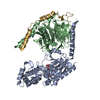
Movie
Movie Controller


+ Open data

- Basic information
| Entry |  | ||||||||||||
|---|---|---|---|---|---|---|---|---|---|---|---|---|---|
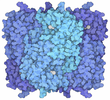
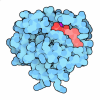
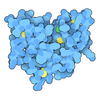
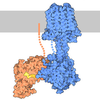
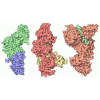
| Title | Gbg crosslinked to PLCb3 - second conformation | ||||||||||||
 Map data Map data | |||||||||||||
 Sample Sample |
| ||||||||||||
 Keywords Keywords | G protein / heterotrimeric G protein / lipase / phospholipase / SIGNALING PROTEIN | ||||||||||||
| Function / homology |  Function and homology information Function and homology informationphosphatidylinositol phospholipase C activity / regulation of systemic arterial blood pressure / phosphoinositide phospholipase C / Olfactory Signaling Pathway / Sensory perception of sweet, bitter, and umami (glutamate) taste / Fatty Acids bound to GPR40 (FFAR1) regulate insulin secretion / Synthesis, secretion, and inactivation of Glucagon-like Peptide-1 (GLP-1) / Acetylcholine regulates insulin secretion / phosphatidylinositol metabolic process / phospholipase C-activating serotonin receptor signaling pathway ...phosphatidylinositol phospholipase C activity / regulation of systemic arterial blood pressure / phosphoinositide phospholipase C / Olfactory Signaling Pathway / Sensory perception of sweet, bitter, and umami (glutamate) taste / Fatty Acids bound to GPR40 (FFAR1) regulate insulin secretion / Synthesis, secretion, and inactivation of Glucagon-like Peptide-1 (GLP-1) / Acetylcholine regulates insulin secretion / phosphatidylinositol metabolic process / phospholipase C-activating serotonin receptor signaling pathway / phosphatidylinositol-4,5-bisphosphate phospholipase C activity / PLC beta mediated events / Activation of the phototransduction cascade / C-type glycerophospholipase activity / Activation of G protein gated Potassium channels / G-protein activation / G beta:gamma signalling through PI3Kgamma / Prostacyclin signalling through prostacyclin receptor / G beta:gamma signalling through PLC beta / ADP signalling through P2Y purinoceptor 1 / Thromboxane signalling through TP receptor / Presynaptic function of Kainate receptors / G beta:gamma signalling through CDC42 / Inhibition of voltage gated Ca2+ channels via Gbeta/gamma subunits / G alpha (12/13) signalling events / Glucagon-type ligand receptors / G beta:gamma signalling through BTK / ADP signalling through P2Y purinoceptor 12 / Adrenaline,noradrenaline inhibits insulin secretion / Cooperation of PDCL (PhLP1) and TRiC/CCT in G-protein beta folding / Ca2+ pathway / G alpha (z) signalling events / Thrombin signalling through proteinase activated receptors (PARs) / Extra-nuclear estrogen signaling / G alpha (q) signalling events / G alpha (s) signalling events / Glucagon-like Peptide-1 (GLP1) regulates insulin secretion / G alpha (i) signalling events / High laminar flow shear stress activates signaling by PIEZO1 and PECAM1:CDH5:KDR in endothelial cells / Vasopressin regulates renal water homeostasis via Aquaporins / Synthesis of IP3 and IP4 in the cytosol / phosphatidylinositol-mediated signaling / postsynaptic cytosol / lipid catabolic process / release of sequestered calcium ion into cytosol / molecular function activator activity / phospholipase C-activating G protein-coupled receptor signaling pathway / G beta:gamma signalling through PLC beta / Presynaptic function of Kainate receptors / photoreceptor disc membrane / cellular response to catecholamine stimulus / adenylate cyclase-activating dopamine receptor signaling pathway / cellular response to prostaglandin E stimulus / heterotrimeric G-protein complex / G-protein beta-subunit binding / signaling receptor complex adaptor activity / GTPase binding / Ca2+ pathway / molecular adaptor activity / G alpha (q) signalling events / calmodulin binding / cadherin binding / G protein-coupled receptor signaling pathway / GTPase activity / calcium ion binding / synapse / protein-containing complex binding / protein-containing complex / nucleoplasm / membrane / plasma membrane / cytosol / cytoplasm Similarity search - Function | ||||||||||||
| Biological species |  Homo sapiens (human) / Homo sapiens (human) /   Bos taurus (domestic cattle) Bos taurus (domestic cattle) | ||||||||||||
| Method | single particle reconstruction / cryo EM / Resolution: 7.0 Å | ||||||||||||
 Authors Authors | Fisher IJ / Lyon AM | ||||||||||||
| Funding support |  United States, 3 items United States, 3 items
| ||||||||||||
 Citation Citation | Journal: bioRxiv / Year: 2026 Title: Gβγ engages PLCβ3 at multiple sites to reorient and facilitate its activation. Authors: Isaac J Fisher / Kanishka Senarath / Kennedy Outlaw / Kaushik Muralidharan / Elisabeth E Garland-Kuntz / Michelle Van Camp / Tommy Komay / Asuka Inoue / Eva Kostenis / Nevin A Lambert / Angeline M Lyon /   Abstract: Phospholipase C β (PLCβ) enzymes are activated by heterotrimeric G protein subunits, increasing hydrolysis of phosphatidylinositol-4,5-bisphosphate (PIP2) at the plasma membrane. All four human ...Phospholipase C β (PLCβ) enzymes are activated by heterotrimeric G protein subunits, increasing hydrolysis of phosphatidylinositol-4,5-bisphosphate (PIP2) at the plasma membrane. All four human PLCβ isoforms (PLCβ1-4) are activated by Gα, while PLCβ1-3 are activated to varying extents by Gβγ. The binding sites for Gα on PLCβ are well-established and much has been learned about its mechanism of activation, but comparatively little is known about Gβγ-dependent activation. In this work, we used cryo-electron microscopy (cryo-EM) single particle analysis (SPA), functional assays, and bioluminescence resonance energy transfer (BRET) to investigate how Gβγ interacts with PLCβ3 in concert with activated Gα to regulate phospholipase activity. Gβγ heterodimers bind multiple surfaces of PLCβ3 to promote activation but alone do not recruit the enzyme to the plasma membrane. Instead, Gβγ facilitates activation by Gα, most likely by reorienting the phospholipase catalytic site at the membrane to maximize PIP2 hydrolysis and downstream Ca release. Cell-based functional assays demonstrate that Gβγ is required for maximal PLCβ3 activation even when G heterotrimers are the sole source of Gβγ. Together, these findings demonstrate that Gβγ acts as a critical positive allosteric modulator that regularly acts in concert with Gα to activate PLCβ3 at the plasma membrane. | ||||||||||||
| History |
|
- Structure visualization
| Supplemental images |
|---|

- Downloads & links
-EMDB archive
| Map data | emd_72732.map.gz | 59.8 MB | EMDB map data format | |
|---|---|---|---|---|
| Header (meta data) | emd-72732-v30.xmlemd-72732.xml | 22.2 KB 22.2 KB | Display Display | EMDB header |
| Images |  emd_72732.png emd_72732.png | 56.5 KB | ||
| Filedesc metadata | emd-72732.cif.gz | 7.4 KB | ||
| Others | emd_72732_half_map_1.map.gzemd_72732_half_map_2.map.gz | 59.5 MB 59.5 MB | ||
| Archive directory |  https://data.pdbj.org/pub/emdb/structures/EMD-72732ftp://data.pdbj.org/pub/emdb/structures/EMD-72732 https://data.pdbj.org/pub/emdb/structures/EMD-72732ftp://data.pdbj.org/pub/emdb/structures/EMD-72732 | HTTPS FTP |
-Related structure data
| Related structure data |  9yaoMC  9y7hC  9yapC M: atomic model generated by this map C: citing same article ( |
|---|---|
| Similar structure data |


-Links
| EMDB pages | EMDB (EBI/PDBe) / EMDataResource |
|---|---|
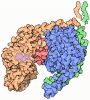
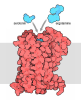
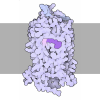
| Related items in Molecule of the Month |

-Map
| File | Download / File: emd_72732.map.gz / Format: CCP4 / Size: 64 MB / Type: IMAGE STORED AS FLOATING POINT NUMBER (4 BYTES) | ||||||||||||||||||||||||||||||||||||
|---|---|---|---|---|---|---|---|---|---|---|---|---|---|---|---|---|---|---|---|---|---|---|---|---|---|---|---|---|---|---|---|---|---|---|---|---|---|
| Projections & slices | Image control
Images are generated by Spider. | ||||||||||||||||||||||||||||||||||||
| Voxel size | X=Y=Z: 1.3475 Å | ||||||||||||||||||||||||||||||||||||
| Density |
| ||||||||||||||||||||||||||||||||||||
| Symmetry | Space group: 1 | ||||||||||||||||||||||||||||||||||||
| Details | EMDB XML:
|
 Z (Sec.)
 Y (Row.)
 X (Col.)


-Supplemental data
-Half map: #1
| File | emd_72732_half_map_1.map | ||||||||||||
|---|---|---|---|---|---|---|---|---|---|---|---|---|---|
| Projections & Slices |
| ||||||||||||
| Density Histograms |


-Half map: #2
| File | emd_72732_half_map_2.map | ||||||||||||
|---|---|---|---|---|---|---|---|---|---|---|---|---|---|
| Projections & Slices |
| ||||||||||||
| Density Histograms |


- Sample components
-Entire : BMOE-crosslinked complex of Gb1g2 and PLCb3
| Entire | Name: BMOE-crosslinked complex of Gb1g2 and PLCb3 |
|---|---|
| Components |
|
-Supramolecule #1: BMOE-crosslinked complex of Gb1g2 and PLCb3
| Supramolecule | Name: BMOE-crosslinked complex of Gb1g2 and PLCb3 / type: complex / ID: 1 / Parent: 0 / Macromolecule list: all |
|---|---|
| Source (natural) | Organism: Homo sapiens (human) |
| Molecular weight | Theoretical: 156 KDa |
-Macromolecule #1: 1-phosphatidylinositol 4,5-bisphosphate phosphodiesterase beta-3
| Macromolecule | Name: 1-phosphatidylinositol 4,5-bisphosphate phosphodiesterase beta-3 type: protein_or_peptide / ID: 1 / Number of copies: 1 / Enantiomer: LEVO / EC number: phosphoinositide phospholipase C |
|---|---|
| Source (natural) | Organism: Homo sapiens (human) |
| Molecular weight | Theoretical: 99.653891 KDa |
| Recombinant expression | Organism:   Spodoptera frugiperda (fall armyworm) Spodoptera frugiperda (fall armyworm) |
| Sequence | String: MAHHHHHHGT ALQLEPPTVV ETLRRGSKFI KWDEETSSRN LVTLRVDPNG FFLYWTGPNM CVDTLDISSI RDTRTGRYAR LPKDPKIRE VLGFGGPDAR LEEKLMTVVS GPDPVNTVFL NFMAVQDDTA KVWSEELFKL AMNILAQNAS RNTFLRKAYT K LKLQVNQD ...String: MAHHHHHHGT ALQLEPPTVV ETLRRGSKFI KWDEETSSRN LVTLRVDPNG FFLYWTGPNM CVDTLDISSI RDTRTGRYAR LPKDPKIRE VLGFGGPDAR LEEKLMTVVS GPDPVNTVFL NFMAVQDDTA KVWSEELFKL AMNILAQNAS RNTFLRKAYT K LKLQVNQD GRIPVKNILK MFSADKKRVE TALESSGLKF NRSESIRPDE FSLEIFERFL NKLSLRPDID KILLEIGAKG KP YLTLEQL MDFINQKQRD PRLNEVLYPP LRPSQARLLI EKYEPNQQFL ERDQMSMEGF SRYLGGEENG ILPLEALDLS TDM TQPLSA YFINSSHNTY LTAGQLAGTS SVEMYRQALL WGSRCVELDV WKGRPPEEEP FITHGFTMTT EVPLRDVLEA IAET AFKTS PYPVILSFEN HVDSAKQQAK MAEYCRSIFG DALLIEPLDK YPLAPGVPLP SPQDLMGRIL VKNKKRHRPS AGGPD SAGR KRPLEQSNSA LSESSAATEP SSPQLGSPSS DSCPGLSNGE EVGLEKPSLE PQKSLGDEGL NRGPYVLGPA DREDEE EDE EEEEQTDPKK PTTDEGTASS EVNATEEMST LVNYIEPVKF KSFEAARKRN KCFEMSSFVE TKAMEQLTKS PMEFVEY NK QQLSRIYPKG TRVDSSNYMP QLFWNVGCQL VALNFQTLDV AMQLNAGVFE YNGRSGYLLK PEFMRRPDKS FDPFTEVI V DGIVANALRV KVISGQFLSD RKVGIYVEVD MFGLPVDTRR KYRTRTSQGN SFNPVWDEEP FDFPKVVLPT LASLRIAAF EEGGKFVGHR ILPVSAIRSG YHYVSLRNEA NQPLSLPALL IYTEASDYIP DDHQDYAEAL INPIKHVSLM DQRARQLAAL IGE UniProtKB: 1-phosphatidylinositol 4,5-bisphosphate phosphodiesterase beta-3 |
-Macromolecule #2: Guanine nucleotide-binding protein G(I)/G(S)/G(T) subunit beta-1
| Macromolecule | Name: Guanine nucleotide-binding protein G(I)/G(S)/G(T) subunit beta-1 type: protein_or_peptide / ID: 2 / Number of copies: 1 / Enantiomer: LEVO |
|---|---|
| Source (natural) | Organism: Bos taurus (domestic cattle) |
| Molecular weight | Theoretical: 36.485914 KDa |
| Recombinant expression | Organism: Trichoplusia ni (cabbage looper) |
| Sequence | String: RQEAEQLKNQ IRDARKACAD ATLSQITNNI DPVGRIQMRT RRTLRGHLAK IYAMHWGTDS RLLVSASQDG KLIIWDSYTT NKVHAIPLR SSWVMTCAYA PSGNYVACGG LDNICSIYNL KTREGNVRVS RELAGHTGYL SCCRFLDDNQ IVTSSGDTTC A LWDIETGQ ...String: RQEAEQLKNQ IRDARKACAD ATLSQITNNI DPVGRIQMRT RRTLRGHLAK IYAMHWGTDS RLLVSASQDG KLIIWDSYTT NKVHAIPLR SSWVMTCAYA PSGNYVACGG LDNICSIYNL KTREGNVRVS RELAGHTGYL SCCRFLDDNQ IVTSSGDTTC A LWDIETGQ QTTTFTGHTG DVMSLSLAPD TRLFVSGACD ASAKLWDVRE GMCRQTFTGH ESDINAICFF PNGNAFATGS DD ATCRLFD LRADQELMTY SHDNIICGIT SVSFSKSGRL LLAGYDDFNC NVWDALKADR AGVLAGHDNR VSCLGVTDDG MAV ATGSWD SFLKIW UniProtKB: Guanine nucleotide-binding protein G(I)/G(S)/G(T) subunit beta-1 |
-Macromolecule #3: Guanine nucleotide-binding protein G(I)/G(S)/G(O) subunit gamma-2
| Macromolecule | Name: Guanine nucleotide-binding protein G(I)/G(S)/G(O) subunit gamma-2 type: protein_or_peptide / ID: 3 / Number of copies: 1 / Enantiomer: LEVO |
|---|---|
| Source (natural) | Organism: Bos taurus (domestic cattle) |
| Molecular weight | Theoretical: 7.861143 KDa |
| Recombinant expression | Organism: Trichoplusia ni (cabbage looper) |
| Sequence | String: MASNNTASIA QARKLVEQLK MEANIDRIKV SKAAADLMAY CEAHAKEDPL LTPVPASENP FREKKFFCAI L UniProtKB: Guanine nucleotide-binding protein G(I)/G(S)/G(O) subunit gamma-2 |
-Experimental details
-Structure determination
| Method | cryo EM |
|---|---|
 Processing Processing | single particle reconstruction |
| Aggregation state | particle |
-Sample preparation
| Concentration | 1 mg/mL |
|---|---|
| Buffer | pH: 7.4 Details: 20 mM HEPES pH 7.4, 100 mM NaCl, 0.1 mM EDTA and 0.1 mM EGTA |
| Grid | Model: Quantifoil R1.2/1.3 / Pretreatment - Type: GLOW DISCHARGE |
| Vitrification | Cryogen name: ETHANE / Instrument: FEI VITROBOT MARK IV |
- Electron microscopy
| Microscope | TFS KRIOS |
|---|---|
| Image recording | Film or detector model: GATAN K3 BIOQUANTUM (6k x 4k) / Average electron dose: 53.69 e/Å2 |
| Electron beam | Acceleration voltage: 300 kV / Electron source:  FIELD EMISSION GUN FIELD EMISSION GUN |
| Electron optics | Illumination mode: FLOOD BEAM / Imaging mode: BRIGHT FIELD / Nominal defocus max: 3.0 µm / Nominal defocus min: 1.0 µm |
| Experimental equipment |  Model: Titan Krios / Image courtesy: FEI Company |
+Image processing
-Atomic model buiding 1
| Initial model |
| ||||||
|---|---|---|---|---|---|---|---|
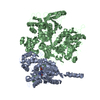
| Details | Crystal structures of Gbetagamma and PLCbeta3 (PDB IDs 1GP2 and 4GNK) were rigid-body fit into the cryo-EM map using Chimera. The model was refined using molecular dynamic flexible fitting (MDFF). MDFF configuration files were generated using VMD. During MDFF simulation, Gbetagamma was set as rigid with domain restraints. The MDFF simulation was conducted with a grid scaling value of 0.5 for 100 ps, followed by 3,000 steps of energy minimization until convergence of the protein RMSD. The MDFF generated model was inspected and manually adjusted in Coot, guided through the use of deep-learning-based amino-acid-wise model quality (DAQ) scoring, and refined in PHENIX. | ||||||
| Refinement | Protocol: FLEXIBLE FIT | ||||||
| Output model | PDB-9yao: |