response to intra-S DNA damage checkpoint signaling / Parkin-FBXW7-Cul1 ubiquitin ligase complex / synaptic assembly at neuromuscular junction / F-box domain binding / DNA translocase activity / PcG protein complex / cullin-RING ubiquitin ligase complex / regulation of xenophagy / maintenance of protein location in nucleus / Loss of Function of FBXW7 in Cancer and NOTCH1 Signaling ...response to intra-S DNA damage checkpoint signaling / Parkin-FBXW7-Cul1 ubiquitin ligase complex / synaptic assembly at neuromuscular junction / F-box domain binding / DNA translocase activity / PcG protein complex / cullin-RING ubiquitin ligase complex / regulation of xenophagy / maintenance of protein location in nucleus / Loss of Function of FBXW7 in Cancer and NOTCH1 Signaling / Cul7-RING ubiquitin ligase complex / regulation of cell cycle process / neural crest cell differentiation / DNA catabolic process / regulation of BMP signaling pathway / ubiquitin ligase activator activity / regulation of mitophagy / positive regulation of intrinsic apoptotic signaling pathway in response to DNA damage / regulation of centrosome duplication / regulation of TOR signaling / SCF ubiquitin ligase complex / regulation of DNA damage checkpoint / PRC1 complex / SCF-dependent proteasomal ubiquitin-dependent protein catabolic process / Prolactin receptor signaling / ubiquitin ligase complex scaffold activity / DNA 3'-5' helicase / limb development / cullin family protein binding / negative regulation of double-strand break repair via homologous recombination / 3'-5' DNA helicase activity / centrosome duplication / cilium assembly / ubiquitin-like ligase-substrate adaptor activity / intrinsic apoptotic signaling pathway / ubiquitin ligase complex / Nuclear events stimulated by ALK signaling in cancer / protein K48-linked ubiquitination / molecular function activator activity / replication fork processing / regulation of mitotic cell cycle / Regulation of BACH1 activity / MAP3K8 (TPL2)-dependent MAPK1/3 activation / G1/S transition of mitotic cell cycle / SCF-beta-TrCP mediated degradation of Emi1 / NIK-->noncanonical NF-kB signaling / Vpu mediated degradation of CD4 / double-strand break repair via homologous recombination / Dectin-1 mediated noncanonical NF-kB signaling / Degradation of CRY and PER proteins / Iron uptake and transport / Activation of NF-kappaB in B cells / Degradation of GLI1 by the proteasome / GSK3B and BTRC:CUL1-mediated-degradation of NFE2L2 / Negative regulation of NOTCH4 signaling / positive regulation of protein phosphorylation / beta-catenin binding / FBXL7 down-regulates AURKA during mitotic entry and in early mitosis / Degradation of GLI2 by the proteasome / GLI3 is processed to GLI3R by the proteasome / GSK3B-mediated proteasomal degradation of PD-L1(CD274) / NOTCH1 Intracellular Domain Regulates Transcription / regulation of circadian rhythm / Degradation of beta-catenin by the destruction complex / Constitutive Signaling by NOTCH1 PEST Domain Mutants / Constitutive Signaling by NOTCH1 HD+PEST Domain Mutants / CLEC7A (Dectin-1) signaling / SCF(Skp2)-mediated degradation of p27/p21 / FCERI mediated NF-kB activation / protein polyubiquitination / Ubiquitin-Mediated Degradation of Phosphorylated Cdc25A / Interleukin-1 signaling / Orc1 removal from chromatin / Cyclin D associated events in G1 / Regulation of RUNX2 expression and activity / Regulation of PLK1 Activity at G2/M Transition / Downstream TCR signaling / Antigen processing: Ubiquitination & Proteasome degradation / single-stranded DNA binding / regulation of inflammatory response / Neddylation / cellular response to oxidative stress / double-stranded DNA binding / heterochromatin formation / regulation of cell cycle / proteasome-mediated ubiquitin-dependent protein catabolic process / regulation of apoptotic process / intracellular iron ion homeostasis / positive regulation of canonical NF-kappaB signal transduction / DNA helicase activity / chromatin remodeling / protein ubiquitination / DNA repair / protein domain specific binding / chromosome / negative regulation of DNA-templated transcription / ubiquitin protein ligase binding / centrosome / DNA damage response / regulation of DNA-templated transcription Similarity search - Function
National Institutes of Health/National Institute of General Medical Sciences (NIH/NIGMS)
R35 GM136401
United States
National Institutes of Health/National Cancer Institute (NIH/NCI)
P01 CA092584
United States
Citation
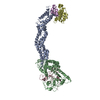
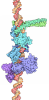
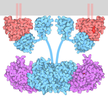
Journal: Nat Commun / Year: 2026 Title: Structural basis for fork reversal and RAD51 regulation by the SCF ubiquitin ligase complex of F-box helicase 1. Authors: Briana H Greer / Javier Mendia-Garcia / Elwood A Mullins / Emma M Peacock / Sander K Haigh / Carl J Schiltz / Clara Aicart-Ramos / Miaw-Sheue Tsai / David Cortez / Fernando Moreno-Herrero / Brandt F Eichman / Abstract: Replication fork reversal helps maintain genomic stability during replication stress. F-box helicase 1 (FBH1) catalyzes fork reversal and is an SCF (SKP-CUL1-F-box) E3 ubiquitin ligase that limits ...Replication fork reversal helps maintain genomic stability during replication stress. F-box helicase 1 (FBH1) catalyzes fork reversal and is an SCF (SKP-CUL1-F-box) E3 ubiquitin ligase that limits RAD51 association with chromatin. Here, we show that preferential binding of SCF to the lagging strand template at DNA fork structures stimulates helicase activity and is required for fork reversal. A cryo-EM structure of SCF bound to DNA representing a stalled fork reveals an intimate interaction between FBH1 and the fork junction. Disruption of this interface severely curtails fork reversal in vitro and replication progression in cells, providing a model for how ssDNA translocation by FBH1 facilitates annealing of parental DNA by a fundamentally different mechanism than the fork remodelers SMARCAL, HLTF, and ZRANB3. The structure provides a model for SCF disassembly of RAD51 filaments through translocation and ubiquitination, and implies that RAD51 is associated with the lagging strand at stalled forks.
In the structure databanks used in Yorodumi, some data are registered as the other names, "COVID-19 virus" and "2019-nCoV". Here are the details of the virus and the list of structure data.
Jan 31, 2019. EMDB accession codes are about to change! (news from PDBe EMDB page)
EMDB accession codes are about to change! (news from PDBe EMDB page)
The allocation of 4 digits for EMDB accession codes will soon come to an end. Whilst these codes will remain in use, new EMDB accession codes will include an additional digit and will expand incrementally as the available range of codes is exhausted. The current 4-digit format prefixed with “EMD-” (i.e. EMD-XXXX) will advance to a 5-digit format (i.e. EMD-XXXXX), and so on. It is currently estimated that the 4-digit codes will be depleted around Spring 2019, at which point the 5-digit format will come into force.
The EM Navigator/Yorodumi systems omit the EMD- prefix.
Related info.:Q: What is EMD? / ID/Accession-code notation in Yorodumi/EM Navigator
Yorodumi is a browser for structure data from EMDB, PDB, SASBDB, etc.
This page is also the successor to EM Navigator detail page, and also detail information page/front-end page for Omokage search.
The word "yorodu" (or yorozu) is an old Japanese word meaning "ten thousand". "mi" (miru) is to see.
Related info.:EMDB / PDB / SASBDB / Comparison of 3 databanks / Yorodumi Search / Aug 31, 2016. New EM Navigator & Yorodumi / Yorodumi Papers / Jmol/JSmol / Function and homology information / Changes in new EM Navigator and Yorodumi
 Movie
Movie Controller

 Yorodumi
 Open data
 Basic information
 Map data
 Sample
 Keywords
 Function and homology information
 Homo sapiens (human) / synthetic construct (others)
 Authors
 United States, 2 items
  Citation
 Structure visualization
 Downloads & links
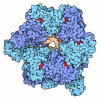
 emd_72361.png
 https://data.pdbj.org/pub/emdb/structures/EMD-72361



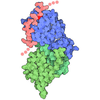
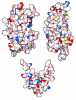
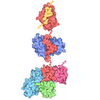
 Z (Sec.)
 Y (Row.)
 X (Col.)


 Sample components
 Spodoptera frugiperda (fall armyworm)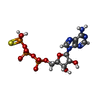
 Processing
 Electron microscopy
 FIELD EMISSION GUN