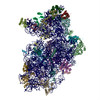
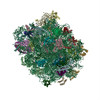
Movie
Movie Controller

[English] 日本語
 Yorodumi
- EMDB-72070: Multi-body SSU head map for Babesia divergens ribosome structure ... -
+ Open data

- Basic information
| Entry |  | |||||||||
|---|---|---|---|---|---|---|---|---|---|---|
| Title | Multi-body SSU head map for Babesia divergens ribosome structure by single-particle cryo-EM (3D class3, E-site tRNA) | |||||||||
 Map data Map data | ||||||||||
 Sample Sample |
| |||||||||
 Keywords Keywords | tRNAs / RNA modification / 80S / RIBOSOME | |||||||||
| Biological species |  Babesia divergens (eukaryote) Babesia divergens (eukaryote) | |||||||||
| Method | single particle reconstruction / cryo EM / Resolution: 2.7 Å | |||||||||
 Authors Authors | Gutierrez-Vargas C / Leger-Abraham M | |||||||||
| Funding support |  United States, 2 items United States, 2 items
| |||||||||
 Citation Citation | Journal: bioRxiv / Year: 2025 Title: Ribosomal Architecture and rRNA Modification Landscape in the Tick-Borne Parasite . Authors: Cristina Gutierrez-Vargas / Lee S Izhaki-Tavor / Diana Calvopina-Chavez / Caroline D Keroack / Pablo Copello / Manoj T Duraisingh / Mélissa Léger-Abraham / Abstract: is a tick-borne intracellular apicomplexan parasite responsible for diseases ranging from mild to fatal, with a broadening geographic distribution. Due to the complex life cycle of species, their ... is a tick-borne intracellular apicomplexan parasite responsible for diseases ranging from mild to fatal, with a broadening geographic distribution. Due to the complex life cycle of species, their survival depends on the precise control of gene expression, which is primarily regulated by epigenetic, transcriptional, and post-transcriptional mechanisms. High-resolution structural information on key components of the translation machinery, such as ribosomes, could aid in the development of antiparasitic drugs. Here, we report cryo-EM ribosome structures (2.6 Å) from the tick-borne apicomplexan pathogen , showing associated tRNAs, an mRNA fragment, and RACK1, a signaling scaffold crucial to translation regulation. Density map analysis displays ribosome regions at atomic resolution (1.7 Å), which, when combined with nanopore sequencing, enabled the comprehensive identification of rRNA modifications, including modifications unreported in other organisms. The new rRNA modifications localize not only to the reduced rRNA expansion segments but also to functionally essential ribosomal sites, uncovering new avenues for therapeutic intervention against babesiosis. | |||||||||
| History |
|
- Structure visualization
| Supplemental images |
|---|

- Downloads & links
-EMDB archive
| Map data | emd_72070.map.gz | 289.3 MB |  EMDB map data format EMDB map data format | |
|---|---|---|---|---|
| Header (meta data) | emd-72070-v30.xmlemd-72070.xml | 45.8 KB 45.8 KB | Display Display | EMDB header |
| FSC (resolution estimation) | emd_72070_fsc.xml | 15.9 KB | Display | FSC data file |
| Images |  emd_72070.png emd_72070.png | 66.6 KB | ||
| Masks | emd_72070_msk_1.map | 343 MB | Mask map | |
| Filedesc metadata | emd-72070.cif.gz | 5.5 KB | ||
| Others | emd_72070_additional_1.map.gzemd_72070_half_map_1.map.gzemd_72070_half_map_2.map.gz | 22 MB 209.5 MB 209.5 MB | ||
| Archive directory |  http://ftp.pdbj.org/pub/emdb/structures/EMD-72070ftp://ftp.pdbj.org/pub/emdb/structures/EMD-72070 http://ftp.pdbj.org/pub/emdb/structures/EMD-72070ftp://ftp.pdbj.org/pub/emdb/structures/EMD-72070 | HTTPS FTP |
-Related structure data


-Links
| EMDB pages | EMDB (EBI/PDBe) / EMDataResource |
|---|
-Map
| File | Download / File: emd_72070.map.gz / Format: CCP4 / Size: 343 MB / Type: IMAGE STORED AS FLOATING POINT NUMBER (4 BYTES) | ||||||||||||||||||||||||||||||||||||
|---|---|---|---|---|---|---|---|---|---|---|---|---|---|---|---|---|---|---|---|---|---|---|---|---|---|---|---|---|---|---|---|---|---|---|---|---|---|
| Projections & slices | Image control
Images are generated by Spider. | ||||||||||||||||||||||||||||||||||||
| Voxel size | X=Y=Z: 0.825 Å | ||||||||||||||||||||||||||||||||||||
| Density |
| ||||||||||||||||||||||||||||||||||||
| Symmetry | Space group: 1 | ||||||||||||||||||||||||||||||||||||
| Details | EMDB XML:
|
 X (Sec.)
 Y (Row.)
 Z (Col.)


-Supplemental data
-Mask #1
| File | emd_72070_msk_1.map | ||||||||||||
|---|---|---|---|---|---|---|---|---|---|---|---|---|---|
| Projections & Slices |
| ||||||||||||
| Density Histograms |


-Additional map: #1
| File | emd_72070_additional_1.map | ||||||||||||
|---|---|---|---|---|---|---|---|---|---|---|---|---|---|
| Projections & Slices |
| ||||||||||||
| Density Histograms |


-Half map: #2
| File | emd_72070_half_map_1.map | ||||||||||||
|---|---|---|---|---|---|---|---|---|---|---|---|---|---|
| Projections & Slices |
| ||||||||||||
| Density Histograms |


-Half map: #1
| File | emd_72070_half_map_2.map | ||||||||||||
|---|---|---|---|---|---|---|---|---|---|---|---|---|---|
| Projections & Slices |
| ||||||||||||
| Density Histograms |


- Sample components
-Entire : 80S ribosome
| Entire | Name: 80S ribosome |
|---|---|
| Components |
|
-Supramolecule #1: 80S ribosome
| Supramolecule | Name: 80S ribosome / type: complex / ID: 1 / Parent: 0 / Macromolecule list: #1-#78 |
|---|---|
| Source (natural) | Organism: Babesia divergens (eukaryote) / Strain: Rouen 1987 |
-Supramolecule #2: 40S
| Supramolecule | Name: 40S / type: complex / ID: 2 / Parent: 1 / Macromolecule list: #42-#72, #74-#75, #78 |
|---|---|
| Source (natural) | Organism: Babesia divergens (eukaryote) / Strain: Rouen 1987 |
-Supramolecule #3: 60S
| Supramolecule | Name: 60S / type: complex / ID: 3 / Parent: 1 / Macromolecule list: #1-#41, #73, #76-#77 |
|---|---|
| Source (natural) | Organism: Babesia divergens (eukaryote) / Strain: Rouen 1987 |
-Experimental details
-Structure determination
| Method | cryo EM |
|---|---|
 Processing Processing | single particle reconstruction |
| Aggregation state | particle |
-Sample preparation
| Buffer | pH: 7.4 Component:
| ||||||||||||||||||
|---|---|---|---|---|---|---|---|---|---|---|---|---|---|---|---|---|---|---|---|
| Grid | Model: Quantifoil R1.2/1.3 / Material: COPPER / Mesh: 300 / Support film - Material: CARBON / Support film - topology: HOLEY / Support film - Film thickness: 12 / Pretreatment - Type: GLOW DISCHARGE / Pretreatment - Time: 30 sec. / Pretreatment - Atmosphere: AIR / Pretreatment - Pressure: 0.037 kPa Details: The grid had an additional ultrathin continuous carbon layer (2 nm) | ||||||||||||||||||
| Vitrification | Cryogen name: ETHANE / Chamber humidity: 100 % / Chamber temperature: 277.15 K / Instrument: FEI VITROBOT MARK IV |
- Electron microscopy
| Microscope | TFS KRIOS |
|---|---|
| Software | Name: SerialEM (ver. 3.8.6) |
| Image recording | Film or detector model: GATAN K3 (6k x 4k) / Number real images: 12144 / Average exposure time: 1.4 sec. / Average electron dose: 42.0 e/Å2 |
| Electron beam | Acceleration voltage: 300 kV / Electron source:  FIELD EMISSION GUN FIELD EMISSION GUN |
| Electron optics | C2 aperture diameter: 50.0 µm / Illumination mode: FLOOD BEAM / Imaging mode: BRIGHT FIELD / Cs: 2.7 mm / Nominal defocus max: 2.2 µm / Nominal defocus min: 0.8 µm / Nominal magnification: 105000 |
| Sample stage | Specimen holder model: FEI TITAN KRIOS AUTOGRID HOLDER / Cooling holder cryogen: NITROGEN |
| Experimental equipment |  Model: Titan Krios / Image courtesy: FEI Company |
+Image processing

-Atomic model buiding 1
| Initial model |
| |||||||||||||||||||||
|---|---|---|---|---|---|---|---|---|---|---|---|---|---|---|---|---|---|---|---|---|---|---|
| Software | Name: UCSF ChimeraX | |||||||||||||||||||||
| Details | Initial docking and fitting was done in UCSF ChimeraX for the ribosomal proteins using AlphaFold2 predicted models, except for eL41; the T. gondii eL41 chain (PDB 5XXB) served as the initial model. The T. gondii PDBs 5XXU and 5XXB were also fit with UCSF ChimeraX and used for initial model building of the Babesia divergens rRNAs. | |||||||||||||||||||||
| Refinement | Space: REAL / Protocol: RIGID BODY FIT |