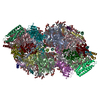
- EMDB-71652: Structure of the D1-Val185Asn mutated photosystem II complex with... -
+
Open data
ID or keywords:
Loading...
-
Basic information
Entry
Database: EMDB / ID: EMD-71652
Title
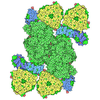
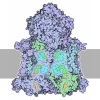
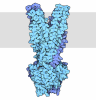
Structure of the D1-Val185Asn mutated photosystem II complex with slow O-O bond formation reveals changes in the Cl1 water channel
Map data
unsharpened map, nonmasked
Sample
Complex: photosystem II
Protein or peptide: x 21 types
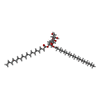
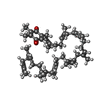
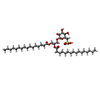
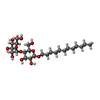
Ligand: x 17 types
Keywords
photosynthesis / photosystem II / water oxidation / oxygen-evolving complex / D1-V185N
Function / homology
Function and homology information
plasma membrane-derived thylakoid photosystem II / photosystem II oxygen evolving complex / photosystem II assembly / thylakoid / oxygen evolving activity / photosystem II stabilization / photosystem II reaction center / photosystem II / photosynthetic electron transport chain / photosystem II ...plasma membrane-derived thylakoid photosystem II / photosystem II oxygen evolving complex / photosystem II assembly / thylakoid / oxygen evolving activity / photosystem II stabilization / photosystem II reaction center / photosystem II / photosynthetic electron transport chain / photosystem II / extrinsic component of membrane / chlorophyll binding / photosynthetic electron transport in photosystem II / plasma membrane-derived thylakoid membrane / photosynthesis, light reaction / phosphate ion binding / photosynthesis / respiratory electron transport chain / manganese ion binding / electron transfer activity / protein stabilization / iron ion binding / heme binding / calcium ion binding / identical protein binding Similarity search - Function
Photosystem II PsbQ, cyanobacteria / Oxygen-evolving enhancer protein 3 / Oxygen evolving enhancer protein 3 / PsbQ-like domain superfamily / Photosystem II protein Y (PsbY) / Photosystem II PsbY / Photosystem II PsbU, oxygen evolving complex / Photosystem II 12 kDa extrinsic protein (PsbU) / Photosystem II PsbV, cytochrome c-550 precursor / Photosystem II cytochrome c-550 precursor ...Photosystem II PsbQ, cyanobacteria / Oxygen-evolving enhancer protein 3 / Oxygen evolving enhancer protein 3 / PsbQ-like domain superfamily / Photosystem II protein Y (PsbY) / Photosystem II PsbY / Photosystem II PsbU, oxygen evolving complex / Photosystem II 12 kDa extrinsic protein (PsbU) / Photosystem II PsbV, cytochrome c-550 precursor / Photosystem II cytochrome c-550 precursor / Cytochrome c-550 domain / Cytochrome c-550 domain / Photosystem II PsbX, type 1 subfamily / Photosystem II PsbJ / Photosystem II PsbJ superfamily / PsbJ / Photosystem II PsbO, manganese-stabilising / Manganese-stabilising protein / photosystem II polypeptide / Photosystem II reaction centre protein Ycf12 / Photosystem II complex subunit Ycf12 / Photosystem II reaction centre M protein (PsbM) / Photosystem II PsbM superfamily / Photosystem II PsbM / Photosystem II PsbZ, reaction centre / Photosystem II PsbZ superfamily / YCF9 / Photosystem II PsbX / Photosystem II reaction centre X protein (PsbX) / Photosystem II PsbT / Photosystem II PsbL / Photosystem II CP43 reaction centre protein / Photosystem II PsbL superfamily / Photosystem II PsbT superfamily / Photosystem II CP43 reaction centre protein superfamily / Photosystem II reaction centre T protein / PsbL protein / Photosystem II PsbK / Photosystem II PsbK superfamily / Photosystem II 4 kDa reaction centre component / Photosystem II PsbI / Photosystem II CP47 reaction centre protein / Photosystem II PsbI superfamily / Photosystem II reaction centre I protein (PSII 4.8 kDa protein) / Photosystem II reaction centre protein H / Photosystem II protein D1 / Photosystem II reaction centre protein H superfamily / Photosystem II 10 kDa phosphoprotein / Photosystem II D2 protein / Photosystem II cytochrome b559, conserved site / Photosystem II cytochrome b559, alpha subunit / Photosystem II cytochrome b559, beta subunit / Photosystem II cytochrome b559, N-terminal / Photosystem II cytochrome b559, alpha subunit, lumenal region / Photosystem II cytochrome b559, alpha subunit superfamily / Cytochrome b559, alpha (gene psbE) and beta (gene psbF)subunits / Lumenal portion of Cytochrome b559, alpha (gene psbE) subunit / Cytochrome b559 subunits heme-binding site signature. / : / Photosystem antenna protein-like / Photosystem antenna protein-like superfamily / Photosystem II protein / Outer membrane protein/outer membrane enzyme PagP, beta-barrel / : / Photosynthetic reaction centre, L/M / Photosystem II protein D1/D2 superfamily / Photosynthetic reaction centre protein / Photosynthetic reaction center proteins signature. / Cytochrome c family profile. / Cytochrome c-like domain / Cytochrome c-like domain superfamily / Prokaryotic membrane lipoprotein lipid attachment site profile. Similarity search - Domain/homology
Photosystem II CP47 reaction center protein / Cytochrome b559 subunit alpha / Cytochrome b559 subunit beta / Photosystem II D2 protein / Photosystem II CP43 reaction center protein / Photosystem II extrinsic protein O / Photosystem II reaction center protein H / Photosystem II reaction center protein K / Photosystem II protein D1 2 / Photosystem II reaction center protein X ...Photosystem II CP47 reaction center protein / Cytochrome b559 subunit alpha / Cytochrome b559 subunit beta / Photosystem II D2 protein / Photosystem II CP43 reaction center protein / Photosystem II extrinsic protein O / Photosystem II reaction center protein H / Photosystem II reaction center protein K / Photosystem II protein D1 2 / Photosystem II reaction center protein X / Photosystem II reaction center protein M / CyanoQ / Photosystem II reaction center protein J / Photosystem II reaction center protein Z / Photosystem II reaction center protein Y / Photosystem II reaction center protein T / Photosystem II reaction center protein I / Photosystem II extrinsic protein V / Photosystem II extrinsic protein U / Photosystem II reaction center protein L / Photosystem II reaction center protein Psb30 Similarity search - Component
Biological species
Synechocystis sp. PCC 6803 (bacteria)
Method
single particle reconstruction / cryo EM / Resolution: 1.99 Å
Journal: Proc Natl Acad Sci U S A / Year: 2025 Title: Structure of the D1-Val185Asn mutated photosystem II complex with slow O-O bond formation reveals changes in the Cl1 water channel. Authors: David A Flesher / Richard J Debus / Gary W Brudvig / Abstract: During photosynthesis, the photosystem II (PSII) enzyme catalyzes the light-driven oxidation of water, fueling life on Earth by storing light energy and releasing O as a byproduct. Determining the ...During photosynthesis, the photosystem II (PSII) enzyme catalyzes the light-driven oxidation of water, fueling life on Earth by storing light energy and releasing O as a byproduct. Determining the molecular mechanism for this water oxidation reaction has been of significant interest for the development of synthetic catalysts, but many details remain elusive. One of the open questions is how protons are strategically removed from the active site, a MnCaO cluster called the oxygen-evolving complex (OEC), during the reaction cycle via conserved water channels, and how proton transfer contributes to O-O bond formation energetics. Site-directed mutagenesis studies have investigated the role of conserved amino acid side chains in facilitating proton transfer. One of the most influential mutations is the Val185Asn substitution on the D1 subunit, which substantially slows O release kinetics without abolishing catalytic activity. Forming a molecular understanding of how this mutation affects the active site will provide insight into the water oxidation reaction mechanism. Here, we investigated the structural basis of the Val185Asn substitution by determining a 1.99 Å-resolution cryo-EM structure. We observed that Asn185 orients away from the OEC and donates a H-bond to Cl1, a conserved chloride ion. We furthermore observed an alternative D2-Glu312-facing conformation of the D2-Lys317 side chain in the Cl1 water channel, a conformation that is consistent with recent models for proton transfer. These changes also produce perturbations to the hydrogen-bonding network. Overall, these finding provide insight into proton transfer in the Cl1 channel and its effect on the water oxidation reaction mechanism.
In the structure databanks used in Yorodumi, some data are registered as the other names, "COVID-19 virus" and "2019-nCoV". Here are the details of the virus and the list of structure data.
Jan 31, 2019. EMDB accession codes are about to change! (news from PDBe EMDB page)
EMDB accession codes are about to change! (news from PDBe EMDB page)
The allocation of 4 digits for EMDB accession codes will soon come to an end. Whilst these codes will remain in use, new EMDB accession codes will include an additional digit and will expand incrementally as the available range of codes is exhausted. The current 4-digit format prefixed with “EMD-” (i.e. EMD-XXXX) will advance to a 5-digit format (i.e. EMD-XXXXX), and so on. It is currently estimated that the 4-digit codes will be depleted around Spring 2019, at which point the 5-digit format will come into force.
The EM Navigator/Yorodumi systems omit the EMD- prefix.
Related info.:Q: What is EMD? / ID/Accession-code notation in Yorodumi/EM Navigator
Yorodumi is a browser for structure data from EMDB, PDB, SASBDB, etc.
This page is also the successor to EM Navigator detail page, and also detail information page/front-end page for Omokage search.
The word "yorodu" (or yorozu) is an old Japanese word meaning "ten thousand". "mi" (miru) is to see.
Related info.:EMDB / PDB / SASBDB / Comparison of 3 databanks / Yorodumi Search / Aug 31, 2016. New EM Navigator & Yorodumi / Yorodumi Papers / Jmol/JSmol / Function and homology information / Changes in new EM Navigator and Yorodumi
 Movie
Movie Controller

 Yorodumi
 Open data
 Basic information
 Map data
 Sample
 Keywords
 Function and homology information
 Synechocystis sp. PCC 6803 (bacteria)
 Authors
 United States, 1 items
  Citation
 Structure visualization
 Downloads & links
 emd_71652.png
 https://data.pdbj.org/pub/emdb/structures/EMD-71652
 Z (Sec.)
 Y (Row.)
 X (Col.)


 Sample components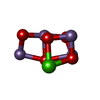



 Processing
 Electron microscopy
 FIELD EMISSION GUN