 Movie
Movie Controller
 Structure viewers
 About Yorodumi Papers


+Search query
-Structure paper
| Title | Structure of the D1-Val185Asn mutated photosystem II complex with slow O-O bond formation reveals changes in the Cl1 water channel. |
|---|---|
| Journal, issue, pages | Proc Natl Acad Sci U S A, Vol. 122, Issue 47, Page e2522652122, Year 2025 |
| Publish date | Nov 25, 2025 |
 Authors Authors | David A Flesher / Richard J Debus / Gary W Brudvig /  |
| PubMed Abstract | During photosynthesis, the photosystem II (PSII) enzyme catalyzes the light-driven oxidation of water, fueling life on Earth by storing light energy and releasing O as a byproduct. Determining the ...During photosynthesis, the photosystem II (PSII) enzyme catalyzes the light-driven oxidation of water, fueling life on Earth by storing light energy and releasing O as a byproduct. Determining the molecular mechanism for this water oxidation reaction has been of significant interest for the development of synthetic catalysts, but many details remain elusive. One of the open questions is how protons are strategically removed from the active site, a MnCaO cluster called the oxygen-evolving complex (OEC), during the reaction cycle via conserved water channels, and how proton transfer contributes to O-O bond formation energetics. Site-directed mutagenesis studies have investigated the role of conserved amino acid side chains in facilitating proton transfer. One of the most influential mutations is the Val185Asn substitution on the D1 subunit, which substantially slows O release kinetics without abolishing catalytic activity. Forming a molecular understanding of how this mutation affects the active site will provide insight into the water oxidation reaction mechanism. Here, we investigated the structural basis of the Val185Asn substitution by determining a 1.99 Å-resolution cryo-EM structure. We observed that Asn185 orients away from the OEC and donates a H-bond to Cl1, a conserved chloride ion. We furthermore observed an alternative D2-Glu312-facing conformation of the D2-Lys317 side chain in the Cl1 water channel, a conformation that is consistent with recent models for proton transfer. These changes also produce perturbations to the hydrogen-bonding network. Overall, these finding provide insight into proton transfer in the Cl1 channel and its effect on the water oxidation reaction mechanism. |
 External links External links | Proc Natl Acad Sci U S A / PubMed:41237214 / PubMed Central |
| Methods | EM (single particle) |
| Resolution | 1.99 Å |
| Structure data | EMDB-71652, PDB-9phw: |
| Chemicals | 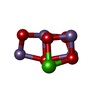 ChemComp-OEX:  ChemComp-FE2:  ChemComp-CL: 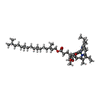 ChemComp-CLA:  ChemComp-PHO: 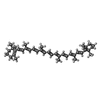 ChemComp-BCR: 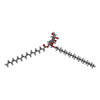 ChemComp-LMG:  ChemComp-PL9:  ChemComp-SQD:  ChemComp-LMT:  ChemComp-BCT:  ChemComp-LHG:  ChemComp-DGD:  ChemComp-HEM:  ChemComp-RRX:  ChemComp-CA:  ChemComp-HOH: |
| Source |
|
 Keywords Keywords | PHOTOSYNTHESIS / photosystem II / water oxidation / oxygen-evolving complex / D1-V185N |


 synechocystis sp. pcc 6803 (bacteria)